Athletic Sock OEM Communication Workflow Review for United States Buyers
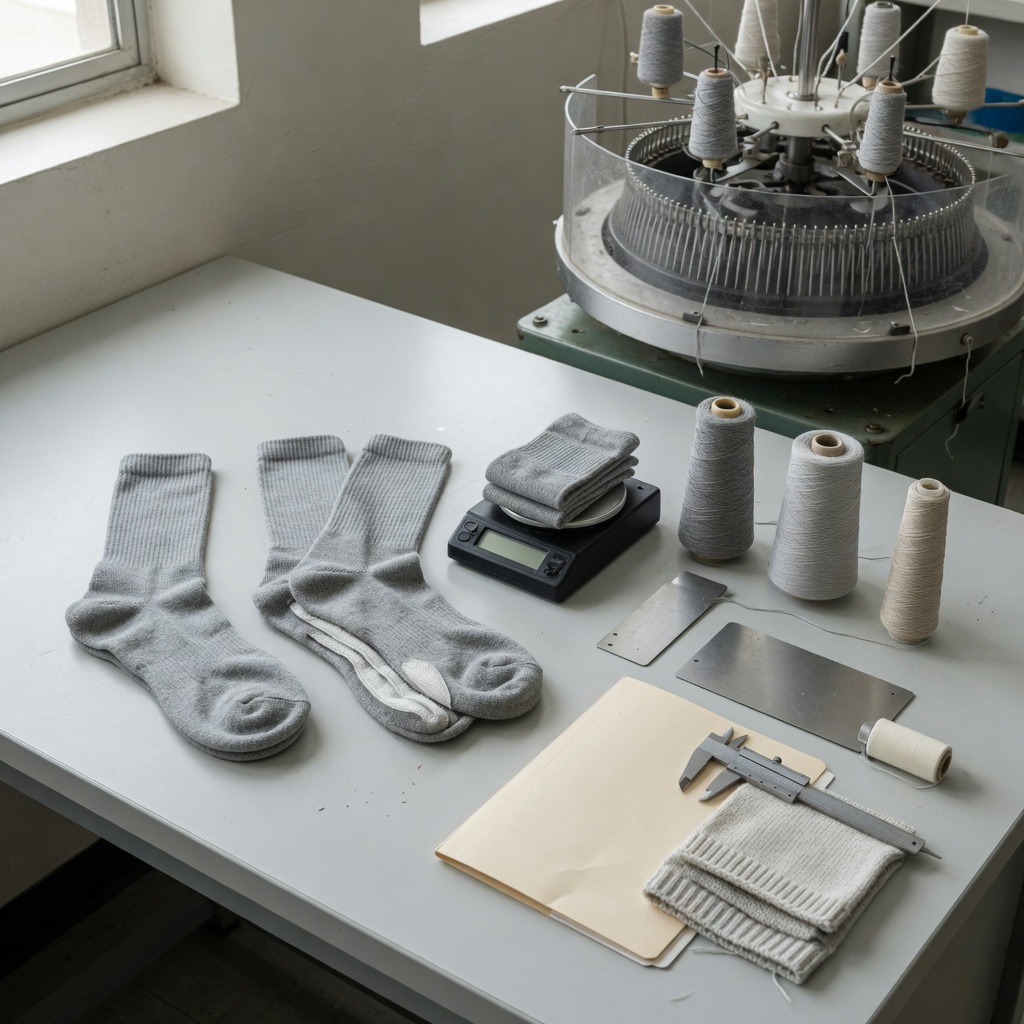
Vincent Xi, Editorial Author, prepared this review for ZheSock. Author profile: https://www.zhesock.com/authors/vincent-xi/. It is a procurement-document review for United States buyers of an athletic sock manufacturing program. It reports no factory visit, wear test, certification audit, or customer outcome, and it claims no first-hand production experience.
Do not release an athletic sock bulk purchase order until one named contact has tied the same construction to four records: the tech pack, the pre-production sample (PPS), a corrective-action note for every rejected sample, and the purchase order. That release rule is this review's control. It is not an industry standard and not a ZheSock quote.
This athletic sock OEM communication workflow review covers that manufacturing handoff only. ZheSock supplies wearable socks and hosiery. Nothing below is a ZheSock price, lead time, machine list, or certificate. Figures stay inside the scope printed on three supplier-authored pages: CMAX, Auditing Sample Protocols, 30 January 2026; FutureStitch, How to Choose a Reliable Custom Socks Manufacturer, 14 April 2026 on the page; and Yuintal, Production Workflow for Custom Socks, update time 22 December 2025, 14:38:31. Each page is that supplier's statement, not an independent laboratory result.
Before manufacturing starts, name the athletic construction and the United States size breaks to be sampled. Record the PPS machine, dyed yarn lot, pair weight, packaging, and separate landed-cost lines against the retained sample.
Why a United States Buyer Runs the Communication Workflow Review Before Manufacturing
The decision is whether bulk knitting may start. For a United States buyer, a missed athletic sock specification becomes a procurement problem once the order is in production or in transit. Check whether machine, yarn lot, size, pair weight, and approval authority are in writing before that point. This review does not assign title or cargo risk. Those terms belong in the contract. United States legal text for them was not supplied in these research excerpts.
FutureStitch's 14 April 2026 article says that, for brands based in the United States, local manufacturers such as those in North Carolina or Alabama are often preferred for faster communication, quicker delivery, and closer quality inspection, especially for premium or fast-moving projects. The same passage says major manufacturing hubs such as China and Vietnam offer more cost-efficient production and better scalability. No cost delta, transit-day count, or duty difference among those origins was supplied in this research excerpt, so the passage cannot price a United States landing. A manufacturing origin is not a second sales market. The buyer here is in the United States.
On communication itself, FutureStitch lists English-language support, timely replies, a clear and complete quotation, a one-to-one business manager, and an after-sales team. The page says the team will send a detailed quote within 24 hours. That 24-hour figure is FutureStitch's own offer on the 14 April 2026 page, not a measured industry service level and not a ZheSock commitment. The article also says buyers usually choose between two and three suppliers using sample consistency across batches, price stability, and reliability in communication and delivery. That is FutureStitch's decision rule, not a requirement to solicit three factories.
FutureStitch tells buyers to cross-check company name, address, and contact details across the website, B2B platforms, and email signatures, and to slow down when those details do not fully match. The check tests whether the correspondence matches. It is not evidence of knitting capability.
What the Athletic Sock OEM Communication Workflow Review Checks
Yuintal's workflow page, with an update time of 22 December 2025, 14:38:31, describes custom sock production as yarn preparation, knitting, linking and toe closing, boarding and finishing, in-process checks, and packaging. On an athletic sock, a change at those stages can affect cushion, stretch, length, or color. Assign an owner and a written record to each approved change before bulk proceeds.
Yuintal says professional factories operate multi-gauge circular knitting machines, typically ranging from 108N to 200N: lower gauge for thicker, cushioned, or terry socks; mid-gauge for mainstream sports and daily socks; and higher gauge for refined, performance-oriented designs. Numeric bounds for lower, mid, and higher inside that 108N to 200N span were not supplied in this research excerpt. FutureStitch's 14 April 2026 article associates its 168N-to-200N machine range with detailed patterns and fashion socks, and its 72N-to-144N range with thicker fabrics for sports or functional socks. These are the supplier's equipment-use descriptions; they do not establish the yarn count for the buyer's approved athletic construction. Specify the yarn count separately from the machine's needle count. FutureStitch also says Lonati circular knitting machines maintain stable tension and fabric density during mass production, reducing size variation. No numeric size-variation percentage for that Lonati sentence was supplied in this research excerpt.
CMAX's 30 January 2026 checklist gives 144N or 168N as examples of the needle count to match to the final run, and it tells the buyer to ask whether the sample was produced on a Lonati or a generic prototype machine. The three statements overlap. They are not one shared specification, and they should not be averaged. A cushioned athletic sock and a fine fashion sock should not be forced onto the same gauge.
Yuintal says boarding uses steam and heat on size-specific boards matched to US, EU, UK, or Asian sizing, and that length and width should stay consistent within tolerance. A numeric length or width tolerance was not supplied in this research excerpt. Name the United States size breaks to be boarded. Do not treat a sample boarded on another size system as the approval sample by default.
Yuintal places checks at incoming material, inline knitting density and pattern accuracy, boarding and size, and a final AQL inspection before packing. A numeric AQL level was not supplied in this research excerpt. In that same workflow paragraph, Yuintal says additional testing for functional socks may include grip durability greater than 50,000 cycles, wash resistance greater than 100 washes, and color fastness of Grade 4-5. Those are optional tests Yuintal states for functional socks as of the 22 December 2025 update. They are not a universal athletic sock specification. Do not copy grip-cycle language onto a running sock that has no grip sole unless the approved specification calls for a grip test.
CMAX's 30 January 2026 article treats sampling as a test of internal communication. It presents a detailed corrective-action report sent with a second sample as more useful than a new sock with a note that says fixed.
Sample Records That Control the Manufacturing Release
On the 30 January 2026 page, CMAX places 7-12 days under its own label, Industry Standard Lead Time, and describes that figure as the average duration for custom hosiery PPS production and dispatch. A standards body, survey panel, or factory sample behind that average was not supplied in this research excerpt. The label is not, by itself, an ASTM, ISO, or other consensus standard. A scorecard on the same page uses a green flag of delivered within 7-12 business days and a red flag of turnaround exceeding 21 days without cause. This research excerpt does not present the 7-12 day callout or the 7-12 business-day scorecard as a counted multi-factory benchmark or as door-to-door delivery into the United States. The clock start, whether tech-pack receipt, deposit, or yarn arrival, was not supplied in this research excerpt. Put a day count into a contract only as that supplier's written commitment, and only with the clock start and the day type defined. Days and business days are not interchangeable.
The same article says sampling adds approximately 10 business days, set against a 6-week lead time to re-manufacture a failed batch. Both figures are CMAX's contrast on that page. This research excerpt does not present them as a measured duration for every athletic sock order or as ocean transit to the United States.
The page labels a Risk Mitigation Rate of 95 percent as the percentage of bulk issues prevented by physical PPS sign-off. Population, product mix, geography, date range, and formula were not supplied in this research excerpt. That 95 percent is CMAX's label on the 30 January 2026 page, not a market probability for athletic socks.
The page is bylined Irena and labels the author perspective as Senior Supply Chain Consultant (Textile Specialisation). A first-person field tip on that page says not to sign a PPS unless it is knit on the same circular machine intended for the bulk run, never a single-cylinder prototype machine, because the difference in needle density and cam settings can alter the finished size by up to 8 percent once bulk tensions are applied. The tip states 15 years sourcing textiles. That history belongs to the page author. A laboratory name, sample size, product mix, and measurement method for the 8 percent figure were not supplied in this research excerpt. Vincent Xi does not adopt that history, or the 8 percent figure, as first-hand experience. Do not treat the 8 percent observation as a measured gap between the needle-count ranges quoted earlier.
CMAX tells buyers to weigh the sample on a precision scale and treats a bulk delivery even 2 grams lighter per pair as a shortfall in yarn density. The printed line is one-directional: lighter by 2 grams per pair. A limit for a heavier pair was not supplied in this research excerpt. Separately, CMAX says professional hosiery production allows plus or minus 5 percent variance in bulk weight compared with the PPS. CMAX states that claiming zero variance is dishonest, that exceeding 5 percent is cutting corners, and that the contract should require the bulk delivery to match the PPS within a 5 percent weight tolerance. Two grams per pair and 5 percent of pair weight are not the same rule. This review does not invent a pair weight to convert one figure into the other. The purchase order should state grams per pair, identify the retained comparison sample, and say whether the allowed band is plus or minus.
CMAX describes cutting the approved PPS in half, with the buyer and the factory each keeping one half, so a later yarn cross-section can be compared. It also says to sign two tags if the sample passes: one for the factory to hang on the production line and one for the buyer's archive. Those are CMAX's stated record practices, not a ZheSock procedure.
CMAX says that, according to ISO 9001:2015, bulk output must be measured against the approved pre-production output. Treat that sentence as CMAX's characterization of a quality-management standard. It is not evidence that a named factory, or ZheSock, holds a current ISO 9001 certificate, and it is not a full restatement of the standard. CMAX names ASTM D629 as a yarn-composition test a bulk lot might fail. A required fiber percentage, tolerance, or pass-fail limit for an athletic sock blend was not supplied in this research excerpt. In a separate example on the same page, CMAX says that if the tech pack was supposed to be 80 percent combed cotton and the sample feels synthetic, demand a composition test report before bulk knitting starts. That 80 percent figure is CMAX's example, not a measured result and not an athletic sock fiber specification.
CMAX says the answer to whether samples are offered should include lab dips and size sets, and that the sample should use the actual dyed yarn lots rather than a closest-match stock yarn. Its size-scaling scorecard marks only one size sample as a red flag and a full size set, written as Teens/Kids, as a green flag. The green-flag wording names teens and kids. Adult athletic size breaks were not supplied in that scorecard line in this research excerpt. The article also says a one-size sample for a youth sock range can mask fit issues, and that accurate sizing needs a physical sample for each break in the size chart. For a United States athletic order, name every US size break to be sampled. Do not use the teens/kids scorecard as the size specification.
In one spec-dilution scenario on the CMAX page, a sample of 40s/1 combed cotton is replaced in bulk by 32s/1 carded yarn. CMAX states that the bulk product is 15 percent cheaper to produce but will pill and lose shape after three washes. A test method, sample size, wash-standard number, and tex or denier equivalent for those yarn counts were not supplied in this research excerpt. The opening scenario uses a 30 percent discount as pressure to skip a second physical sample and rely on digital renderings. The same page states that digital mockups cannot simulate yarn tension or the hand-feel of carded versus combed cotton. No instrument reading for that comparison was supplied in this research excerpt. Treat any live discount as a proposal to accept or reject in writing, not as a market rate.
Tech Pack, Golden Sample, and Landed-Cost Lines
FutureStitch's 14 April 2026 article says to lock Pantone colors, material ratio, sizing, and packaging in the tech pack, then put price, lead time, payment terms, and defect handling in the contract. Its payment example is 30 percent deposit and 70 percent before shipment. The example marker shows that split is illustrative, not a United States legal default. The article says to approve a golden sample and to make mass production follow it. It says factories will usually allow one or two revisions of the design draft during proofing. Usually is not an included revision count. State in the RFQ how many rounds are included and what is billable after that.
Before first contact, FutureStitch recommends a brief covering target market, sock type, material, customization, order quantity, and budget range. For sports brands it names moisture-wicking, abrasion resistance, and structural features such as cushioning. It describes nylon and polyester blends as elastic and quick-drying, and suitable for athletic use, and it describes cotton as soft and moisture-wicking for everyday wear. Those notes are not a finished athletic fiber recipe. Write each fiber percentage. A later lot that only feels similar is the substitution pattern in CMAX's 40s/1 combed cotton versus 32s/1 carded yarn scenario.
FutureStitch says OEKO-TEX, ISO, and BSCI certifications mean a factory has reached higher standards in product safety, quality management, and social responsibility. That is the supplier's general statement on the 14 April 2026 page. A certification name in email is not a current certificate. A CMAX footer line says OEKO-TEX Certified Materials. A certificate number or validity date for that line was not supplied in this research excerpt. This review claims no certificate for ZheSock or for the three publishers.
Yuintal's yarn stage belongs in the same communication file: cotton, polyester, nylon, and blended functional yarns sorted by specification; spandex and elastic components matched to target compression levels; color lots managed for repeat-order consistency. If the athletic sock has no compression target, write that no compression level is specified so spandex content is not left implied. Yuintal says sampling, bulk production, and repeat orders rely on the same workflow. A reorder should cite the approved golden sample, needle count, and yarn specification. Write any change before knitting.
United States duty rates, freight amounts, and a current athletic sock price were not supplied in these research excerpts. Require separate quote lines for price per pair and the quantity basis, whether per size, per color, or per SKU; the sample fee and whether it credits against bulk; setup charges; the named Incoterm; and the freight and duty amounts that are excluded. United States fiber-content and country-of-origin labeling text was not supplied in these research excerpts and needs verification against current rules before labels are printed. Yuintal lists folding, banding, labeling, custom packaging for private-label brands, and barcode and carton marking as packaging steps. Those items belong in the same approval chain as the sock. A packaging photo is not a substitute for the written label text.
CMAX states that even with a trusted partner, machine wear, new staff, and fluctuating yarn suppliers can introduce variables that only a physical PPS can catch.
Buyer Decision Table
Use this buyer decision table in the athletic sock communication workflow review before the purchase order is released. It applies the communication file above. It is not the CMAX red-flag scorecard and not a ZheSock term.
| Buyer decision | Approve only if | Hold the order if |
|---|---|---|
| Bulk release | Tech pack, PPS, corrective-action notes, and purchase order match one construction | Any record is missing or conflicts |
| Machine and yarn | PPS states bulk machine class, needle count, and dyed yarn lot | Prototype sample, closest-match yarn, or an unflagged change |
| Revision note | Defect, process change, and recheck are written | The note only says fixed |
| United States size and weight | Each boarded US size has a sample; grams per pair and the chosen weight band are stated | One size or two weight rules are left unresolved |
| Landing and contact | Price, sample fee, setup, Incoterm, and excluded freight and duty are separate; one manager's details match | Charges are bundled or the contact details do not match |
Day counts, needle ranges, weight bands, and test figures remain qualified in the sections above and are not restated here as benchmarks.
Methodology and Source Limits
The figures above were copied from the three public pages with the unit, scope, and date printed beside them. Where needle-count ranges differ, they are shown separately and are not averaged. The buyer decision table does not introduce a separate figure. Where a clock start, population, numeric AQL, boarding tolerance, fiber pass-fail limit, tex equivalent, or duty rate was absent from the research excerpt, the gap is left open.
Page dates are not quote-validity dates, measurement windows, or transit times. CMAX shows 30 January 2026 as the article date. Article structured data on that page also lists 30 January 2026 for datePublished and dateModified. The byline is Irena. FutureStitch shows 14 April 2026 on the article. Article structured data on that page lists datePublished 13 April 2026 and dateModified 16 April 2026. Yuintal shows an update time of 22 December 2025, 14:38:31. A separate publication date for the Yuintal page was not supplied in this research excerpt.
Standards are named only where a source page names them. A standard's name is not treated as a current certificate or as ZheSock's own practice. First-person observations on the CMAX page stay with that page's bylined author. No first-hand production experience is claimed for Vincent Xi or for ZheSock.
Before purchase-order release, verify the supplier's written clock start, currency, Incoterm, any current certificate document the supplier claims, the United States label text, and the physical sample against the tech pack.
RFQ Checklist
Use these actions while the athletic sock manufacturing file is still editable.
- Specify the athletic sock construction in the RFQ, including fiber percentages, yarn count, needle count, cushion or terry zones, cuff length, pair-weight target in grams, and the United States size run to be boarded.
- Ask the supplier to name one manager for tech-pack questions, sample comments, and corrective-action replies, and to state the hours that manager covers on United States business days.
- Require the manufacturer to define the PPS clock start, whether the day count uses calendar days or business days, the included revision count, the dispatch point, and whether the PPS will be knit on the same machine type and needle count planned for bulk.
- Ask the supplier to attach machine class and needle count to the PPS record and to flag any difference from the bulk plan before approval.
- Require the manufacturer to issue a corrective-action note with each revised sample, covering the defect, the process change, and the measurement to be rechecked.
- Specify the bulk acceptance band in writing, with pair weight in grams against the retained PPS and a separate size tolerance, and state how an out-of-band result stops shipment.
- Ask the supplier to identify the lab dip or dyed yarn lot used in the approved sample and to notify the buyer before any lot change.
- Require the manufacturer to quote product price, sample fee, setup fee, any sample-fee credit against bulk, Incoterm, and excluded freight or duty as separate lines, with the quantity basis per size or per color stated.
- Specify golden-sample retention by both parties, and require bulk goods, packaging, and carton marks to follow that sample unless a written deviation is approved.
- Ask the supplier to state payment milestones, defect handling, and the evidence required before shipment release.
- Verify current United States fiber-content, country-of-origin, and customs requirements before label approval, because those legal texts were not supplied in the supplier articles used here.
- Compare the signed response commitment, the sample-revision terms, and the weight-tolerance clause across finalist factories before awarding the purchase order.
Sources used in this review: CMAX, Auditing Sample Protocols (30 January 2026), FutureStitch, How to Choose a Reliable Custom Socks Manufacturer (14 April 2026), and Yuintal, Production Workflow for Custom Socks (update 22 December 2025).
Discuss Your Requirements
Review our manufacturing capabilities, then share your specifications for a supplier-fit review.