Athletic Sock Wholesale Supplier Material Options for Europe
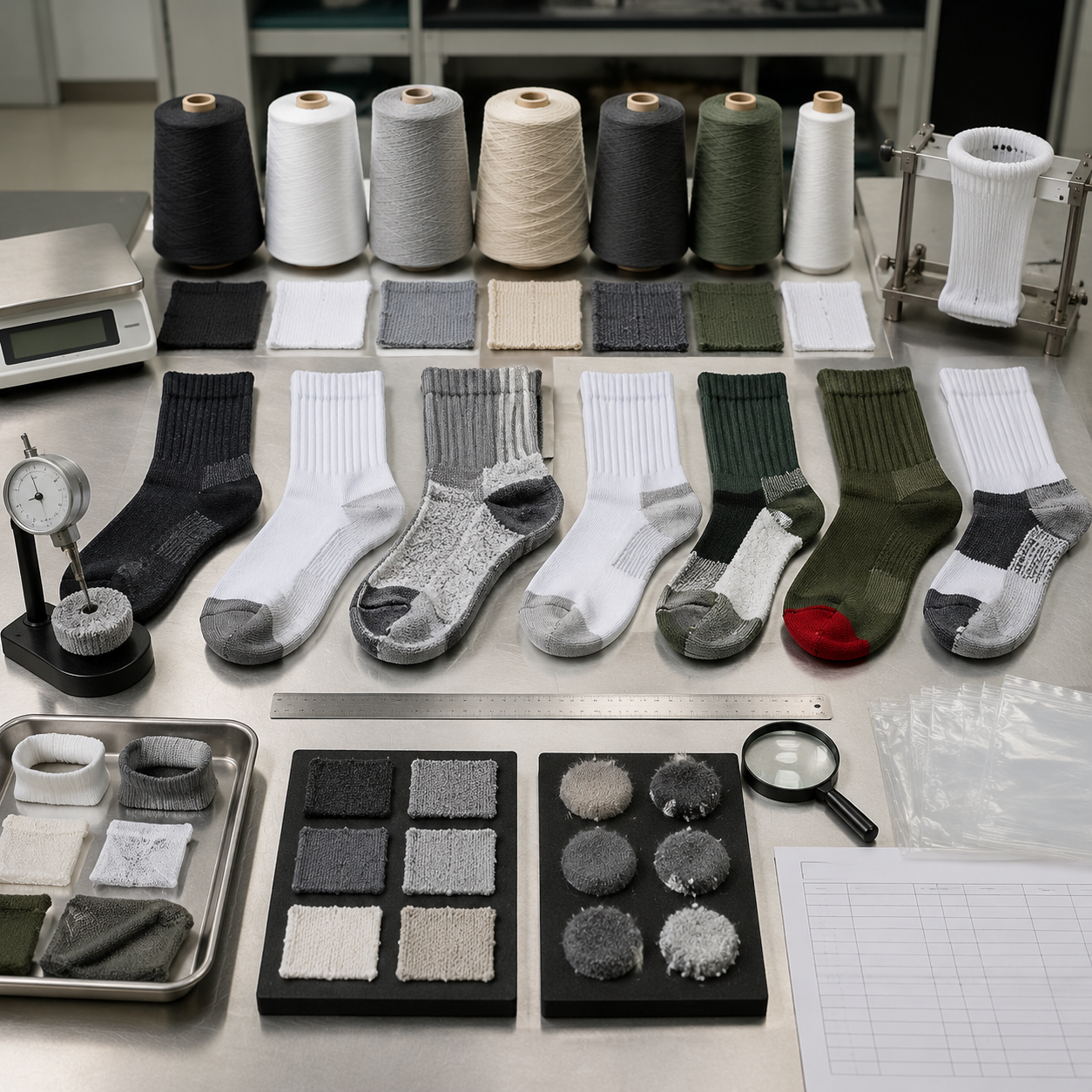
By Vincent Xi, Editorial Author
For European procurement teams, athletic sock material options become comparable only when each wholesale supplier quotes against the same RFQ fields. Ask for exact fiber composition by mass, yarn placement by knit zone, finished-pair mass, sample status, test methods, acceptance limits, destination-document responsibilities, and every proposed deviation.
Treat the fiber name as a starting point, not evidence of drying, recovery, abrasion resistance, warmth, odor control, comfort, durability, or regulatory suitability. Any required outcome needs a defined method, an acceptance limit, representative specimens, and evidence tied to the quoted construction.
The cited sources do not establish that ZheSock or any candidate supplier offers a particular blend, minimum quantity, price, test result, certification, manufacturing capability, or delivery term. Confirm each point in a dated quote, destination review, and production-representative sample record.
Athletic Sock Material Options for Europe RFQs
The routes below are RFQ comparison categories, not verified performance claims. Include only those that answer the intended sport, footwear, climate, care, fit, and European destination brief.
| Material route | When to request it | Supplier response and evidence required |
|---|---|---|
| Polyester-led body with polyamide or elastane support | The buyer wants this construction evaluated against defined drying, recovery, abrasion, pilling, thermal-comfort, or odor criteria | Exact percentages by mass, yarn forms, zone placement, elastic components, finishes, proposed methods, acceptance limits, dated results, and deviations |
| Polyamide-led body or selected wear-zone placement | The buyer wants heel, toe, sole, or shoe-contact zones compared under a specified abrasion or durability protocol | Reinforcement map, knit construction, total composition, specimen preparation, test method, result, and retained sample identity |
| Cotton-containing blend with synthetic support | Cotton content and a buyer-defined hand or care target are part of the range brief | Cotton percentage, supporting yarns, construction, care protocol, pre-care and post-care dimensions, controlled comparison, and deviations |
| Wool-containing blend with synthetic support | Wool content is explicit in a cold-weather or sourcing brief | Wool percentage, yarn reference, care recommendation, pilling and shade plan, traceability documents for any sourcing claim, and claim-scope review |
| Polypropylene-containing blend | The buyer specifically wants this route compared for a defined mass, moisture-management, color, odor, or hand target | Yarn placement, coloring method, finishes, sample mass, proposed methods, controlled comparison samples, and finish disclosure |
| Mixed-yarn, mixed-knit-zone construction | Different yarns or structures are assigned to the cuff, instep, arch, sole, heel, or toe | Complete yarn-by-zone schedule, technical drawing, inside-out sample, total composition by mass, approved construction record, and written substitution control |
Apply the same decision order to every route:
- Define the use conditions, care regime, fit target, required outcomes, and exact European destinations.
- Shortlist only material routes that answer those requirements.
- Send identical composition, construction, evidence, commercial, and deviation fields to each candidate.
- Resolve omissions and substitutions before comparing price.
- Approve a route only after reviewing representative samples, dated evidence, and destination-specific documents.
The Velon Socks knowledge-base page is retained as supplier-authored context for questions about yarn selection, samples, production control, and supplier comparison. It is not independent laboratory evidence and does not verify another supplier's materials, practices, or performance.
Measurable Material Options for Wholesale Supply
The values below are buyer-created example assumptions for a hypothetical athletic-sock RFQ. Each is scoped to the RFQ issue date, is not a market benchmark or supplier specification, and must be confirmed or replaced in the supplier's dated quote and approved sample record.
| Example RFQ field | Hypothetical value and scope | Source status and required verification |
|---|---|---|
| Order quantity | 1,200 pairs for the entire hypothetical athletic-sock program as of the RFQ issue date | Buyer-created example assumption. Supplier must verify whether its minimum applies to the total program, material, style, size, color, or packaging format |
| Declared composition | 72% polyester, 23% polyamide, and 5% elastane by declared fiber mass for the hypothetical quoted style and buyer-defined reference size as of the RFQ issue date | Buyer-created example assumption. Supplier must verify the calculation scope, tolerance, declaration or test method, and treatment of reinforcement and elastic-carrier yarns |
| Finished-pair mass | 60 g per pair with a +/- 3 g per-pair tolerance for the hypothetical reference size, excluding packaging and after the agreed conditioning procedure, as of the RFQ issue date | Buyer-created example assumption. Supplier must verify conditioning, weighing method, specimen selection, production tolerance, control frequency, and treatment of outliers |
| Sample care trial | 5 wash-and-dry cycles at 40 degrees C for the hypothetical approval sample as of the RFQ issue date | Buyer-created example assumption. Supplier must verify the machine program, detergent, load, drying method, specimen count, measurement points, and acceptance limits |
| Material-mass arithmetic | 43.2 g polyester, 13.8 g polyamide, and 3.0 g elastane per pair, derived from the hypothetical composition and 60 g finished-pair mass for the reference size as of the RFQ issue date | Derived example calculation from the buyer-created assumptions. Supplier must verify the composition and pair mass; the arithmetic is not a composition test, yarn-consumption record, or legal label determination |
The component masses were derived by multiplying the hypothetical finished-pair mass by each hypothetical percentage by mass. This is a consistency check for quote review, not measured product data.
Replace every example with program-specific requirements. The material specification should also identify yarn form, construction reference, cushioning and ventilation zones, reinforcement placement, cuff and arch construction, toe-seam approach, coloring method, and every finish applied before or after knitting.
For a finish associated with moisture, odor, softness, antimicrobial positioning, or another performance statement, request its chemical or commercial reference, application location, intended function, durability basis, test method, document scope, and destination-review status. Do not convert a supplier description into a product claim without evidence tied to the quoted material, production scope, destination, and relevant period.
Athletic Sock Material RFQ Fields
| RFQ section | Buyer input | Supplier return |
|---|---|---|
| Intended use | Sport, footwear, indoor or outdoor use, climate, care regime, fit objective, and required outcomes | Proposed material route, assumptions, limitations, and deviations |
| Composition | Required or target generic fiber names, calculation scope, and whether alternatives are permitted | Exact percentages by mass, tolerances, evidence source, and treatment of reinforcement and elastic components |
| Yarn and finish | Hand, bulk, color, construction, sourcing objectives, and permitted finish categories | Yarn form, supplier reference, reinforcement and carrier details, coloring method, finish identity, application point, and substitution policy |
| Zone construction | Reference size, sock height, fit target, and required functional zones | Technical drawing showing yarn and knit structure at the cuff, leg, instep, arch, sole, heel, toe, and seam |
| Mass and dimensions | Conditioning procedure, measurement points, targets, tolerances, and care state | Quoted pair mass, production tolerance, measurement method, control frequency, dimensional results, and deviation statement |
| Material testing | Required outcome, method-selection responsibility, specimen scope, and acceptance limit | Method and edition where relevant, specimen details, laboratory identity, report date, result, reported qualifications, and retest process |
| Samples | Required development, care-tested, pre-production, and retained-reference stages | Sample identity, yarn source, construction status, differences from intended bulk production, charge, and timing |
| Claims and documents | Intended composition, sourcing, chemical, or performance claims | Current document, issuer, scope, validity, material and facility connection, and permitted claim wording |
| Commercial basis | Quantity by material, style, size, color, and packaging; currency; delivery point; and requested trade term | Minimum quantity at each applicable level, unit price, exclusions, sample and testing costs, payment terms, quote validity, and delivery basis |
| Change control | Buyer approval authority, notice requirements, and deviation format | Written commitment not to substitute fiber, yarn, finish, coloring method, construction, facility, or evidence source without approval |
| Bulk release | Required lot identity, inspection records, reports, and retained references | Production-lot identity, material records, inspection results, packaging identity, destination documents, and signed deviations |
A price comparison is valid only after the quoted compositions, pair masses, yarn forms, zone constructions, finishes, sample status, evidence packages, minimum-quantity basis, and delivery basis have been normalized. Require a signed deviation schedule even when a supplier states that its quote meets the RFQ.
Practical Athletic Sock Material Options RFQ Checklist for Europe
Attach this checklist to the RFQ and require a written supplier response for every item. Mark an item complete only when the answer is connected to the quoted style, material route, sample identity, destination, and quote date. Record unanswered items as open deviations rather than treating silence as acceptance.
- [ ] Identify every destination country and classify its route as an EU Member State, an EEA destination outside the EU, the United Kingdom, or another European destination requiring separate review.
- [ ] State the intended sport, footwear, climate, care regime, fit target, reference size, and required material outcomes.
- [ ] Request exact generic fiber percentages by mass and the calculation scope, including reinforcement and elastic-carrier treatment.
- [ ] Request the yarn form, yarn reference, coloring method, finish identity, and intended function for every proposed component.
- [ ] Require a yarn-by-zone drawing covering the cuff, leg, instep, arch, sole, heel, toe, and seam construction.
- [ ] Define finished-pair mass, measurement points, conditioning procedure, tolerances, and pre-care or post-care status.
- [ ] Define each required test outcome, method-selection responsibility, specimen scope, acceptance limit, report date, and retest process.
- [ ] Require sample identities and written confirmation of whether development and pre-production samples use the intended bulk yarns, finishes, coloring methods, and construction.
- [ ] Request the minimum-quantity basis by material, style, size, color, and packaging instead of accepting an unexplained total minimum.
- [ ] Normalize currency, unit-price inclusions, sample and testing charges, payment terms, delivery point, trade term, quote validity, and lead-time basis before price comparison.
- [ ] Request current documents for any composition, sourcing, chemical, performance, or certification claim, including issuer, scope, validity, covered material or facility, and connection to the quoted production.
- [ ] Require the supplier to list every exception, assumption, alternative, and proposed substitution in a signed deviation schedule.
- [ ] Prohibit changes to fiber percentages, yarns, finishes, coloring methods, knit zones, facilities, and claim-supporting documents without written buyer approval.
- [ ] Assign responsibility for EU, EEA, UK, and country-specific label, chemical, product-safety, traceability, packaging, language, operator, and claims review as applicable.
- [ ] Define bulk-release records, including lot identity, material records, inspection results, destination documents, retained references, and approved deviations.
The buyer should return an incomplete response for clarification before commercial comparison. A completed checklist supports quote normalization; it does not replace destination-specific legal review, representative sampling, testing, inspection, or document validation.
Europe Destination Routing for Material Evidence
Europe is not a single compliance route. This table is a procurement review framework, not legal advice or a claim that obligations are uniform across products, operators, sales channels, or countries. The cited commercial sources are not official regulatory guidance; a qualified reviewer must determine the current requirements for each destination.
| Destination route | Material and document review | Release record |
|---|---|---|
| EU destination | Review current EU-level questions and destination Member State requirements for fiber naming, composition, chemicals, product safety, traceability, operator details, packaging, claims, and language as applicable to the actual product and route | Approved destination label, document register, responsible-party details, review owner, and dated decision |
| EEA destination outside the EU | Create a separate country line and verify local implementation, language, operator, and documentation questions instead of assuming an EU destination packet transfers unchanged | Country-specific review, language decision, responsible-party details, and documented basis for any reused evidence |
| United Kingdom | Maintain a standalone review for the exact UK destination and route, covering the current textile, chemical, product-safety, importer or address, packaging, claims, and language questions that the reviewer determines are applicable | UK-specific label, document register, responsible-party details, route decision, and dated approval |
| Other European destination | Obtain a destination-country review before finalizing composition wording, claims, labels, packaging, or responsible-party details | Country requirements record, approved artwork, document scope, and named review owner |
| Country-specific overlay | Check language, care-information, environmental, packaging, sales-claim, and registration questions for the exact destination and operator structure | Final country and SKU record linked to the approved label, purchase order, evidence register, and release decision |
When a supplier cites a regulation, standard, certification, or test method, record its exact title, current edition or version where relevant, issuer, scope, and connection to the quoted material and production. Classify it as a legal requirement, buyer specification, test method, certification scheme, or supplier quality-control practice. Do not present one category as another.
Do not describe a supplier, facility, yarn, or athletic sock as certified without a current document identifying the issuer, validity, covered facility or chain of custody, material or product scope, and connection to the quoted production. A yarn-source document does not by itself establish coverage for the finished product or a downstream claim.
Source Context and Evidence Boundaries
| Cited source | Narrow use retained in this article | What it does not establish |
|---|---|---|
| Vincent Xi author profile | Supports the visible author name, Editorial Author role, profile URL, and structured-data identity | Factory visits, wear tests, laboratory work, audits, manufacturing experience, client outcomes, credentials, awards, or certifications |
| Velon Socks knowledge-base page | Supplier-authored context for asking about yarn selection, samples, production control, and supplier comparison | Independent material-performance evidence, market benchmarks, candidate capability, certification, or ZheSock practice |
| DeadSoxy bulk-buying article | Supplier-authored bulk-order context for asking each candidate to define minimum-quantity conditions, material grade, and quote basis | A Europe market benchmark, athletic-sock demand estimate, ZheSock minimum, candidate-supplier minimum, price forecast, or recommended order quantity |
| Solos Socks quality-comparison article | Supplier-authored context for adding yarn-documentation requests to the RFQ | Proof that ZheSock or a candidate supplier holds a certification, or that a document covers the quoted finished product |
These sources support question design only. They are not treated as independent laboratory evidence, official European regulatory guidance, or proof of another company's operations.
Sample-to-Bulk Material Controls
Desk review: Confirm the proposed composition, yarn records, zone drawing, finishes, destination list, evidence plan, testing basis, commercial terms, and deviations. Undefined terms such as premium cotton, performance yarn, responsible wool, or eco material should not enter the specification without a definition and supporting evidence.
Development sample: Assign a sample identity and record whether it uses the intended bulk yarn, coloring method, finish, and construction. Inspect the exterior and inside-out construction for yarn placement, cushioning, reinforcement, seams, dimensions, mass, shade, hand, and visible defects. Apply the agreed conditioning, care, and test procedures, then compare the findings with the pre-care record and acceptance limits.
Pre-production approval: Match intended bulk yarns, colors, knit construction, finishes, labels, and packaging to the signed specification. Record approved deviations and identify the retained physical reference, specification version, evidence register, and artwork version.
Bulk release: Apply the purchase order's documented sampling and acceptance plan. Link the inspected lot to composition records, pair-mass checks, dimensions, appearance and shade records, packaging identity, destination documents, and required reports. Sample approval does not authorize an undisclosed material, finish, construction, facility, or evidence change.
Change control: Require written buyer approval before a supplier changes a fiber percentage, yarn form, reinforcement, elastic carrier, finish, coloring method, knit zone, facility, or claim-supporting document. The change request should identify affected orders, samples, tests, labels, pricing, timing, and inventory.
Methodology, Limitations, and Author Scope
The decision structure was derived by mapping each material route to records that a buyer can compare: the quote, composition declaration, yarn-by-zone drawing, sample identity, test report, document register, deviation schedule, checklist response, and bulk-inspection record. Supplier-authored sources were assigned only the narrow question-design uses shown in the evidence table; they were not used to infer another supplier's capabilities or results.
The numeric examples are hypothetical buyer assumptions. Their component masses were derived through percentage-by-mass arithmetic using the hypothetical finished-pair mass. They are not measured values, market data, production specifications, test results, legal label determinations, or evidence of supplier capability.
The cited material does not establish ZheSock's available blends, minimum quantities, prices, tests, certifications, manufacturing location, delivery capability, or compliance status. Actual results depend on the complete yarn, knit, reinforcement, finish, sizing, care, and production system. Current official sources, qualified destination review, production-representative samples, applicable testing, and documents tied to the quoted supply remain necessary before approval or publication of a claim.
Author scope: The cited Vincent Xi author profile supports only Vincent Xi's role as Editorial Author. It provides no basis for first-hand factory, manufacturing, laboratory, audit, client, or wear-test claims, so none are asserted here.
Discuss Your Requirements
Review our manufacturing capabilities, then share your specifications for a supplier-fit review.