Athletic Sock Wholesale Supplier Packing Requirements for Europe
By Vincent Xi, Editorial Author
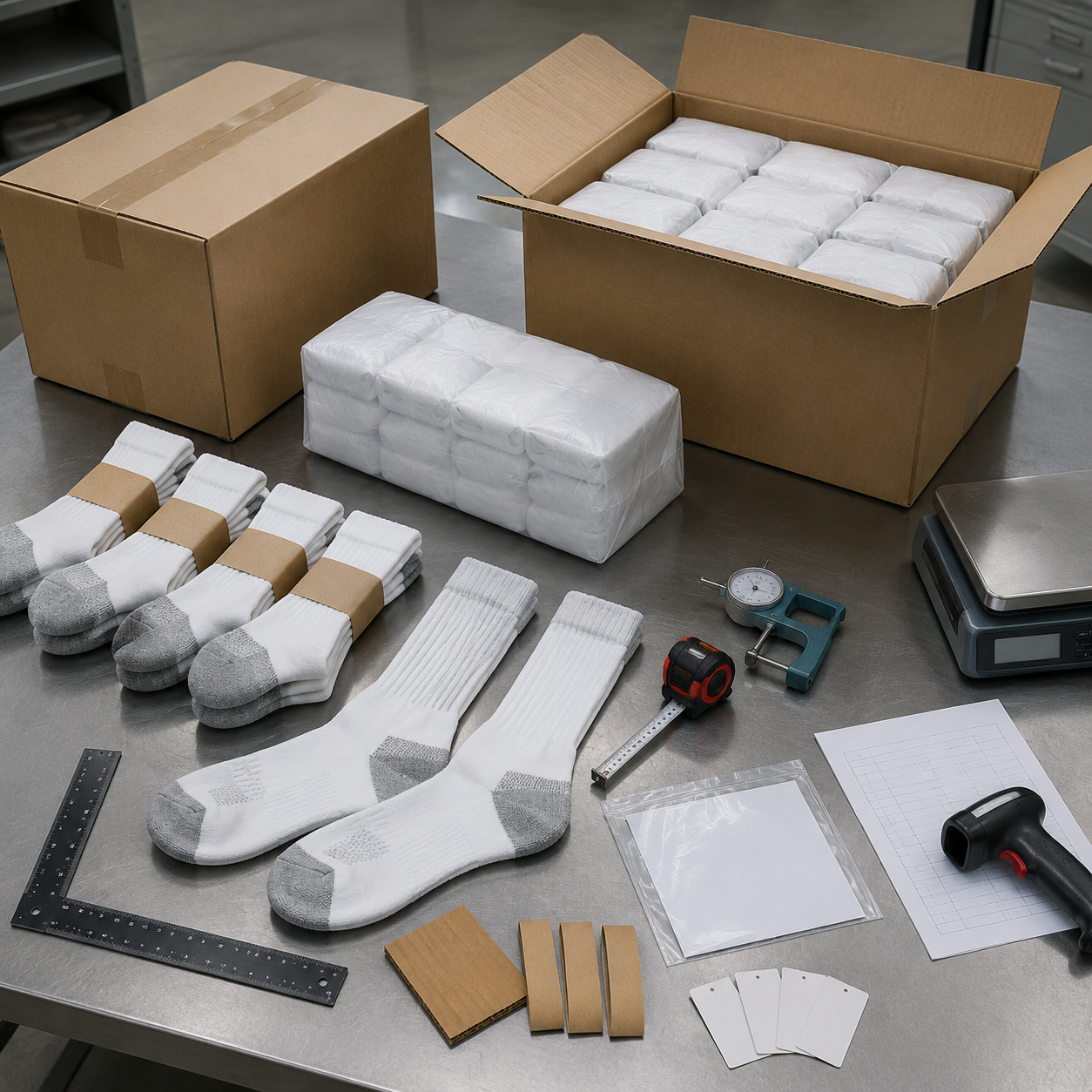
Procurement answer: Put the packing requirements in a controlled RFQ attachment rather than relying on a general request for export or retail-ready packing. For a Europe-bound athletic sock order, define the saleable unit, pair-retention method, SKU mapping, inner-pack and carton quantities, artwork ownership, carton measurement method, weight ceiling, pallet constraints, approval evidence, inspection checks, and change process.
Use these athletic sock wholesale supplier packing requirements to compare quotations against the same pack-out. Require suppliers to identify every deviation, assumption, exclusion, optional charge, and unresolved destination instruction. Hold a quotation when its quantities cannot be reconciled, packaging costs are hidden, product variants cannot be matched to their packaging versions, or acceptance depends on an undefined supplier practice.
Route EU destinations, non-EU EEA destinations, the UK, and other country-specific European destinations through separate packaging reviews. These are procurement routes, not claims that requirements are uniform within a route. A qualified reviewer should confirm the current legal, retailer, fulfilment, warehouse, and carrier instructions for the named destination before artwork or bulk packing is approved.
Europe packing requirements for an athletic sock wholesale RFQ
Attach a packing schedule to the RFQ and give it a revision identifier. The buyer should complete the requirement column, while the supplier should complete the proposed value, evidence reference, price effect, and deviation fields.
| Packing control | Buyer-issued RFQ requirement | Supplier return | Hold point |
|---|---|---|---|
| Destination and order scope | Name the European destination country, review route, buyer entity, sales channel, receiving point, delivery basis, responsible reviewer, SKUs, sizes, colourways, and quantities. | Confirm the scope and list missing, conflicting, or conditional instructions. | Hold if the destination, order scope, or review owner is unclear. |
| Saleable unit | Define the declared pair count, loose or retail-ready status, fold, orientation, pair-retention method, permitted components, and presentation reference. | Describe and price the proposed construction and provide a packed-sample reference. | Hold an alternative until the buyer approves it in writing. |
| Product-to-pack mapping | Link every athletic sock SKU, size, colourway, and destination version to the correct packaging and artwork. | Return the completed matrix with substitutions and unresolved mappings identified. | Hold if a product cannot be matched unambiguously to its pack data. |
| Artwork and identifiers | Assign ownership of copy, language versions, artwork, symbols, product identifiers, barcode data, placement, and final approval. | Supply the proof revision, production-file reference, placement confirmation, and open questions. | Hold if buyer-controlled data or the destination version is unresolved. |
| Inner pack | Define the retail-unit quantity, assortment, orientation, wrapping or tying method, identification, and partial-pack rule. | Provide the pack-out calculation, complete inner-pack sample, count record, and deviations. | Hold if the sample and calculation do not match. |
| Master carton | Define inner-pack quantity, total pair quantity, mixed-SKU policy, partial-carton treatment, carton construction or performance criteria, closure, external dimensions, tolerances, and gross-weight ceiling. | Provide a closed-carton trial, measurements, gross weight, photographs, and proposed packing-list treatment. | Hold if counts, dimensions, weights, or records conflict. |
| Materials and claims | Identify required component data, restricted or preferred materials, evidence needed for buyer-requested claims, and approved destination wording. | List each component, material description, measured or declared value, supporting document, proposed substitute, and itemised cost. | Hold unsupported claims or substitutions pending review. |
| Pallet and receiving constraints | State the approved footprint, height and weight constraints, stacking orientation, overhang rule, protection, wrap, and receiving-label requirements. | Return a pallet plan based on the quoted carton configuration. | Hold if the proposed carton arrangement does not fit the receiving constraints. |
| Approval and change control | Name the required packed sample, carton trial, inspection method, sampling basis, defect rules, evidence format, approval authority, and attributes frozen after approval. | Accept written change control and identify the records that will support release. | Hold any undocumented component, artwork, quantity, or arrangement change. |
| Commercial scope | Request separate price lines, currency, named delivery place, tax treatment, quotation validity, setup charges, optional work, and repacking or relabelling rates. | Return itemised prices with assumptions, exclusions, alternatives, and price effects. | Do not compare the quotation until its commercial scope matches the baseline. |
Terms such as retail-ready, strong carton, export packing, or minimal plastic are not measurable acceptance criteria. Replace them with named components, observable attributes, measured values, documented methods, or buyer-approved physical references.
A supplier may propose a value where the RFQ leaves a technical field open, but the quotation should mark that value as conditional. It becomes an order requirement only after the buyer records approval in the controlled specification.
When an external standard is relevant, record its exact title, edition, scope, method, conditioning, sample basis, and acceptance criteria. A supplier's internal procedure remains company practice unless the buyer expressly adopts it for the order. Do not treat a logo, website statement, internal test, or expired document as evidence of current certification; request a current document that identifies the issuing party, named entity or site, covered scope, validity, and exclusions.
Practical RFQ checklist for packing requirements
Use this checklist before sending the RFQ and again before placing the purchase order. Each checked item should point to a controlled RFQ field, attachment, evidence reference, or named approval owner rather than an informal email assumption.
- [ ] Identify every athletic sock SKU, size, colourway, order quantity, sales channel, buyer entity, receiving point, and destination country in scope.
- [ ] Classify each destination as EU, non-EU EEA, UK, or another country-specific European route and assign a qualified reviewer for that route.
- [ ] Attach a packing schedule with a revision identifier and require the supplier to return the same schedule with proposed values completed.
- [ ] Define the saleable unit, declared pair count, fold, orientation, pair-retention method, permitted components, and loose or retail-ready status.
- [ ] Link each product variant and destination version to its correct packaging components, artwork file, identifier data, and approval record.
- [ ] State the inner-pack quantity, assortment, orientation, closure, identification method, and treatment of partial inner packs.
- [ ] State the master-carton quantity, mixed-SKU policy, partial-carton rule, construction criteria, closure method, dimension method, tolerances, and gross-weight ceiling.
- [ ] Define pallet footprint, stack orientation, overhang rule, protection, wrap, height and weight constraints, and receiving-label requirements where palletisation applies.
- [ ] Request separate prices for product, retail components, packing labour, inner packaging, cartons, setup, samples, verification, palletisation, and approved optional work.
- [ ] Require assumptions, exclusions, substitutions, destination dependencies, optional charges, and deviations to be listed explicitly in the quotation.
- [ ] Require a production-representative packed sample, complete inner pack, and closed-carton trial before bulk packing approval.
- [ ] Specify how counts, dimensions, gross weight, artwork revision, identifiers, carton condition, and product-to-pack matching will be inspected and recorded.
- [ ] Reconcile saleable-unit, inner-pack, master-carton, order-total, and pallet calculations before comparing suppliers.
- [ ] Record the exact document required for every material, environmental, disposal, performance, or certification claim and verify its entity, site, scope, issue date, validity, and exclusions.
- [ ] Freeze approved packaging components, artwork, pack quantities, samples, carton arrangement, costs, and deviations in the purchase order or controlled attachment.
- [ ] Require written approval before a supplier changes a component, material description, artwork version, quantity, arrangement, identifier, carton, or pallet plan.
- [ ] Define shipment-release evidence and a hold rule for unresolved counts, unapproved revisions, unsupported claims, missing inspection records, or packing-list discrepancies.
A completed checklist supports comparison but does not replace destination-specific legal review. Supplier acceptance should remain conditional until the buyer has resolved open fields and approved the applicable pack-out in writing.
Example packing requirements to verify in the supplier quote
Status of every figure below: These are editorial example assumptions and calculations for a hypothetical Europe-bound athletic sock RFQ. They are not market data, legal limits, ZheSock specifications, or evidence of supplier capability. Verify every figure in the supplier quotation, production-representative packed sample, complete inner pack, and closed-carton trial before adopting it as an order requirement.
| Pack-out field | Explicit example assumption or calculation | Supplier verification required |
|---|---|---|
| Saleable unit | Example assumption for this hypothetical RFQ: 1 pair per saleable retail unit. | Confirm the pair count, fold, orientation, identifier, and retention method in the quoted packed sample. |
| Inner pack | Example calculation for this hypothetical RFQ: 12 retail units x 1 pair = 12 pairs per inner pack. | Confirm physical fit, assortment, orientation, closure, identification, and actual count in a complete inner pack. |
| Master carton | Example calculation for this hypothetical RFQ: 10 inner packs x 12 pairs = 120 pairs per closed carton. | Reconcile the calculation with the actual carton contents and proposed packing-list format. |
| External carton dimensions | Example assumption for this hypothetical RFQ: 50 cm x 40 cm x 30 cm at the widest external points after normal closure. | Measure the closed trial carton using the buyer-approved method and state the proposed tolerance. |
| External carton volume | Example calculation for this hypothetical RFQ: a 50 cm x 40 cm x 30 cm closed carton has an external volume of 0.060 cubic metres. | Recalculate from the verified trial-carton dimensions and replace the result if the configuration changes. |
| Gross-weight ceiling | Example assumption for this hypothetical RFQ: 12 kg per closed carton, including the socks and all packing components. | Weigh the completed carton with the agreed instrument and method, then report the actual result and proposed tolerance. |
| Order pack-out | Example calculation for this hypothetical RFQ: 6,000 pairs divided by 120 pairs per carton = 50 full cartons. | Reconcile the result after approved quantity, assortment, mixed-carton, or partial-carton changes. |
The RFQ should define where carton dimensions are measured and whether closure, bulging, liners, or external fittings affect the result. Gross weight should cover every packed component included in the shipment. If a trial cannot preserve the approved presentation or meet the assumed limits, require a revised configuration, calculation, and quotation.
Compare wholesale supply quotations on the same packing basis
Normalize the commercial scope only after a supplier has completed the packing schedule. A lower athletic sock price is not directly comparable when packaging components, labour, trials, or pallet work sit outside the quoted scope.
| Quotation line | Supplier response required | Comparison control |
|---|---|---|
| Athletic sock product | Price for the same controlled SKU, size, colourway, and product specification. | Separate the product price from optional retail-pack additions where the quotation permits. |
| Retail-pack components | Itemised price for each approved band, sleeve, hanger, bag, box, insert, label, or other component. | Compare the same construction, material field, artwork revision, and destination version. |
| Packing labour | Included operations and separately charged matching, folding, attachment, assortment, inspection, or retailer-ready work. | Check that each supplier has priced the same operations. |
| Inner and master packaging | Inner materials, carton, liner, divider, closure materials, and associated labour. | Reconcile the price with the approved retail units per inner pack and inner packs per carton. |
| Artwork and setup | Proofing, plates, tooling, setup, data handling, and version-change charges. | Confirm ownership, reuse conditions, and charges created by SKU or destination variants. |
| Buyer-requested verification | Packed samples, identifier checks, carton trials, inspections, and expressly requested tests. | Record the method, sample basis, report owner, acceptance criteria, and repeat-order treatment. |
| Palletisation | Pallet, wrap, protection, receiving labels, and pallet-building labour. | Check that the price uses the approved footprint and carton arrangement. |
| Repacking or relabelling | Rates, triggers, and assumptions for changes requested after approval. | Keep these disclosed contingencies separate from the compliant baseline. |
| Delivery basis | Named place, included handling, currency, tax treatment, and quotation validity. | Do not compare packing totals embedded in different commercial scopes. |
Classify responses as compliant, conditional, or non-compliant. A conditional response should identify the affected requirement, technical consequence, cost effect, evidence offered, and approval needed. Supplier silence should remain unresolved rather than being interpreted as acceptance.
Europe destination review for packing requirements
The supplied sources do not establish packaging law or legal labelling requirements for a particular European destination. Use the following routes to assign destination-specific review ownership without treating them as interchangeable legal conclusions.
| European review route | Packing record to maintain | Inference to prevent |
|---|---|---|
| EU destination | Name the destination country and record any current EU-level, member-state, retailer, fulfilment, warehouse, and carrier instructions confirmed by the responsible reviewer. Link those decisions to the approved packaging and artwork versions. | Do not accept a general EU compliant statement as evidence for an unidentified rule, component, entity, country, or effective period. |
| Non-EU EEA destination | Maintain a destination-specific review record, approved artwork version, evidence references, and named approval owner. | Do not copy an EU decision into the order without confirming that every cited instruction applies to the named non-EU EEA destination. |
| UK destination | Maintain a UK-specific record for packaging data, artwork, supporting documents, retailer instructions, and final approval. | Do not assume that an EU or non-EU EEA approval automatically covers a UK order. |
| Other European destination | Use a country-specific record covering the buyer entity, channel, receiving point, packaging version, artwork, carrier instructions, and evidence relevant to that shipment. | Do not extrapolate approval from another European destination. |
For a packaging-material, environmental, disposal, or certification claim, identify the exact component, claim owner, destination, proposed wording, evidence document, issue date, scope, and validity where applicable. Hold artwork or production when the evidence does not match the quoted component, named entity, destination version, or order scope.
Supplier documents can support the review, but the buyer's qualified reviewer should decide whether they address the applicable destination and order. A supplier's usual carton, liner, recycling mark, material preference, or transit check remains company practice unless it is documented and approved as an order requirement.
Packed-sample and carton-trial evidence
Approve a production-representative athletic sock with the proposed production packaging components. An empty packaging mock-up can support an artwork review, but the RFQ should not use it as the sole evidence for finished fold, pair retention, pack dimensions, inner-pack arrangement, carton fit, or gross weight.
| QC characteristic | Method to define in the RFQ | Release evidence |
|---|---|---|
| Product-to-pack identity | Define how the SKU, size, colourway, destination version, and packaging reference will be matched. | Inspection record linked to the controlled product-to-pack matrix. |
| Fold and pair retention | Define orientation, attachment method, handling check, and observable defect criteria. | Comparison with the approved production-representative packed sample. |
| Packaging components | Define approved references, material-description fields, dimensions, mass where required, and permitted tolerances. | Component check against the controlled packing-material list. |
| Artwork and product identifiers | Define the approved file revision, destination version, position, orientation, verification method, and pass condition. | Recorded proof-to-sample and identifier-verification results. |
| Inner-pack count and assortment | Define quantity, SKU sequence, orientation, closure, identification, and partial-pack rule. | Reconciliation against the approved matrix and inner-pack record. |
| Carton count and assortment | Define inner-pack quantity, total pair quantity, mixed-carton rule, and partial-carton treatment. | Reconciliation against the carton identification and packing list. |
| Carton dimensions and gross weight | Define closure condition, measurement points, instruments, units, tolerances, and included components. | Recorded measurements linked to the inspected closed carton. |
| Carton closure and condition | Define the closure method and the rejection criteria for opening, damage, moisture, soil, or contamination. | Inspection record and clear photographs of the checked carton. |
| Pallet arrangement | Define footprint, orientation, overhang, protection, wrap, height, weight, and receiving constraints. | Pallet drawing or packing record based on the approved carton configuration. |
| Change control | Define the frozen attributes and substitutions requiring approval. | Buyer-approved change record issued before affected production or shipment release. |
If transit, compression, drop, rub, colour-transfer, moisture, or adhesive verification is requested, the RFQ should state the method, conditioning, applied load or exposure, sample basis, acceptance criteria, and report owner. Do not describe an internal supplier check as compliance with an external standard unless the named standard, method, scope, and evidence match.
RFQ, purchase-order, and shipment decisions
RFQ comparison: Confirm that each supplier has quoted the same controlled pack-out, destination version, component list, evidence scope, and delivery basis. Resolve conditional fields before ranking prices.
Purchase-order release: Freeze the accepted packing-schedule revision, product-to-pack matrix, artwork files, component references, sample references, pack quantities, carton arrangement, measurement limits, itemised costs, and approved deviations. Require written approval before any affected value changes.
Shipment release: Reconcile the final packing list with carton count, SKU assortment, partial cartons, external dimensions, gross weights, pallet plan, inspection evidence, and approved changes. Hold release if a final record uses an unapproved revision or cannot be traced to the quoted and sampled configuration.
Methodology, source contexts, and limitations
Methodology: This article uses documentary synthesis rather than first-hand testing. The supplied commercial sourcing pages were reviewed for topics relevant to athletic sock packaging, quotation inputs, sampling, and quality control. Those topics were converted into buyer-controlled RFQ fields and decision gates. The numerical pack-out is transparent editorial example arithmetic and is not attributed to a supplier or presented as a market norm.
| Source context | Supported use | Evidence boundary |
|---|---|---|
| SaySock discusses wholesale-order inputs that include quantity, SKU variation, cartons, labels, destination, timing, and replenishment (SaySock). | Supports collecting related order and packing inputs in the same supplier brief. | Does not establish a Europe-wide carton limit, legal label, material rule, or acceptance threshold. |
| Velon Socks discusses custom packaging and private-label planning alongside sample approval and quality control (Velon Socks). | Supports linking the proposed pack construction to sample and QC records before bulk release. | Does not prove a particular packing value, test result, certification, or supplier capability. |
| Texcyle includes athletic socks in its custom wholesale sourcing discussion and addresses sampling and manufacturing during supplier assessment (Texcyle). | Supports the athletic-sock product context and use of a sample checkpoint in supplier assessment. | Does not establish the dimensions, quantities, weights, costs, or destination rules used in an RFQ. |
| The ZheSock profile identifies Vincent Xi as Editorial Author (author profile). | Supports the visible byline and structured-data identity. | Does not support first-person manufacturing, factory-visit, testing, certification, or customer-outcome claims. |
Limitations and what to verify: The cited sourcing pages are commercial content, not regulatory authorities, independent laboratories, or legal opinions. They do not establish a uniform European packaging rule, carton specification, barcode method, legal label, certification, or destination obligation. A qualified compliance owner should verify the current requirements for the named EU, non-EU EEA, UK, or other European destination using authoritative sources. Retailer, fulfilment, warehouse, and carrier instructions also require confirmation for the order.
Verify every quantity, dimension, tolerance, weight, material field, cost, test, claim, artwork revision, and pack-out assumption in the supplier quotation, physical samples, carton trial, and production inspection. No ZheSock manufacturing capability, certification, minimum order quantity, lead time, test result, customer outcome, or supplier-performance claim is made.
Author basis: The author profile identifies Vincent Xi as Editorial Author. It does not provide a basis for first-person manufacturing, factory-visit, testing, certification, or customer-outcome statements, so none are included.
Discuss Your Requirements
Review our manufacturing capabilities, then share your specifications for a supplier-fit review.