Athletic Sock Wholesale Supplier Sample Approval for United States Buyers
By Vincent Xi, Editorial Author
For United States buyers, athletic sock wholesale supplier sample approval should be granted only when the coded physical pre-production sample, dated specification, artwork, label proof, assembled pack-out, final quote, and purchase order all identify the same revision. This approval should be the release gate between product development and bulk production. Record the decision as approve, reject, or revise and resubmit. Hold approval while any material, measurement, construction detail, label field, packaging item, price basis, or delivery milestone remains unresolved.
This is a buyer-defined control framework, not a claim about a supplier's capabilities or established practices. The cited DeadSoxy supplier-selection article discusses sample quality, lead-time reliability, and communication as evaluation considerations. The cited SaySock wholesale supplier page provides commercial context involving sample approval, SKU mix, cartons, labels, destination, and delivery windows. Neither source establishes ZheSock pricing, capacity, tolerances, certification, product conformity, or delivery performance.
Sample Approval Release Gate for United States Athletic Sock Orders
Identify whether the submitted item is a development sample or a pre-production sample. A development sample should remain a development reference unless every affected specification and commercial document has been revised to match it. For the sample that will authorize production, require the following evidence:
| Approval control | Evidence tied to the submitted sample | Hold approval when |
|---|---|---|
| Revision identity | Matching SKU, size, colorway, sample code, artwork revision, specification revision, and pack-out revision on the approval record, quote, proofs, and purchase order | An identifier is missing or the documents reference different revisions |
| Dimensions and fit | Measurement points, grading rules, conditioning method, measuring method, tolerance, individual results, and sample code | A result is outside the agreed tolerance or the method is undefined |
| Knit construction | Construction record and right-side-out and inside-out inspection covering cuff, leg, mesh, arch, sole cushioning, heel, toe, reinforcement, and toe closure | A specified zone is absent, differs from the specification, or is described only with subjective quality language |
| Materials | Generic fiber names, composition basis, approved material references, color references, and substitution restrictions linked to the sample revision | A production material is unidentified or substitution authority remains open-ended |
| Appearance and workmanship | Controlled color and artwork references, placement criteria, pair-consistency checks, surface-condition rules, and defined defect criteria | Color or placement lacks a reference, the pair is inconsistent, or acceptance depends on an undefined description |
| Performance | Agreed property, test method, specimen preparation, reporting unit, acceptance threshold, report date, and sample identity | A performance claim lacks a defined method or cannot be linked to the submitted construction |
| United States label and pack-out | Final label artwork and a complete assembled package showing the approved fold, band, bag, hanger, unit count, and operational data | A review field is missing, order data conflicts, or a product claim lacks substantiation |
| Commercial match | Itemized quote showing quantity, SKU mix, sample charges, packaging, testing, inspection, delivery basis, named place, and quote validity | Price or minimum quantity is based on a different material, assortment, pack-out, or delivery scope |
| Delivery and change control | Dated schedule, defined starting event, dependencies, inspection readiness, cargo-ready milestone, destination window, and reapproval triggers | The schedule excludes unresolved work or permits controlled changes without notice and reapproval |
Approval should be unconditional when it releases bulk production. Close a minor administrative correction in writing only when it cannot affect the product, label, packaging, cost, or schedule. Material, construction, artwork, labeling, pack-out, or production-location changes should trigger written notice and risk-appropriate resubmission.
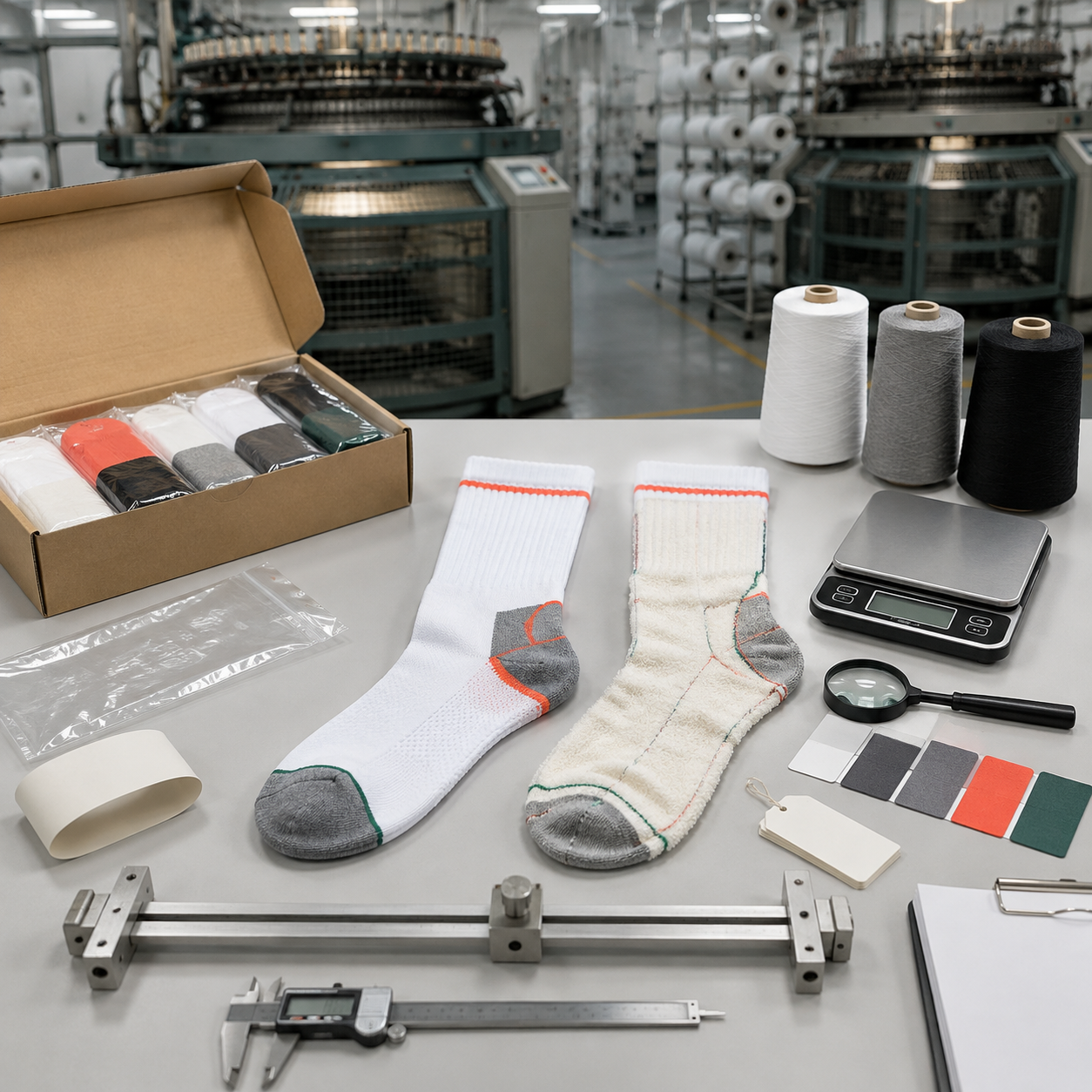
Both parties should retain physical samples carrying matching identifiers and record where each reference is stored. Photographs can support revision records, but they should not replace the physical reference when approval depends on dimensions, stretch, thickness, hand feel, color, or inside finishing.
Measurable Athletic Sock Sample Approval Criteria
The figures below are buyer-created example assumptions prepared in March 2026 for one hypothetical adult-medium crew athletic sock. They are not supplier data, ZheSock specifications, market benchmarks, legal requirements, or universal tolerances. Each value must be verified in the supplier's dated specification, sampling quote, and sample report before approval.
| Criterion | Buyer-created assumption to verify | Required evidence |
|---|---|---|
| Finished foot length | 260 mm target with a +/-5 mm tolerance for one conditioned adult-medium crew sample; buyer-created March 2026 example | Defined heel and toe landmarks, conditioning method, measuring tool, individual result, and sample code |
| Leg height | 180 mm target with a +/-5 mm tolerance for one conditioned adult-medium crew sample; buyer-created March 2026 example | Agreed heel reference, cuff endpoint, conditioning method, individual result, and sample code |
| Pair mass | 68 g target with a +/-4 g tolerance per conditioned adult-medium crew pair; buyer-created March 2026 example | Scale identification, conditioning basis, individual pair result, and sample code |
| Contractual fiber declaration | 72% polyester, 24% nylon, and 4% elastane by mass for the complete hypothetical finished sock; buyer-created March 2026 example | Material declaration reconciled with the label proof and any composition report required by the contract |
| Sample review quantity | 5 finished pairs for each selected size-color SKU; buyer-created March 2026 example | Pair-level identifiers and results plus a sampling quote confirming the submitted quantity |
These assumptions demonstrate the structure of a measurable approval record. They do not establish the correct dimensions, composition, sample quantity, or tolerance for another style. Require the supplier to disclose exceptions before making the sample.
Approve the measurement or test method as well as the result. For instrumental color control, define the physical reference, equipment basis, viewing or lighting condition, and acceptance rule. For a performance requirement, state the method, specimen preparation, reporting unit, and threshold before sampling. Machine and yarn terminology should remain process information unless the contract connects it to a measurable product requirement.
United States Label and Pack-Out Checks Before Sample Approval
The FTC textile labeling guidance explains federal context for fiber-content disclosure, country-of-origin identification, responsible-business identification, and care labeling. Applicability and presentation must be evaluated for the actual athletic sock, product claims, label format, and packaging configuration.
Use the assembled sample pack-out to review whether:
- Generic fiber names and percentages reconcile with the approved material declaration.
- Country-of-origin wording reflects the manufacturing origin documented for the order.
- Manufacturer, dealer, or other permitted responsible-business identification is accurate.
- Care information, when applicable, is supported for the approved materials and construction.
- Size, SKU, color, barcode, unit count, and purchase-order data agree across the label, package, assortment plan, and carton record.
- Sustainability, recycled-content, antimicrobial, compression, moisture-management, and medical-adjacent claims remain blocked until suitable substantiation and qualified review are complete.
- Required information remains legible and accessible in the approved fold, band, bag, hanger, or other presentation.
Regulatory label information should be distinguished from operational data such as SKU, barcode, assortment, and carton controls. This checklist is an RFQ control, not legal advice or evidence of an existing supplier labeling practice.
Sample approval also does not determine customs admissibility. CBP importer guidance states that importers must exercise reasonable care and provides context concerning classification, valuation, and marking. The United States importer and its qualified advisers should verify tariff classification, origin, valuation, marking, and entry documentation for the actual shipment rather than treating proposed supplier data as final.
When an RFQ cites a test standard, identify the applicable edition, method, specimen preparation, reporting unit, and acceptance threshold. Separate the standard's requirements from buyer-defined contractual tolerances. Do not describe a product, material, facility, or supplier as certified without a current document identifying the certificate holder, issuing body, covered scope, applicable site, and validity.
Landed-Cost Reconciliation at Sample Approval
Require a revised quote whenever the approved sample changes composition, yarn, construction, artwork, SKU mix, packaging, testing, inspection, or delivery scope. The approval-stage quote should identify:
- Product price by SKU, size, color, quantity tier, and approved revision.
- Development sample, revision sample, tooling, setup, and sample-freight charges.
- Label, retail-packaging, assortment, export-carton, and carton-marking charges.
- Testing, inspection, corrective-action, and document charges.
- Origin handling, international freight, insurance, and destination handling.
- Duty and brokerage assumptions linked to the proposed classification, origin, and valuation basis.
- United States inland transport, warehousing, and other destination costs.
- Currency, payment milestones, quote validity, delivery term, named place, inclusions, exclusions, and provisional amounts.
Illustrative calculation only: Every figure in this paragraph is a buyer-created March 2026 assumption to verify for a hypothetical United States purchase order covering 5,000 finished pairs. The currency is U.S. dollars, and every cost is allocated per finished pair. An assumed product cost of $2.10 per finished pair, international freight and insurance of $0.28 per finished pair, duty and brokerage of $0.17 per finished pair, and sampling and inspection allocation of $0.09 per finished pair produce an illustrative import landed subtotal of $2.64 per finished pair at a United States port of entry. The subtotal excludes United States inland transport and warehousing. It is not a supplier quote, tariff rate, freight offer, market average, or forecast. Verify each amount against the supplier quote, transport offer, tariff classification, origin analysis, valuation basis, and shipment-specific entry costs.
Do not compare supplier prices until packaging, testing, inspection, freight, duty, brokerage, and destination handling have each been marked as included, excluded, provisional, or buyer-arranged.
Delivery Evidence Tied to Sample Approval
A lead-time statement is incomplete unless it identifies the event that starts the commitment, its dependencies, and its exclusions. Require a dated schedule covering:
- Sample submission and buyer approval cutoff.
- Material approval and reservation.
- Artwork, label, and packaging release.
- Bulk knitting and finishing completion.
- Inspection readiness and corrective-action allowance.
- Cargo-ready status and booking responsibility.
- Planned transport mode and United States destination window.
- Schedule treatment after rejection, revision, or late approval.
Link the approved sample code and document revisions to the schedule. The purchase order should state who may authorize a change, what notice is required, how price and timing effects will be recorded, and which changes require renewed sample approval. This creates an auditable connection between product approval and the supplier's delivery commitment without assuming a lead time that has not been quoted.
RFQ Returns Required for Sample Approval
| RFQ block | Buyer provides | Supplier returns before approval |
|---|---|---|
| Order scope | United States destination, importer role, sales channel, destination window, and SKU matrix by style, size, color, and quantity | Minimum quantities by SKU, color, size, and order; quantity-tier pricing; over-or-short shipment rule |
| Sample protocol | Sample type, requested size-color set, submission deadline, review method, and approval authority | Sample quantity, fee, freight responsibility, revision allowance, sample code, and submission date |
| Technical specification | Measurement diagram, grading logic, construction map, fiber requirements, color references, tolerances, and substitution rule | Construction record, material declaration, measurement report, and written exception list linked to the sample |
| Artwork and appearance | Controlled production artwork, placement, orientation, color references, and defect definitions | Physical rendition, returned artwork revision, and disclosure of knit-detail or placement constraints |
| Testing | Contract-critical properties, methods, specimen preparation, thresholds, and reporting requirements | Test plan, responsible testing party, timing, cost, sample identity, and report format |
| Labels and packaging | United States review fields, claims, folding, bands, bags, hangers, carton assortment, and markings | Label proof, assembled pack-out sample, packed dimensions, gross weight, carton quantity, and packaging-material description |
| Commercial terms | Quote breakdown, currency, delivery basis, named place, payment milestones, and quote validity | Final quote tied to the approved revision, with assumptions, inclusions, exclusions, and change effects identified |
| Delivery | Destination window, inspection point, approval deadlines, and booking responsibility | Dated production and transport milestones, dependencies, reservation basis, and delay-notice process |
| Bulk verification | Inspection timing, sampling basis, defect categories, measurement checks, and nonconformance remedy | Inspection access, retained-reference location, relevant production records, and written acceptance of the remedy process |
| Change control | Changes to material, construction, artwork, label, packaging, production location, cost, or schedule that require notice or reapproval | Named change authority, written notice procedure, price and schedule effect, and resubmission commitment |
The final approval record should identify the decision date, authorized buyer, sample code, linked document revisions, accepted deviations, rejected-revision disposition, and locations of the buyer and supplier reference samples. Release bulk production only when that record agrees with the final quote and purchase order.
Sources, Method, and Verification Limits
| Source context | Supported use | Not supported by the source |
|---|---|---|
| DeadSoxy supplier-selection article | Commercial context for considering sample quality, lead-time reliability, and communication | ZheSock capability, capacity, pricing, tolerances, certification, or delivery performance |
| SaySock wholesale supplier page | Commercial context for sample approval and order details involving SKU mix, cartons, labels, destination, and delivery windows | ZheSock manufacturing performance, product conformity, legal compliance, or customer outcomes |
| FTC textile labeling guidance | United States textile-labeling context involving fiber, origin, responsible-business identification, and care considerations | Product-specific legal approval or confirmation that a proposed label is compliant |
| CBP importer guidance | United States importer reasonable-care context involving classification, valuation, and marking | Shipment-specific classification, duty, valuation, origin, marking, or admissibility decisions |
| Vincent Xi author profile | Vincent Xi's displayed name and Editorial Author role | Factory visits, product tests, customer outcomes, credentials, certifications, or first-person experience claims |
Method: The commercial sources were used only to identify sample-approval and wholesale-order themes. The FTC and CBP pages were used for the regulatory and importer contexts attributed to them. Those themes were converted into buyer-controlled document requests, release gates, hold conditions, and purchase-order links. The dimensional, composition, sample-quantity, and landed-cost figures are explicitly labeled buyer-created examples; they were not derived from the cited pages or attributed to a supplier.
Limitations and verification: Source publication or access dates were not supplied with this package, so buyers should confirm that the linked regulatory guidance remains current. The actual supplier must confirm materials, construction, tolerances, sample quantity, sample fees, test methods, packaging, quote scope, production timing, and shipment terms. The United States importer and its qualified advisers should verify labeling, claims, classification, valuation, duty, origin marking, and current entry requirements. An approved sample reduces specification ambiguity but does not by itself prove bulk consistency, capacity, delivery performance, legal compliance, or certification status. Those matters require current documents, contractual controls, and shipment-level verification.
Author basis: The Vincent Xi author profile identifies Vincent Xi as an Editorial Author. It does not provide a basis for a first-person factory-visit, product-test, customer-outcome, credential, or certification claim, and none is made here.
Discuss Your Requirements
Review our manufacturing capabilities, then share your specifications for a supplier-fit review.