Custom Sock MOQ, Pricing Structure, and Landed-Cost Controls for B2B Buyers
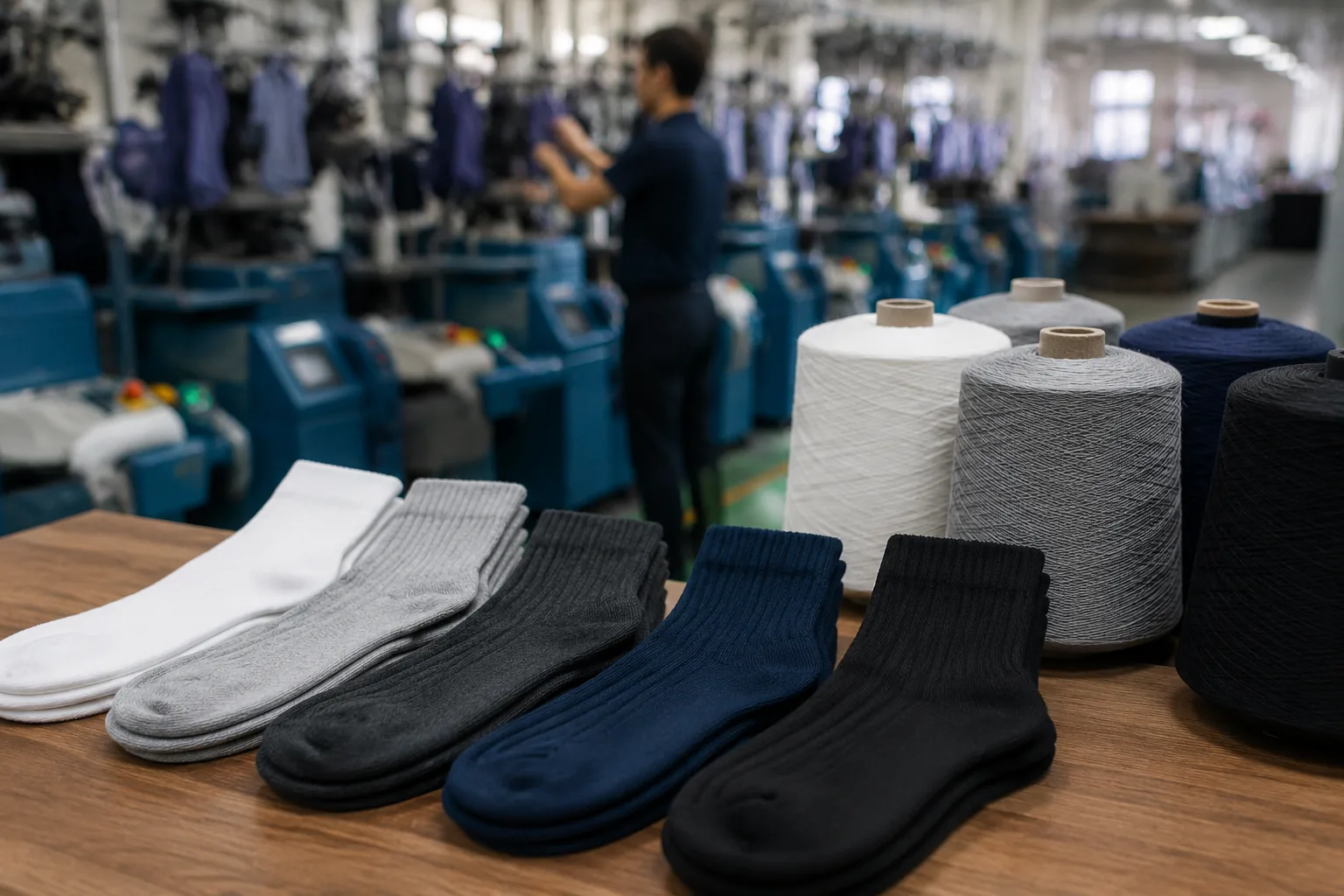
Custom Sock MOQ, Pricing Structure, and Landed-Cost Controls for B2B Buyers
**By Vincent Xi, Editorial Author, ZheSock**
<script type="application/ld+json"> { "@context": "https://schema.org", "@type": "Article", "headline": "Custom Sock MOQ, Pricing Structure, and Landed-Cost Controls for B2B Buyers", "author": { "@type": "Person", "name": "Vincent Xi", "jobTitle": "Editorial Author", "url": "https://www.zhesock.com/authors/vincent-xi/" }, "publisher": { "@type": "Organization", "name": "ZheSock", "url": "https://www.zhesock.com/" } } </script>
B2B custom sock programs are controlled by three linked commercial variables: minimum order quantity (MOQ), the line items that build unit price, and landed cost after freight, duties, packaging, sampling, inspection, and reorder friction. For fashion labels, sports brands, retailers, corporate gift teams, and promotional buyers, the useful question is not only “What is the cheapest pair?” It is “Which combination of MOQ, construction, decoration, packaging, and shipping terms keeps margin and delivery risk under control?”
This article is written for procurement and product teams evaluating custom sock manufacturing models such as OEM, ODM, private label, and white label. It restates publicly published B2B sourcing guidance into RFQ-ready controls. It does not present ZheSock factory pricing, customer outcomes, production capacity, certifications, or test results, and it does not treat any single supplier’s program terms as universal market law.
Key commercial controls at a glance
Use these published planning brackets as starting controls, then replace every placeholder with quote-dated numbers from your shortlist:
| Control | Source-stated planning bracket | Buyer action | |---|---|---| | Bulk program volume | **100 to 10,000+ pairs**, program- and supplier-dependent; material dated **18 February 2026** (DeadSoxy bulk guide) | Separate style, colorway, size-run, packaging, and reorder MOQs | | Corporate / gifting volume | Commonly around **200 to 5,000 pairs per order** in the same guide (DeadSoxy bulk guide) | Match MOQ to real event or onboarding demand, not catalogue minimums alone | | Volume pricing framing | Source states volume tiers can reduce per-unit costs by **30–60% compared with retail** for bulk programs in the **100 to 10,000+ pair** range (DeadSoxy bulk guide) | Compare fully scoped quotes, not headline pair price vs retail | | Supplier shortlist | Evaluate **3–5** manufacturers and validate with a small test order before scale (DeadSoxy manufacturer guide) | Issue one identical RFQ package to every plant | | Supplier-stated example (not a market average) | One custom program described as starting at **100 pairs** and **USD 5.27 per pair** in the **February 2026** bulk guide (DeadSoxy bulk guide) | Verify inclusions, size-run rules, packaging, freight, duties, art setup, and sampling |
What “custom sock” means in a commercial RFQ
In B2B usage, “custom sock” is not one SKU. It is a family of manufacturing models with different design ownership, development cost, and lead-time profiles. A Turkey-focused B2B guide distinguishes several common structures that buyers should name explicitly in RFQs (Goren Socks B2B guide):
- **OEM:** the buyer supplies design direction, colors, patterns, logo treatment, and yarn targets; the factory knits to specification under the buyer’s brand.
- **ODM:** the manufacturer provides a developed style; the buyer brands and colorways it.
- **Private label:** production follows a standard specification, then the buyer applies brand labels, hang tags, and packaging.
- **White label:** pre-made unbranded stock is labeled later; design investment is lower, differentiation is usually lower.
Those distinctions matter because MOQ and price rarely move for one reason alone. A limited-color private-label crew sock is commercially different from a performance athletic sock with multi-zone cushioning, specialty yarns, engineered mesh panels, and retail-ready packaging. Manufacturer-selection guidance also stresses that buyers should define product complexity, volume path, customization depth, timeline, and target unit cost before comparing factories (DeadSoxy manufacturer guide).
Factory-oriented wholesale and private-label knowledge bases similarly frame sourcing as a chain of decisions—supplier selection, materials, QC, packaging, and launch planning—rather than a single unit-price negotiation (Velon Socks knowledge base).
How MOQ works for custom sock programs
MOQ is not only a catalogue preference. In sock manufacturing it commonly proxies for yarn dyeing or yarn inventory risk, machine changeover and needle/setup time, packaging setup, and the commercial value of a production slot.
Published bulk-buying guidance describes B2B sock purchasing as typically spanning **100 to 10,000+ pairs**, depending on program type and supplier model, in material dated **18 February 2026** (DeadSoxy bulk guide). The same source frames corporate sock programs as commonly landing around **200 to 5,000 pairs per order** for gifting, onboarding, or event use. Those ranges are planning brackets only. They do not guarantee that every factory will open at the low end or remain efficient at the high end.
As one concrete published program example—not an industry average—one supplier’s custom sock program is described as starting at **100 pairs** with a **USD 5.27 per pair** starting price in the same **February 2026** guide (DeadSoxy bulk guide). Buyers should treat that figure as a dated supplier-stated example and verify current currency, inclusions, size-run rules, and whether packaging, freight, duties, art setup, or sampling are extra.
Practical MOQ questions that change the quote
Ask suppliers to separate MOQ by these layers:
1. **Style MOQ** — minimum pairs of one construction (for example, crew terry sole vs plain ankle). 2. **Colorway MOQ** — minimum pairs per color or jacquard pattern. 3. **Size-run MOQ** — whether sizes can be mixed inside the style MOQ, and at what ratio. 4. **Packaging MOQ** — carton marks, polybags, hangers, header cards, gift boxes. 5. **Reorder MOQ** — whether repeat orders can drop below first-run MOQ once yarn lots and machine settings exist.
A manufacturer that looks attractive at 1,000 pairs of one black crew may become expensive if the buyer actually needs eight colorways, six sizes, and branded insert cards. Manufacturer-evaluation guidance recommends shortlisting **3–5** manufacturers and validating with a small test order before large production commitments (DeadSoxy manufacturer guide).
Pricing structure: what actually moves the unit cost
Unit price is a stack of commercial choices. Volume is only one lever. Bulk-buying material published on **18 February 2026** states that volume-based pricing tiers can reduce per-unit costs by **30–60% compared with retail** for bulk programs in the **100 to 10,000+ pair** range (DeadSoxy bulk guide). That percentage is a source-stated retail-to-wholesale framing. It is not a prediction of margin against every buyer’s current cost base, and it does not isolate landed cost.
Core price drivers to request line by line
- **Yarn system:** cotton, combed cotton, polyester, nylon, spandex/elastane content, recycled-content claims, and any performance-yarn premium.
- **Construction complexity:** plain knit vs jacquard, cushion zones, arch bands, compression features, terry sole, mesh panels, and linking quality.
- **Machine/setup intensity:** more colors, denser logos, specialty gauges, and frequent changeovers usually raise setup risk and waste allowance.
- **Decoration method:** knit-in logo, embroidery, transfer/print, or combined methods each carry different durability and cost profiles.
- **Finishing and handfeel targets:** boarding shape, hand-feel expectation, shade tolerance, and defect disposition rules.
- **Packaging and labeling:** bulk polybag vs retail-ready packs, barcodes, care labels, hang tags, and multi-language inserts.
- **Sampling path:** paid or free sampling, revision rounds, and whether approved samples lock the production standard.
- **Commercial terms:** EXW/FOB/CIF/DDP, payment terms, currency, and quote validity window.
When comparing quotes, force the same scope. A low FOB unit price that excludes artwork setup, carton quality, size-assortment balancing, and pre-shipment inspection can lose to a higher unit price with clearer inclusions.
Landed-cost controls beyond the factory gate
Landed cost is the figure that should drive assortment and margin models: product cost + packaging + inland handling + international freight + insurance + duties/taxes + brokerage + inspection + inventory carrying + expected defect/return allowance.
Geographic sourcing can change the landed-cost equation even when the factory-gate price looks higher. A B2B guide on Turkish custom sock manufacturing states that Turkey is described as the world’s **second-largest sock exporter**, and argues that proximity to European markets can reduce transit time and freight cost versus some East Asia routes when reorders and total logistics are included (Goren Socks B2B guide). That is a published sourcing argument, not a universal rule for every destination market, HS code, or carrier contract. Buyers shipping into the US, EU, UK, Middle East, or Asia-Pacific still need route-specific freight and duty modeling.
Landed-cost control checklist for custom sock buyers
1. **Normalize Incoterms.** Compare EXW with EXW, FOB with FOB. Convert everything to a common destination cost model. 2. **Model air vs ocean explicitly.** Launch samples and first replenishment often justify air; ongoing replenishment usually favors ocean if calendar risk is acceptable. 3. **Separate duty-sensitive variables.** Fiber content, country of origin, and packaging classification can all affect duty exposure. 4. **Quantify packaging density.** Heavier gift boxes improve unboxing but can raise volumetric weight and carton count. 5. **Budget quality leakage.** Include expected seconds, claims, and inspection cost rather than assuming zero variance. 6. **Price the reorder cycle.** A slightly higher first-run cost may be acceptable if reorder MOQ, color continuity, and lead-time reliability reduce stockouts.
Wholesale and private-label planning resources consistently treat packaging, QC, and supplier reliability as part of commercial planning rather than afterthoughts (Velon Socks knowledge base; DeadSoxy manufacturer guide).
Buyer decision table: MOQ, price, and landed-cost tradeoffs
| Decision lever | Lower-friction option | Higher-control option | Cost / risk implication | What to require in the RFQ | |---|---|---|---|---| | Program model | White label or light private label | Full OEM construction and packaging | Faster start vs higher development load | State OEM/ODM/private label/white label clearly (Goren Socks B2B guide) | | First-order volume | Around 100–300 pairs for test demand | 1,000+ pairs for assortment breadth | Higher unit cost vs better amortization | Ask style, colorway, and size-run MOQs separately (DeadSoxy bulk guide) | | Supplier shortlist | One familiar vendor | 3–5 comparable manufacturers | Speed vs better commercial leverage | Same brief to every shortlisted plant (DeadSoxy manufacturer guide) | | Price comparison basis | Headline pair price only | Fully scoped unit + setup + packaging | Hidden extras vs transparent total cost of ownership | Itemized quote with validity date and Incoterm | | Shipping plan | Cheapest quoted lane | Lane matched to launch date and reorder cadence | Calendar risk vs freight savings | Air/ocean options, transit days, carton specs | | Quality gate | Visual check on arrival | Pre-production sample + AQL inspection plan | Lower admin vs fewer downstream claims | Approved sample, defect definitions, inspection timing | | Assortment complexity | 1–2 colorways, limited sizes | Multi-color, multi-size retail run | Simpler MOQ vs higher planning burden | Size curve and color MOQ matrix | | Landed-cost ownership | Factory gate only | Destination-duty model owned by buyer team | Unclear margin vs controllable margin | Duty assumptions, brokerage, and packaging weight |
Practical RFQ checklist for custom sock sourcing
Use this checklist so every supplier answers the same commercial questions.
1) Product and performance brief
- End use: retail, corporate gift, team, promotional, or performance.
- Sock type: no-show, ankle, crew, knee-high, compression, sports, dress.
- Target handfeel, thickness, and boarding shape.
- Fiber content targets and any restricted-substance expectations.
- Size range and planned size curve.
- Artwork placement rules and maximum color count.
2) Commercial structure
- Requested model: OEM, ODM, private label, or white label (Goren Socks B2B guide).
- First-order quantity and 12-month volume scenario.
- Target ship window and whether a test order is required first (DeadSoxy manufacturer guide).
- Currency, payment terms, and quote validity period.
- Incoterm preference and destination port/airport.
3) MOQ and assortment rules
- Style MOQ, colorway MOQ, packaging MOQ, reorder MOQ.
- Whether mixed sizes count toward one MOQ.
- Surcharge rules for low-volume colorways.
- Yarn inventory policy for reorders and color continuity.
4) Pricing structure to demand in writing
- Unit price by quantity tier.
- Sampling cost and revision policy.
- Setup/artwork fees, if any.
- Packaging unit cost by pack type.
- Carton packing method and pairs per carton.
- Any surcharge for rush production.
5) Landed-cost inputs
- Net weight and gross carton weight estimates.
- Carton outer dimensions for volumetric freight.
- Suggested freight modes and transit-time ranges.
- Documents included: commercial invoice, packing list, certificate of origin if applicable.
- Buyer-owned assumptions for duty rate and brokerage (label these as assumptions to verify).
6) Quality and acceptance
- Pre-production sample approval process.
- Measurement chart and tolerance band.
- Appearance standard for logos, color matching, and boarding shape.
- Inspection timing: in-line, final random, or third-party.
- Disposition process for seconds and replacements.
7) Example calculation fields to verify in the supplier quote
The following is an **example calculation framework only**, not a market price claim:
- Factory unit price: **USD X.XX / pair** (verify scope and as-of date in quote)
- Packaging: **USD X.XX / pair**
- Freight allocation: **USD X.XX / pair** based on carton density and mode
- Duty/tax assumption: **Y%** of dutiable value (verify HS code and destination rules)
- Inspection/claims allowance: **Z%** of product cost
- **Estimated landed cost / pair = sum of the above**
Require the supplier to populate every “X/Y/Z” field or mark it “buyer-provided assumption.”
How to evaluate manufacturers without over-indexing on headline price
Manufacturer-selection guidance is consistent on process: define requirements first, then judge equipment fit, yarn capability, sample quality, MOQ realism, lead-time reliability, communication, and QC systems; verify with a limited test order before scaling (DeadSoxy manufacturer guide). Wholesale knowledge bases likewise organize buying work around supplier comparison, materials, packaging, and private-label planning rather than single-score price shopping (Velon Socks knowledge base).
A disciplined evaluation loop looks like this:
1. Issue one identical RFQ package to 3–5 suppliers. 2. Score quotes on scoped unit cost, MOQ flexibility, lead time, and documentation quality. 3. Approve a physical sample against written tolerances. 4. Run a controlled pilot quantity before seasonal or national rollout. 5. Lock packaging, barcode, and carton standards before bulk release. 6. Recalculate landed cost after the first real shipment, not only after the first pro forma invoice.
Where origin strategy is part of the decision, use published geographic claims carefully. Turkey’s position as a major sock export origin and its proximity advantages for some European replenishment models are discussed in supplier-side B2B material (Goren Socks B2B guide). Buyers should still compare actual transit times, duty treatment, capacity, and quality systems for their own destination markets.
Methodology, source context, and limitations
Source contexts used
1. **B2B manufacturing-model and origin context** from a custom sock manufacturer guide covering OEM/ODM/private label/white label definitions and Turkey export positioning (https://www.gorensocks.com/b2b-guide/). 2. **Bulk commercial ranges and manufacturer-selection process** from B2B bulk-buying and manufacturer-choice guides describing quantity brackets, retail-to-wholesale price framing, corporate order ranges, and a 3–5 supplier evaluation approach (https://deadsoxy.com/blogs/custom-socks/buying-socks-in-bulk-b2b-guide; https://deadsoxy.com/blogs/private-label-socks-manufacturing/how-to-choose-custom-sock-manufacturer). 3. **Wholesale/private-label planning context** from a factory-oriented sock knowledge base organized for supplier selection, materials, QC, packaging, and private-label workflows (https://www.velonsocks.com/socks-blog).
How the data was derived
Figures and process recommendations above are extracted only from the cited public pages and restated for buyer controls. Quantity ranges, percentage savings claims, supplier-stated starting prices, and evaluation counts are attributed to those pages with their published timing where available. No ZheSock factory price list, customer outcome, certification status, capacity claim, or production test result is used here. Editorial authorship is limited to structuring the sourcing logic for RFQ use by Vincent Xi, Editorial Author.
Limitations / what to verify before purchase
- Supplier MOQs, tier prices, and starting pair prices change with yarn markets, machine loading, and packaging scope; re-verify on the quote date.
- The **30–60%** retail-to-bulk framing and the **USD 5.27 / pair** starting example are source-stated commercial claims from **February 2026** material, not universal benchmarks (DeadSoxy bulk guide).
- Origin advantages depend on destination, Incoterm, carrier contracts, and duty treatment; do not assume one origin wins for every lane.
- Standards, restricted-substance policies, and any certification language must be confirmed with current documents from the supplier or accredited body. Naming a standard is not the same as holding a current certificate.
- Example landed-cost formulas in this article are calculation templates. Every exact number used in a purchase decision should carry unit, scope, as-of date, and source—or be labeled as a buyer assumption to verify.
Closing takeaway for procurement teams
A custom sock program is commercially controlled when MOQ matches real assortment demand, pricing is itemized by construction and packaging choices, and landed cost is modeled before artwork is finalized. Use published planning brackets—such as bulk ranges of **100 to 10,000+ pairs**, corporate order bands around **200 to 5,000 pairs**, and multi-supplier evaluation of **3–5** factories—as starting controls, then replace every placeholder with quote-dated numbers from shortlisted manufacturers (DeadSoxy bulk guide; DeadSoxy manufacturer guide).
For teams buying under a private-label roadmap, keep the RFQ, sample approval, and first-shipment reconciliation in one file. That is the practical way to control custom sock cost without confusing factory-gate price with the cost that actually hits the P&L.
---
*Editorial author: Vincent Xi, Editorial Author at ZheSock. This article is an evidence-bound sourcing briefing based on the cited public B2B materials and does not constitute a factory quotation.*