Eco Sock OEM Quality Control Inspection for Canada RFQs
By Vincent Xi, Editorial Author
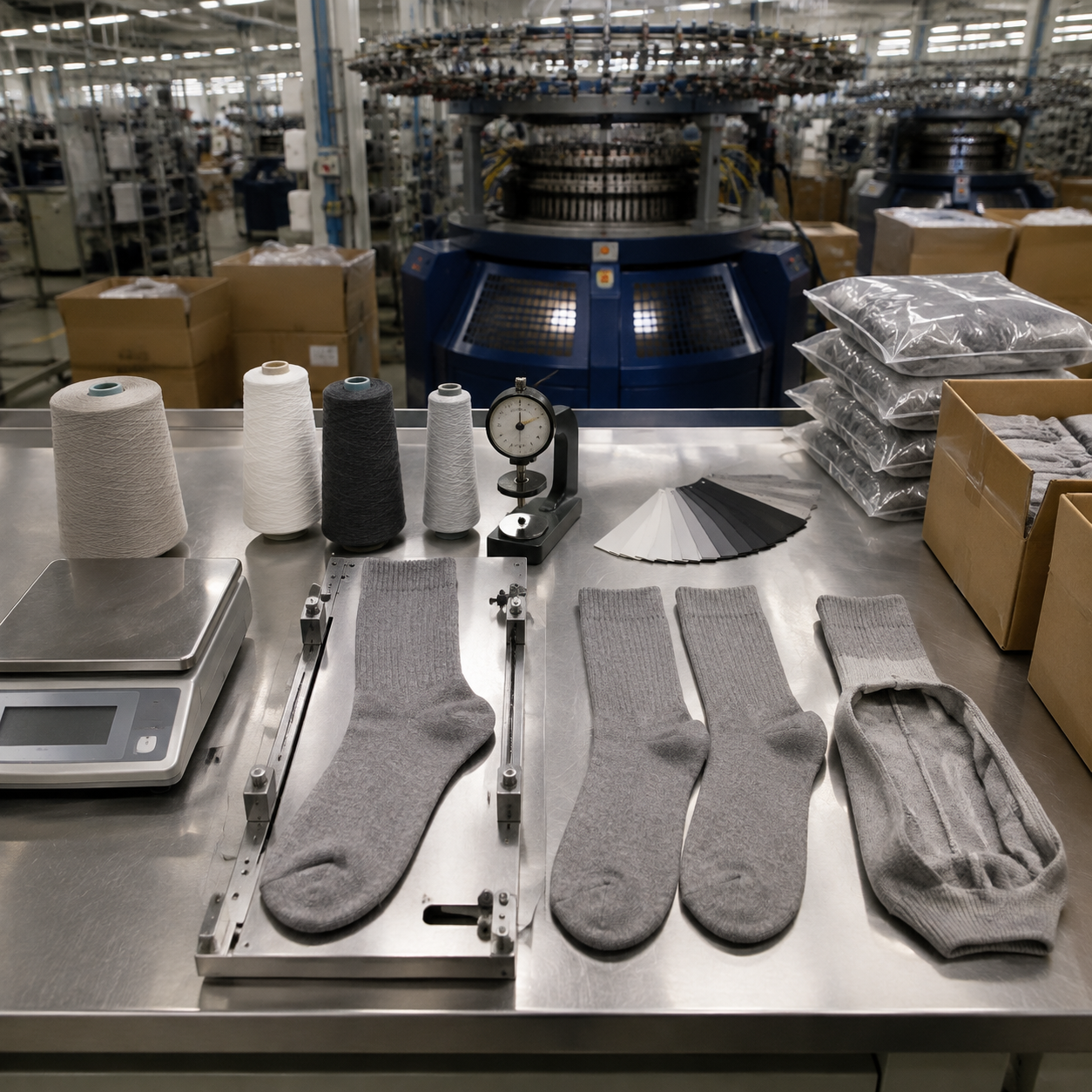
For a Canada-bound order, an eco sock OEM quality control inspection RFQ should answer the release question: what evidence allows the identified production lot to ship? Canadian B2B buyers should define the controlled specification, lot identity, environmental-claim evidence, defect rules, sampling plan, test responsibilities, reporting deadline, and remedies before comparing supplier quotes.
If eco communicates an environmental attribute, state the exact claim, the sock component it covers, the required evidence, and what happens when that evidence is missing or out of scope. A general marketing statement, supplier profile, or facility document should not be treated as automatic proof for the ordered SKU or production lot.
The supplied sources provide manufacturing and sourcing context. They do not establish the capability, certification, environmental performance, inspection result, or product conformity of ZheSock or any other supplier.
Canada Eco Sock Quality Control Inspection: Set the Release Rule
The supplied DeadSoxy article discusses quality checks in raw-material, production, and finished-product contexts, including yarn consistency, knit density, dimensions, colorfastness, and visible defects (DeadSoxy). The supplied Goren Socks guide describes OEM work based on buyer-defined designs, colors, patterns, and yarn specifications (Goren Socks). These sources support the process categories below, but they do not prove that a separate supplier, SKU, or lot conforms.
| Release field | Buyer-controlled RFQ requirement | Evidence required before release | Response when unmet |
|---|---|---|---|
| Product identity | Purchase order, SKU, size, colorway, approved sample, and technical-pack revision | Matching identifiers across production records, sampled goods, packaging, cartons, and inspection report | Hold goods whose identity or revision cannot be reconciled |
| Material identity | Component-level material specification and an explicit substitution rule | Yarn and accessory records linked to the ordered SKU and applicable material or production lot | Hold or reject an unauthorized material or substitution |
| Environmental claim | Exact wording, covered component, evidence type, scope, validity, and required lot linkage | Records cross-referenced to the relevant holder, facility, process, component, SKU, and lot where required | Withhold the claim or apply the contracted hold, correction, or rejection remedy |
| Construction and dimensions | Buyer-defined knit structure, cuff, reinforcement, toe closure, decoration, measurement points, targets, and tolerances | Approved-sample comparison, individual measurements, workmanship findings, and photographs | Segregate, re-pair, rework, regrade, or reject as contracted |
| Performance | Named method, sample source, conditions, pass criterion, report format, and release dependency | Traceable results for samples taken from the required production stage | Keep the lot on hold until the required result or authorized deviation is recorded |
| Packing | Approved artwork, pairing, assortment, attachments, packaging components, and carton configuration | Count reconciliation, packing findings, photographs, and identifier continuity | Correct and reinspect affected goods before cargo handover |
| Disposition | Authorized decision-maker and permitted outcomes | Signed release, hold, rework, deviation, or rejection record | Do not ship without the required authorization |
Use explicit disposition terms:
- Release: The identified lot meets every criterion required for shipment authorization.
- Hold: Evidence is missing, a result is pending, or inspected goods cannot be reconciled with the reported lot.
- Rework and reinspect: An authorized correction is completed and the contracted reinspection rule is satisfied.
- Reject: The lot fails a non-waivable requirement or an authorized correction does not restore conformity.
Terms such as standard size, durable cuff, matching color, normal tolerance, or sustainable yarn are not complete inspection criteria. Replace them with a controlled reference, observable condition, measurement method, test result, or defect rule.
Control the Specification and Environmental-Claim Evidence
Issue the inspection basis with the RFQ. Define the order of precedence among the signed purchase order, technical pack, approved physical sample, approved color reference, environmental-claim evidence schedule, defect catalogue, test plan, and packing instruction. Every controlled item should carry a revision identifier, approval status, and owner.
The component schedule should separate the sock body, cuff elastic, heel and toe reinforcement, sewing thread, grip or print application, and decoration where applicable. When an environmental claim covers only a specified component, preserve that limitation in the specification, artwork, evidence request, inspection report, and release decision.
When a buyer elects to name a standard, certification, or material program, the RFQ should identify the applicable document and revision. Request current evidence showing the holder, covered facility, product or process scope, validity status, and any order-level linkage required by that program. A contractual requirement to follow a standard is distinct from a supplier's own routine practice. A sourcing-page reference does not establish certification of ZheSock, another supplier, or the ordered product; rely only on a current, applicable document.
The supplied evidence does not establish Canada-specific labeling, bilingual artwork, legal, customs, or import-document requirements. Do not ask an inspector to invent those requirements. Where they apply, provide legally reviewed artwork and instructions as controlled buyer documents, then require the inspector to compare production against the approved files.
Put Quality Control Inspection Gates into Manufacturing
The raw-material, production, and finished-product contexts described by DeadSoxy support placing buyer decisions at defined manufacturing stages (DeadSoxy). The gates below are proposed RFQ controls, not claims about a supplier's existing practice.
| Manufacturing gate | Buyer decision | Required evidence | Contract response to failure |
|---|---|---|---|
| Material release | Approve, replace, or hold yarn and accessories before use | Purchase-order match, material-lot identity, color reference, component records, and environmental-claim linkage | Segregate unapproved material pending disposition |
| Setup approval | Approve or correct construction before sustained output | Flat measurements, construction checks, inside and outside photographs, and approved-sample comparison | Correct the applicable setup or finishing process and resubmit output |
| In-line inspection | Continue, adjust, segregate, or stop affected production | Findings separated by relevant machine group, production period, size, colorway, and material lot | Isolate affected output and record the corrective action |
| Finished-lot inspection | Release, hold, rework, or reject | Sample-selection record, individual measurements, defect totals, photographs, and test status | Apply the contracted disposition and reinspection rule |
| Packing verification | Approve cargo handover or require correction | Pair count, assortment, package match, carton condition, and identifier reconciliation | Repack and reinspect affected goods before release |
The supplier quote should state the fee, schedule effect, sample consumption, and responsible party for every required gate. For a test that alters or consumes samples, specify whether samples must come from bulk production, who selects and seals them, who pays for initial and repeat testing, and whether shipment stays on hold while results are pending.
Define Defects, Sampling, and Remedies Before Award
The supplied ANV Socks guide discusses AQL, inspection, certification documents, and shipment controls within an OEM sourcing workflow (ANV Socks). It does not select a sampling plan for a particular Canada-bound order. The RFQ should identify either a named sampling standard and revision or a clearly defined custom buyer plan.
Defect classes must also be defined by the buyer rather than assumed to be universal:
- Critical: A condition designated as non-waivable because of an applicable safety, legal, or product-identity requirement.
- Major: A condition defined as preventing the product from meeting an agreed function or acceptance requirement.
- Minor: A workmanship or presentation departure outside the approved specification that does not meet the buyer's major definition.
Possible sock conditions for buyer classification include an open toe closure, mismatched pair, knitting fault, loose yarn, misplaced reinforcement, shade mismatch, damaged decoration, incorrect label, or wrong assortment. Assign the inspection method, severity, and permitted repair for each applicable condition in the order documents.
A complete sampling clause should define:
- The production lot and sampling unit.
- The randomization method and distribution across cartons, sizes, colorways, material lots, and production periods.
- The selected standard and revision, inspection level, and switching rule when a standard plan is used.
- The sample size and acceptance or rejection limits for each buyer-defined defect class.
- Requirements subject to document review, destructive testing, or complete screening instead of ordinary sampled inspection.
- Rules for segregation, corrective work, resampling, and reinspection after failure.
- Whether a passing sampled inspection authorizes release or still requires approval from the named buyer representative.
Do not write the contract as though a passing sampled result proves every uninspected pair. Define it as a sample-based disposition under the selected plan and retain the buyer's stated release authority.
Worked Canada RFQ Assumptions to Verify
Every numeric value below is a hypothetical, buyer-created example assumption or calculation to verify in the supplier quote and signed inspection agreement. None is source-reported factory data, a ZheSock capability, a Canadian legal requirement, an industry benchmark, or a prescribed sampling plan.
| RFQ field | Example assumption or calculation to verify | Supplier response required |
|---|---|---|
| Production-lot scope | Example assumption to verify in the supplier quote: 12,000 pairs form a production lot for a single SKU, colorway, and Canada-bound purchase order. | Confirm the lot definition and disclose any split by material lot, machine group, colorway, or production period |
| Finished-lot sample | Example calculation to verify in the supplier quote: a 240-pair sample equals 2.0% of the hypothetical 12,000-pair production lot. | Confirm whether this custom buyer plan is feasible and state the randomization, carton distribution, inspection time, and price |
| Foot length | Example assumption to verify in the supplier quote: a 250 mm target per sampled sock, with a +/- 5 mm tolerance per sampled sock after 24 hours of conditioning under the agreed inspection environment. | Confirm measurement landmarks, conditioning conditions, equipment resolution, recording method, and treatment of borderline results |
| Pair matching | Example assumption to verify in the supplier quote: a maximum 3 mm foot-length difference between the socks in each sampled pair. | Confirm that both socks in every sampled pair will be measured, recorded, and compared |
| Finished mass | Example assumption to verify in the supplier quote: a 52 g target per sampled pair, with a +/- 4 g tolerance after the agreed conditioning step and excluding packaging. | Confirm balance resolution, conditioning method, tare procedure, and response to out-of-tolerance results |
| Reporting deadline | Example assumption to verify in the supplier quote: the complete report is due 2 buyer-defined business days before the planned cargo handover for the hypothetical Canada-bound order. | Insert calendar dates and state the effect of pending tests, corrective work, or reinspection |
The example sample percentage is derived only from the hypothetical lot and sample quantities shown in the table. It does not establish that the sample provides an appropriate risk level. A supplier counterproposal should state its effect on inspection cost, sample consumption, manufacturing timing, test timing, and reinspection terms.
Compare Supplier Responses on the Same RFQ Basis
Require each supplier to complete the same response schedule. Blank fields, undefined supplier standards, and unpriced exclusions remain unresolved commercial points.
| RFQ section | Buyer issues | Supplier returns |
|---|---|---|
| Order and lot identity | SKU, size range, colorway, quantity basis, approved sample, and controlled revisions | Manufacturing-site identity, proposed lot structure, production split, and traceability method |
| Components and claim scope | Component specifications, permitted substitutions, exact environmental claim, evidence scope, and claim-removal rule | Proposed bill of materials, requested substitutions, document holder, facility, scope, validity, exclusions, and order linkage |
| Measurements and appearance | Measurement diagram, conditioning rule, targets, tolerances, approved color reference, and defect examples | Method, equipment, inspection frequency, shade-lot control, records, and response to nonconforming output |
| Performance testing | Named method, sample source, conditions, pass criteria, and release dependency | Test location, sample requirement, price, timing, report format, and repeat-test terms |
| Defects and sampling | Product-specific defect catalogue, lot definition, sampling unit, distribution, and acceptance rules | Exact quoted plan, inspector time, exclusions, randomization procedure, and reinspection method |
| Manufacturing gates | Required material, setup, in-line, finished-lot, and packing decisions | Gate timing, responsible personnel, records, stop authority, and schedule effect |
| Packing control | Approved artwork, pairing, assortment, packaging, and carton specification | Packing method, count control, traceability placement, and correction process |
| Remedies and release | Permitted correction, segregation, replacement, rejection, deviation, and shipment-authorization rules | Rework scope, reinspection cost, replacement timing, cost responsibility, and confirmation that cargo remains on hold until authorization |
Practical RFQ Checklist for Canada Eco Sock Quality Control Inspection
Mark each item complete only when the RFQ identifies the controlled document, quoted service, required evidence, or decision owner. A supplier acknowledgement without the requested detail does not close the item.
Before supplier award
- [ ] Identify the purchase order reference, SKU, size range, colorway, lot basis, approved sample, and applicable document revisions.
- [ ] Specify each sock component, permitted material substitutions, and the disposition for an unauthorized substitution.
- [ ] State the exact
ecoclaim, covered component, evidence scope, validity requirement, lot-linkage requirement, and claim-removal rule. - [ ] Attach measurement diagrams, conditioning instructions, targets, tolerances, appearance references, and the product-specific defect catalogue.
- [ ] Define the production lot, sampling unit, randomization method, sample distribution, and acceptance or rejection rules.
- [ ] Name each required test method, sample source, test conditions, pass criterion, report format, and shipment-hold dependency.
- [ ] Define material, setup, in-line, finished-lot, and packing gates with the evidence and authorized decision for each gate.
- [ ] Issue approved packing and artwork files; add Canada-specific instructions only after those requirements have been separately verified.
- [ ] Require the quote to price inspection, testing, consumed samples, corrective work, and reinspection and to show their schedule effects.
- [ ] Contract the permitted hold, segregation, rework, replacement, deviation, rejection, and cost-responsibility terms.
- [ ] Name the buyer representative authorized to release the lot and prohibit cargo handover without the required signed disposition.
Before shipment release
- [ ] Reconcile supplier, manufacturing-site, purchase-order, SKU, colorway, production-lot, carton, sample, and report identifiers.
- [ ] Confirm that the report cites the approved revisions used for measurements, defects, tests, environmental-claim evidence, and packing checks.
- [ ] Confirm that sample-selection records and photographs connect the inspected products and cartons to the identified production lot.
- [ ] Review individual measurement, mass, pair-matching, defect, and performance-test results rather than summary averages alone.
- [ ] Check environmental-claim records for the applicable holder, facility, scope, component, SKU, validity, and lot linkage where required.
- [ ] Close corrective actions and reinspection findings; document any deviation against the affected lot and order only.
- [ ] Obtain the signed release, hold, rework, deviation, or rejection decision before cargo handover.
A conditional deviation should identify the affected lot, waived requirement, approving person, order limitation, and required follow-up. It should not silently change the specification for later orders.
Methodology, Source Boundaries, and Limitations
| Supplied source | Use in this article | Boundary applied |
|---|---|---|
| Vincent Xi author profile | Author name, profile URL, and Editorial Author role | Does not support a factory visit, product test, customer outcome, credential, certification, or personal production observation |
| DeadSoxy | Raw-material, production, and finished-product quality-control contexts and the cited examples of sock checks | Does not prove another supplier's process, capability, result, defect rate, or product conformity |
| Goren Socks | Context for buyer-defined OEM designs, colors, patterns, and yarn specifications | Does not prove that another supplier accepts or can meet a particular specification |
| ANV Socks | Commercial context for AQL, inspection, certification documents, and shipment controls | Does not select an order-specific sampling plan, prove certification, or establish conformity for a Canada-bound order |
Methodology: Source-supported process categories were attributed to the supplied pages and translated into buyer-controlled RFQ fields, inspection gates, evidence requests, checklist items, and remedies. Supplier-specific promotional implications were excluded. The quantitative entries were isolated as hypothetical buyer assumptions, and the sample percentage was derived arithmetically from the example lot and sample quantities in the same table.
Limitations and verification: The supplied pages are commercial guidance, not Canadian regulations, independent laboratory reports, current supplier certificates, or order-specific inspection records. Publication and retrieval dates were not supplied, so time-sensitive documents and statements must be checked before award. No ZheSock capability, certification, test result, defect rate, customer outcome, environmental performance, or regulatory compliance is asserted.
Before award, verify technical values with the proposed supplier, inspection party, and qualified testing resource. Check any certificate or material record for current validity, holder, facility, product or process scope, and required lot linkage. Obtain current qualified advice for Canada-specific legal, labeling, import, or commercial requirements not established by the supplied manufacturing evidence.
Author note: The approved Vincent Xi profile supports the byline and Editorial Author role only. No first-hand factory visit, sock test, customer result, or personal production observation is claimed.
Discuss Your Requirements
Review our manufacturing capabilities, then share your specifications for a supplier-fit review.