Fashion Sock Sourcing Customization Options in Europe
Vincent Xi, Editorial Author — Author profile
European buyers comparing fashion sock sourcing customization options should lock the procurement points before price: commercial model, knit construction, yarn, decoration, size and colorway split, pack format, and acceptance test. A style, size, or colorway change can require a new machine setup, so the quote must name the pair minimum and the clock for that split. Minimums, lead time, and Incoterms are commercial controls. Needle range, yarn count, heel placement, and terry height are evidence about the sock itself.
These figures are supplier statements, not a Europe-wide benchmark, and they do not make one rule for the EU, the EEA, the UK, and every national market. The briefing uses three captured pages, not a factory audit. No publication date for the Fumao Fabric page was supplied in this research excerpt; the page was captured on 23 September 2026. The captured Goren Socks B2B guide has a WebPage datePublished of 12 March 2026 and a dateModified of 7 May 2026. The captured SinoKnit comparison has a BlogPosting datePublished of 26 March 2026 and a dateModified of 12 August 2026. All three pages were captured on 23 September 2026. Page dates are not quote-validity dates.
What customization options matter in European fashion sock procurement
Specify what the machine must repeat: style height, fiber blend, stitch zones, color reference, knit-in or applied branding, pairs by size and colorway, and pack format. On the guide modified 7 May 2026, Goren Socks in Istanbul lists crew, ankle, no-show or liner, and knee-high styles. Its table ties crew socks to fashion, corporate gifting, and retail, and knee-high socks to fashion, compression therapy, and workwear (Goren Socks B2B guide).
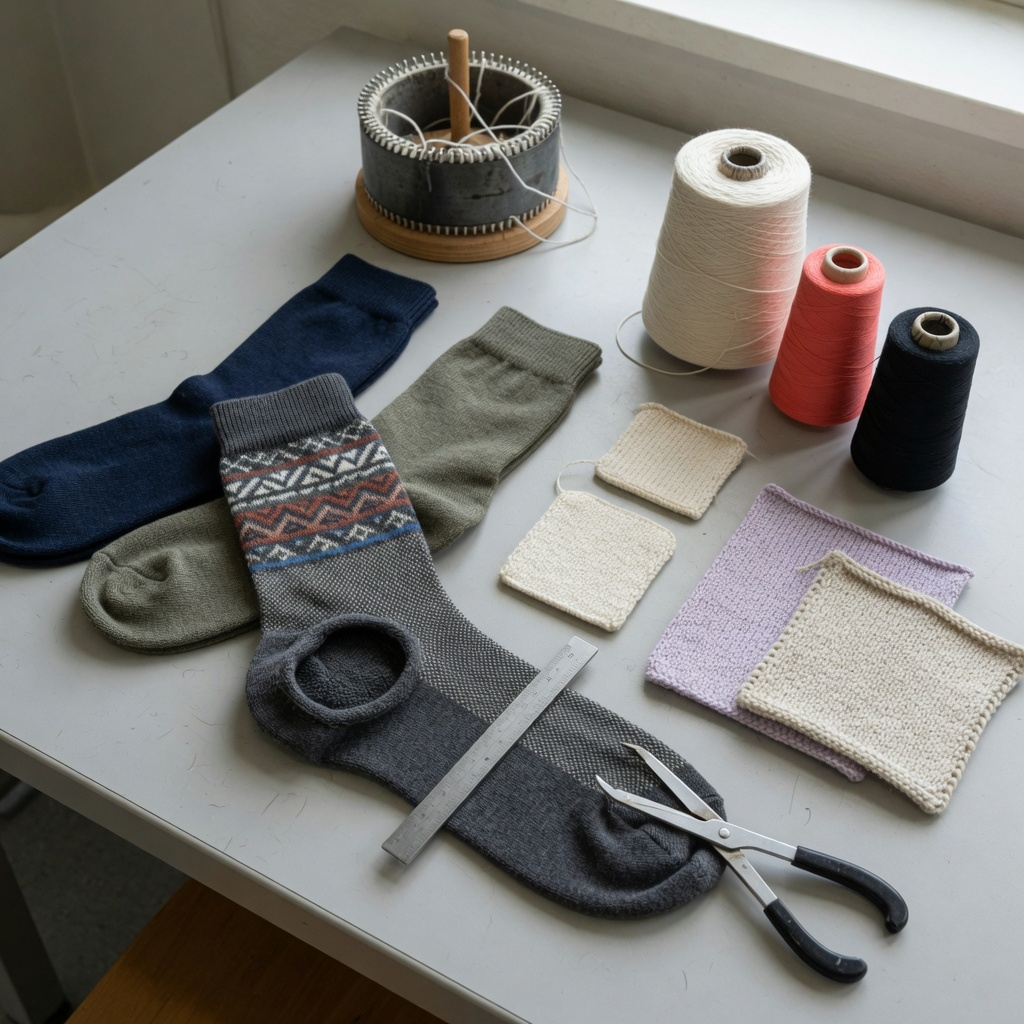
Fumao Fabric states, on the page captured 23 September 2026, that sock machines are small-diameter circular machines, typically 3-5 inches in diameter, and knit a foot-shaped tube in one continuous process. That pass can place terry loops, tighter ankle knitting, and a ribbed cuff. The heel pocket is formed by knitting back and forth on only part of the needles while the rest stay idle. Fumao's 2021 account of a Swedish brand describes heel-placement variation in a bulk shipment. That account is one anecdote, not a measured European defect rate (Fumao Fabric).
Goren's 7 May 2026 guide says knit-in jacquard is a logo and pattern route it offers, and it calls that result higher quality than sublimation or transfer printing. The ranking is Goren's statement, not an independent test. It also says multi-color jacquard, compression structures, and silicone grip need additional lead time. SinoKnit, modified 12 August 2026, lists selected printed styles and selected knitted custom styles with different published minimums, so the request has to name the method (SinoKnit comparison). A box may become a polybag, hang tag, or bulk pack. The simpler pack still has to keep the composition information, pair identity, and yarn-to-setup traceability the buyer specifies. Official label wording for each EU, EEA, or UK destination was not established in the supplied evidence.
Choose an OEM, ODM, private-label, or white-label scope
Use Goren's definitions from the page modified 7 May 2026. OEM means the buyer supplies design, colors, pattern, logo, and yarn specification. ODM means the buyer brands the manufacturer's design. Private label means a standard specification plus the buyer's labels, hang tags, and packaging. White label means unbranded pre-made stock, with labels added later, a faster turnaround than full OEM, and less differentiation (Goren Socks B2B guide).
On that page, stock designs with custom branding start from 500 pairs, and fully custom OEM starts from 1,000 pairs per design. Those are Goren's starts, not a European industry minimum. SinoKnit, modified 12 August 2026, instead reports Goren's minimum as 1,000 pairs per size per design and a 2-3 week production period after sample approval (SinoKnit comparison). Goren's step list says bulk production typically takes 20-25 days after sample sign-off. Its FAQ says 25-35 days. Do not average the per-design and per-size statements, and do not treat 2-3 weeks, 20-25 days, and 25-35 days as one clock. The quote must name the denominator and the clock that starts on written approval.
Goren describes private label as a standard specification plus labels, hang tags, and packaging. That description does not say a woven label requires a new jacquard program. Do not assume a repeated colorway exists in white-label stock. State who owns the knit program and whether a reorder can reuse the approved setup.
Specify knit structure, yarn, and decoration without confusing gauge and yarn count
Needle count does not state yarn fineness. Goren's guide, modified 7 May 2026, groups finer-gauge machines of 168-200 needles with thinner, dressier socks and sharper pattern detail, and coarser gauges of 72-144 needles with sports and casual styles. Treat those bands as Goren's machine classes only. Do not convert them to denier or Ne, and do not treat needle count as the cause of yarn fineness (Goren Socks B2B guide).
Fumao's page, captured 23 September 2026, specifies yarn count as thickness, in denier for synthetics or Ne for cotton, plus ply, twist, and core-spun construction for elastic yarns. It says nylon is typically 15-30 percent for strength, abrasion resistance, and shape recovery; cotton socks typically need 15-25 percent nylon; and spandex or elastane is 2-5 percent for stretch and recovery. Those are general sock statements on that page, not a legal fashion-sock formula. Fumao says a 1 percent change in spandex content, a drift in knitting tension, or a change in yarn diameter changes stretch. A 2023 Danish cycling project used 65 percent merino wool, 32 percent nylon, and 3 percent spandex. Keep that blend inside the project (Fumao Fabric).
Terry on the same page is use-specific: athletic socks might have 3-5 millimetre loops, while dress socks have minimal or no loops. A 2022 hiking example used 5 millimetres on heel and toe, 3 millimetres on the foot, and a flat instep. For a fashion sock, mark zones that must stay flat.
The same page lists relaxed and stretched total length, leg length, foot length, cuff height, heel placement, toe shape, and recovery. Its illustration, an 8-inch relaxed foot at 50 percent stretch fitting up to a 12-inch foot, is stretch arithmetic, not a European shoe-size chart. Shoe-size mapping was not supplied in these research excerpts and needs verification. Goren confirms achievable Pantone matches at sample stage, rather than from the brief alone.
Fumao's setup example says five colors and four sizes, 20 combinations, might use a 100-pair minimum per combination, totaling 2,000 pairs. Treat the 100-pair figure and the 2,000-pair total as a calculation to replace with the supplier's written minimum before an order quantity is approved.
Compare published MOQs and lead times before locking a European delivery date
Keep each figure with its publisher, unit, basis, and page date. On Goren's guide, modified 7 May 2026 and captured 23 September 2026, the step list labels sample development Day 5-15, with samples typically ready within 7-10 days, while the FAQ states 7-15 days. The cumulative step list labels the shipping stage Day 45-50. Express courier from Turkey to most European destinations is stated separately as 3-5 business days, so Day 45-50 is not the transit time. The FAQ's path from brief to delivery in Europe is typically 45-65 days. No duration for the sample-approval step was supplied in that captured FAQ sentence. Do not merge these delivery statements with the separate bulk figures in the commercial-scope section, and do not treat the page as a held production slot (Goren Socks B2B guide).
SinoKnit, modified 12 August 2026, reports EGE Socks in Istanbul at 1,200 pairs per design, pre-production samples in 5-7 days, and bulk production in 3-4 weeks, plus EUR.1, EORI, and customs-document support. It reports selected printed styles at 200 pairs and selected knitted custom or sports styles at 500 pairs per design, color, and size. It says Walknes' MOQ is not publicly stated. SinoKnit describes Euro-Tec in Albania as flexible by product type, with a 25-40 day lead-time range (SinoKnit comparison).
Fumao, captured 23 September 2026, gives its own ranges: sample development of 1-5 pairs per style; small production of 200-500 pairs per style per color for basic styles; efficient production of 1,000-3,000 pairs per style; and 5,000 pairs or more per style for full-scale production. Its stated first-order total is 4-5 months from initial inquiry to delivery, with sea freight in weeks 17-20. Repeat orders are described as 3-4 months once specifications and yarn sources are already identified. One UK client example uses 2 weeks by air for replenishment and 6 weeks by sea for seasonal stock, with air freight costing 4 times the sea cost for that client only (Fumao Fabric).
Goren states that Istanbul shipments to Germany, the Netherlands, the UK, and Scandinavia are faster and lower-cost in freight than equivalent East Asian shipments, and often better on landed cost after time and duty. No duty rate, freight tariff, or comparison year was supplied in the Goren excerpt used here. EGE's EUR.1 and EORI support, as reported by SinoKnit, is not a duty result for every EU, EEA, or UK lane.
Demand multiplied by lead time is demand exposed during the wait. It is not automatically extra buffer or an order quantity. Count usable stock, incoming supply already ordered, and committed demand once each before adding quantity. No demand series was supplied in the captured text, so no stock quantity is calculated.
Buyer decision table for fashion sock customization
Use the rows to specify, compare, and approve one European fashion sock order. They do not rank factories or set a legal limit.
| Decision | What to lock | Trade-off from the cited pages | Check before approval |
|---|---|---|---|
| Commercial scope | OEM, ODM, private label, or white label, plus program ownership | Goren's 7 May 2026 page starts full OEM at 1,000 pairs per design and branded stock at 500 pairs; white label is described as faster and less distinct | Require exclusivity, art ownership, and reorder terms |
| Quantity basis | Pairs, and whether size and colorway sit inside the minimum | SinoKnit on 12 August 2026 reports 1,000 pairs per size per design and a 2-3 week production period, against Goren's per-design start and its 20-25 or 25-35 day bulk statements | Approve one denominator and one clock |
| Gauge and yarn | Needle range, plus denier or Ne, ply, blend, and elastane | Goren's 168-200 needle band is its dressier class and 72-144 its sports or casual class; Fumao's yarn count, ply, twist, and 1 percent spandex note are separate | Reject any line that treats needle count as yarn fineness |
| Zones and decoration | Heel position, terry in millimetres, knit-in or print | Fumao treats the heel and selective loops as programmed zones; dress socks on that page have minimal or no loops; Goren separates knit-in jacquard from sublimation or transfer | Approve one zone sheet and one method on the pre-production pair |
| Timing and freight | Sample revisions, bulk-start event, European mode, Incoterm | Goren labels a shipping stage at Day 45-50 and states 3-5 business-day express transit, plus a 45-65 day path to Europe; Fumao's first order is 4-5 months with sea freight in weeks 17-20 | Write the governing clock and Incoterm into the order |
| Packaging level | Polybag, hang tag, box, or bulk | A simpler pack can change handling, but specified composition information and lot traceability stay in the order | Confirm that information survives if the retail pack is removed |
| Release test | Dimensions, needle lines, toe, color, and recovery | Fumao lists those defects and describes final inspection as usually statistical; cycle counts and a band under 5 percent are client examples, not a legal limit | Define method, reject rule, and who pays rework |
Verify quality, labeling, and traceability before acceptance
On the page captured 23 September 2026, Fumao names needle lines, yarn banding, size variation, poor toe closing, a misplaced heel pocket, and spandex that was not heat-set. Checks run from incoming yarn and a documented setup through first-piece review, in-process sampling, and final inspection that it says is usually statistical. The page discusses modified Martindale abrasion of 20,000-50,000 cycles depending on intended use, recovery after a specified elongation, toe-seam strength, and sweat or rub colorfastness. A Swiss hiking example uses 50,000 cycles. A German medical example accepts stretch variation under 5 percent. Copy either number only if the buyer writes it into the fashion sock specification (Fumao Fabric).
Goren's 7 May 2026 list covers dimensional consistency, color fastness, seam and toe finish, elastic tension, and labeling accuracy. Goren says OEKO-TEX, BSCI social-compliance audits, GOTS for organic materials, and Sedex membership are standard at well-established Turkish manufacturers, and that this means compliance requirements are already met for brands selling into European retail chains. That conclusion is not adopted. A certificate holder, scope, and expiry were not supplied in the captured Goren excerpt and need verification. These names are not treated here as a statute (Goren Socks B2B guide).
Official fiber, chemical, and product-safety thresholds were not established in the supplied evidence. Applicability for the EU, the EEA, the UK, and each destination country stays unresolved. Do not extend one country's rule across Europe, and do not treat Goren's European retail-chain sentence as clearance for a UK or other national shipment. A simpler print, label, or pack is optional only when the order still specifies composition information, pair identity, and traceability to yarn and machine setup. Set Incoterms and documents at quotation. Fumao says socks have specific HS codes, that classification must be accurate, and that miscounting can lead to customs delays and penalties. No HS code was supplied in this research excerpt. EGE's stated EUR.1 and EORI support does not set the duty.
How the figures were derived, and what remains to verify
Figures were taken from the three captured pages. Each number keeps its unit, pair or time basis, publisher, and page date. Where Goren's guide conflicts with SinoKnit's description of Goren, both versions stay visible and neither is averaged. Client stories stay inside those projects and are not European benchmarks. No first-hand factory trial, wear test, or production experience is claimed for Vincent Xi or for this briefing.
Before a European order, replace every example with the live quote. Separate needle range from yarn count, name one decoration method, and fix the minimum's denominator, the bulk-clock start, the Incoterm, and the traceability that remains if branding or packaging is simplified. Confirm whether each document applies to the EU, the EEA, the UK, or one named country. A factory address is not a sales market, and a page date is not a price-validity date.
RFQ Checklist
- Specify style, commercial model, needle or gauge range, yarn count, ply, twist, fiber percentages, elastane content, color references, size run, and pairs by design, size, and colorway.
- Ask the supplier to separate knit-in jacquard, print, embroidery, and labels, and to show the chosen method on a pre-production pair.
- Require relaxed and stretched lengths, heel position, cuff height, toe shape, and terry height in millimetres, including zones that must stay flat.
- Ask the manufacturer to split sample time, revisions, bulk time after written approval, and European freight mode into separate quoted clocks.
- Require the minimum per setup and the commercial result if one size or colorway falls below that minimum.
- Specify polybag, hang tag, box, or bulk packing, and require composition information, pair matching, and lot traceability if retail packaging is removed.
- Ask for any voluntary certificate as a current file with holder, scope, and expiry, and do not treat marketing text as EU, EEA, or UK legal clearance.
- Require dimension, needle-line, toe, colorfastness, and recovery checks, plus who may reject the lot and who pays rework.
- Specify the destination country, Incoterm, the HS classification to confirm, and the customs document set for that lane, without assuming one duty result for all of Europe.
- Ask the supplier to confirm knit-program ownership and whether an approved reorder can reuse the setup without a new minimum.
Discuss Your Requirements
Review our manufacturing capabilities, then share your specifications for a supplier-fit review.