Fashion Sock Wholesale Supplier Quality Control Inspection for United States Buyers
By Vincent Xi, Editorial Author
For a United States buyer deciding whether to award a fashion sock wholesale supply order, quality control inspection should operate as a documented release system rather than a general supplier promise. The RFQ should define the product specification, approved sample, inspection lot, sampling rule, defect definitions, test evidence, labeling files, cost responsibility, delivery milestones, and person authorized to release the shipment.
Require the supplier to answer each control as accepted, accepted with a measurable deviation, or not offered. An unanswered field should remain open during supplier comparison. Sample approval should authorize production only against the recorded reference; it should not excuse nonconforming bulk goods.
This article does not assess ZheSock, a candidate supplier, a production site, or an actual shipment. It converts supported source topics into buyer-controlled RFQ and release requirements for a United States fashion sock order.
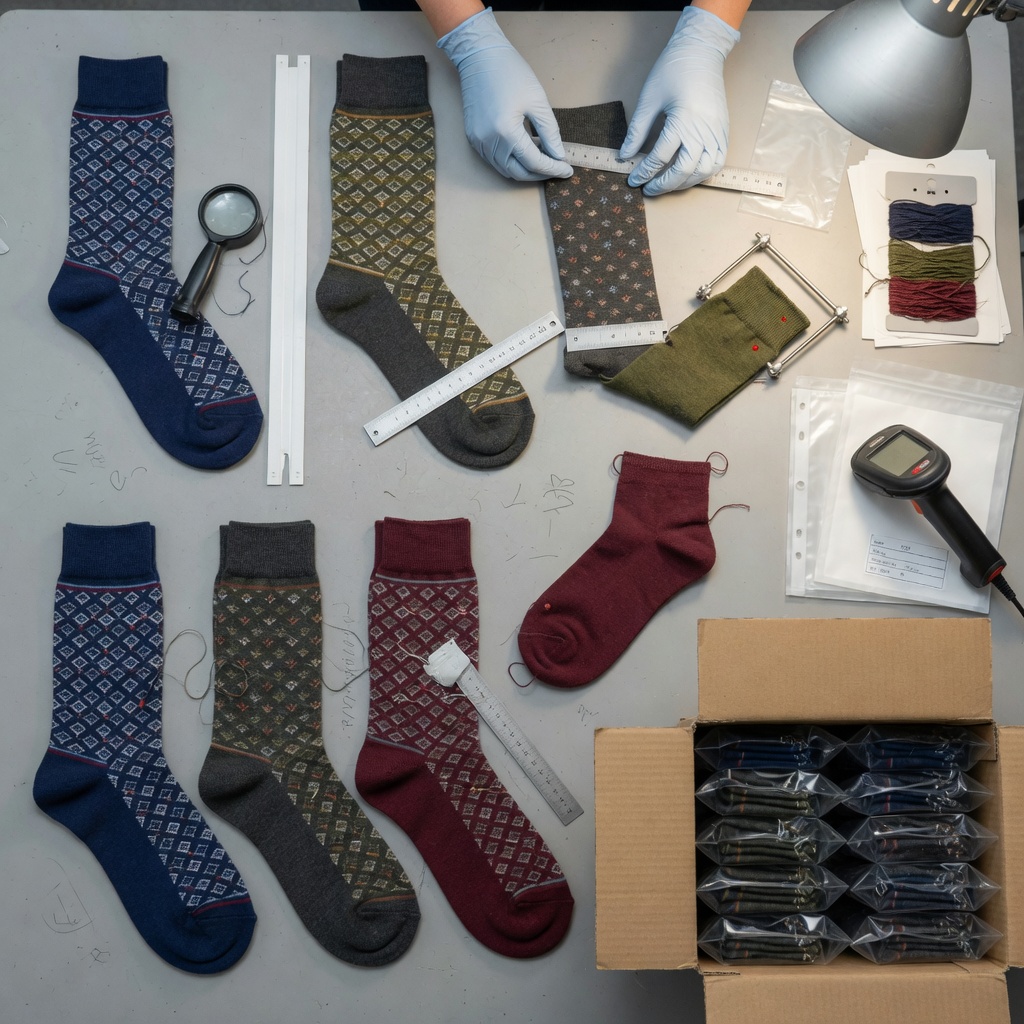
United States fashion sock quality control inspection release file
Keep the commercial and technical requirements in one revision-controlled file. That prevents inspection criteria, payment terms, and delivery decisions from relying on different versions of the order.
| Decision gate | Required RFQ or purchase-order control | Evidence for the buyer | Hold condition |
|---|---|---|---|
| Supplier award | Product, site, inspection, testing, labeling, packing, cost, remedy, and schedule fields are complete | Supplier response, deviation register, contracting entity, proposed production and packing sites, and commercial terms | A requirement is unanswered, replaced by a general quality statement, or assigned to an unidentified party |
| Bulk-production authorization | The specification, sample identity, measurement method, material declaration, color reference, and artwork revision are approved | Dated approval, controlled sample reference, measurement sheet, and approved artwork | A substitution, unresolved deviation, or changed production site has not received buyer approval |
| Final inspection | The defined lot is complete enough for inspection, samples are independently selected, and results are traceable by SKU and carton | Lot record, sample-selection record, measurements, defect counts, packing checks, and photographs | The lot is incomplete, samples are supplier-selected, traceability is missing, or a contracted limit is exceeded |
| Shipment release | Required reports are accepted and corrective actions or concessions are closed | Final reports, packing list, corrective-action record, documented concession where applicable, and written release | A failed requirement remains open or no authorized buyer representative has released the goods |
A concession should identify the affected SKU and lot, nonconformity, affected quantity, remedy, cost allocation, delivery effect, and buyer approver. It should not be inferred from informal correspondence or payment activity.
Convert fashion sock specifications into inspection criteria
A requirement is inspectable only when the RFQ states what will be checked, how it will be checked, what evidence will be retained, and what result will release or hold the lot.
| Control subject | Define before award | Inspection or test evidence | Release basis |
|---|---|---|---|
| SKU and lot identity | Buyer SKU, size, colorway, pattern, pack format, specification revision, approved sample identity, and shipment-lot definition | Product identifiers, carton traceability, approved reference, and lot record | Every sampled pair and package maps to the applicable specification |
| Fiber and yarn | Required fiber declaration, yarn description, controlled color reference, accepted evidence type, and substitution rule | Supplier declaration and, when contracted, a laboratory report tied to identified specimens | Declarations and required reports match the approved specification; no substitution remains undisclosed |
| Measurements | Measurement diagram, unit, relaxed or stretched condition, preparation procedure, measurement points, equipment, and tolerance | Results recorded against identified sampled pairs | Each result meets its point-specific tolerance or has a documented concession |
| Knit and workmanship | Knit structure, reinforcement locations, toe closure, heel position, cuff construction, and prohibited defects | Inside and outside photographs, construction observations, and defect records | Sampled construction matches the approved reference and written criteria |
| Color and pattern | Shade reference, comparison conditions, pattern orientation, placement tolerance, and any required colorfastness method | Shade comparison, placement measurements, photographs, and a method-specific report when contracted | Appearance and tested performance each satisfy their separate acceptance rules |
| Pair matching | Matching requirements for size, shade, length, heel position, pattern orientation, and presentation | Side-by-side photographs and pair-level measurements | Each sampled retail pair meets the stated matching criteria |
| Labels and packing | Artwork revision, placement, attachment, SKU mapping, barcode data, pack assortment, carton marks, and count method | Artwork comparison, barcode result, count record, package sample, and carton photographs | Sampled labels and packing match the approved files and packing schedule |
Do not record a visual shade comparison as a colorfastness result. Likewise, a supplier declaration is not a laboratory composition result unless the purchase order explicitly accepts that declaration as the required evidence.
Source evidence used for quality control inspection controls
The cited commercial pages provide possible control topics, not universal limits or proof of another supplier's performance.
| Source context | Supported use | Boundary |
|---|---|---|
| MU Group supplier article | The company describes attention to stitch density and colorfastness in its own hosiery process. Those topics can be considered when drafting a product-specific RFQ. | The article does not prove that ZheSock, another supplier, or a proposed production site follows the same process or meets an unstated threshold. |
| Minmax sock category page | The page lists possible checks involving appearance, measurements, construction, stretch, packing, yarn consistency, cuff recovery, heel placement, toe seams, pair matching, pattern alignment, knit defects, and loose threads. | The page does not establish universal tolerances, sample sizes, defect limits, or order-specific inspection results. |
| Golden Shiny sourcing article | The article recommends checking business credentials, reviewing samples for material, elasticity, and stitching, and considering independent inspection. | Those recommendations do not verify a candidate supplier's identity, capability, credentials, or production output. |
| Federal Trade Commission guidance | The guidance supports including fiber, origin, responsible-business identity, and applicable care-label controls in the buyer's review. | It is not an order-specific legal opinion, approved artwork, test result, or certification. |
| United States International Trade Commission tariff resource | The resource supports current tariff-schedule research for the actual product attributes used in an entry. | It does not establish a classification, duty rate, or landed-cost amount for an unspecified fashion sock. |
United States labeling quality control inspection gate
The Federal Trade Commission guidance discusses fiber content, country of origin, and manufacturer or responsible-business identity for covered textile products, with care labeling addressed separately (Federal Trade Commission). The importer or qualified adviser should determine the requirements, exceptions, wording, placement, permanence, and package treatment that apply to the actual product and sales format.
Separate legal approval from production inspection:
| Owner | Required action | Release evidence |
|---|---|---|
| Buyer, importer, or qualified adviser | Approve a dated labeling matrix and final artwork before printing or application | Approved matrix and revision-controlled artwork |
| Supplier | Confirm the artwork revision, label material, placement, attachment method, SKU mapping, and pack application | Line-by-line RFQ response and preproduction packaging sample |
| Inspector | Compare sampled labels, retail packs, and carton marks with the approved files | SKU-level comparison, barcode result, counts, and photographs |
| Buyer release authority | Accept the result, reject the goods, or document a concession | Written release, rejection, or concession record |
The labeling matrix should cover the substantiated fiber declaration, origin wording, responsible-business identity, care content where applicable, SKU, size, colorway, barcode data, placement, attachment, retail-pack artwork, and carton marks. Inspection can establish whether sampled production matches approved files; it cannot by itself establish that those files are legally sufficient.
Treat a certificate, audit, or test report as evidence only after checking the named holder, issuer, production-site scope, product or material scope, governing method or program, issue details, current validity, and authenticity route. A badge or general webpage claim does not establish coverage for the actual order. No certification is claimed here for ZheSock or any candidate supplier.
Define sampling and defect rules before supplier award
The cited sources do not provide a universal fashion sock sample size, measurement tolerance, test threshold, or defect limit. The RFQ must define the shipment lot, inspection unit, sample-selection method, carton and SKU distribution, defect classes, counting unit, acceptance calculation, incomplete-lot rule, corrective action, and reinspection process.
Define defects in product-specific terms. Examples may include an incorrect required label, foreign material, open toe closure, hole, mismatched pair, displaced heel, misplaced pattern, loose thread, wrong package, or damaged retail pack. The contract should state whether findings are counted by pair, package, individual defect, or another specified unit. The cited pages do not assign universal severity classes to these conditions.
The following values are illustrative buyer assumptions, not sourced benchmarks, supplier capabilities, recognized-standard requirements, or statistical recommendations. Each must be verified in the supplier quote and incorporated into the purchase order before use.
| Illustrative RFQ control | Scope, as-of context, and source status |
|---|---|
| Apply a tolerance of +/- 0.5 cm per specified measurement point | Scope: relaxed foot length and leg length for each adult crew-length SKU in the purchase-order lot. As-of context: the RFQ issue date shown on the controlled file. Source status: editorial example assumption not supplied by the cited sources; verify in the supplier quote. |
| Run 10 extension cycles per sampled cuff, allow a 30-minute rest per tested cuff, and require recovered cuff width to remain within 8% of that cuff's recorded pre-test width | Scope: cuffs sampled from the identified shipment lot using the RFQ's stated extension distance, fixture, environment, and measurement method. As-of context: the RFQ issue date. Source status: editorial example assumptions not supplied by the cited sources; verify each value in the supplier quote. |
| Independently select 80 finished pairs per identified shipment lot | Scope: the lot, SKU, batch, and carton distribution defined in the RFQ; defect limits must be stated separately. As-of context: the RFQ issue date. Source status: custom editorial sample-size assumption, not a statistically derived plan and not supplied by the cited sources; verify in the supplier quote. |
| Require the final inspection report at least 5 business days before the scheduled cargo handoff for each shipment lot | Scope: the shipment schedule identified in the quote and purchase order. As-of context: the RFQ issue date. Source status: editorial timing assumption not supplied by the cited sources; verify against the supplier's production and booking plan. |
If an acceptance-sampling standard is adopted, the purchase order should identify its exact title, edition, lot definition, inspection level, selection procedure, acceptance criteria, defect classes, and applicable switching rules. Those requirements become buyer-defined contractual controls; they are not proof of supplier certification. Passing a sample-based inspection means the selected sample met the contracted rule, not that every shipped pair was inspected.
Protect United States landed cost and delivery
Compare supplier quotes only after their cost responsibilities and dated assumptions have been normalized.
Inspection-adjusted landed cost = accepted goods value + development and setup + labels and packaging + contracted testing + inspection and reinspection + origin handling + international freight + insurance + duty and customs charges + brokerage and storage + United States domestic delivery + buyer-accepted failure costs.
| Cost input | Evidence required for comparison | RFQ control |
|---|---|---|
| Goods | Unit price by SKU, currency, quantity basis, trade term, named place, quote date, and validity | Keep quotes with different quantities or included services in separate comparison columns |
| Development and packing | Sample, setup, artwork, label, retail-pack, export-carton, and pallet charges where applicable | Mark each cost as included, separate, refundable, or repeated after correction |
| Quality evidence | Laboratory work, inspection, reinspection, documentation, rework, and repacking charges | Allocate cost for a passing result, supplier-caused failure, buyer change, and disputed result |
| Logistics | Pack configuration, carton dimensions, net and gross weight, cargo-ready place, handling, freight, insurance, and storage | Replace preliminary estimates when the approved pack configuration changes |
| United States import treatment | Proposed classification, supporting product attributes, duty treatment, customs fees, brokerage, and entry assumptions | Keep unverified codes, rates, and amounts marked as open |
| Nonconformance | Testing, segregation, correction, replacement, repacking, storage, booking changes, and unusable-goods responsibility | State the payment hold, shipment hold, remedy, evidence requirement, and approval authority |
For the actual order, the importer should verify the current classification and tariff treatment through the official United States International Trade Commission tariff resource and qualified customs advice where needed. A supplier-proposed classification or rate is an input for verification, not a landed-cost guarantee.
Delivery dates should also be tied to evidence:
| Milestone | Supplier evidence | Buyer decision |
|---|---|---|
| Approved reference | Identified sample, revision, measurements, and approval record | Authorize or continue to hold bulk production |
| Material and site readiness | Material identity, color reference, production-site confirmation, subcontractor disclosure, and planned start | Approve readiness or require resolution of a change |
| In-line inspection | Work-in-progress status, sampled items, affected batches, findings, and corrective action | Permit production to continue or hold affected work |
| Required testing | Specimen identity, method, report source, scope, result, and relationship to the production lot | Accept the evidence or hold final release |
| Final inspection | Completed-lot status, traceability, selected cartons, measurements, defects, and packing checks | Accept, reject, require correction, or authorize reinspection |
| Cargo handoff | Cargo-ready confirmation, final packing list, booking details, and release record | Release only after all contracted gates are closed |
Practical RFQ checklist for fashion sock quality control inspection
Add columns for the supplier response, evidence reference, disclosed deviation, cost effect, responsible party, due date, and buyer disposition. Check an item only when the answer is measurable and incorporated into the quote or purchase order.
- [ ] Identify the legal contracting entity, production site, packing site, disclosed subcontractors, and approval process for any site change.
- [ ] Attach the controlled specification with buyer SKU, size, colorway, pattern, pack format, revision, and approved-sample identity.
- [ ] Record the fiber declaration, yarn description, color reference, construction details, measurement method, units, and point-specific tolerances.
- [ ] Require the supplier to list every proposed substitution or deviation instead of relying on its normal production standard.
- [ ] Define each sample stage, sample cost, approval owner, revision-control method, and relationship between the approved sample and bulk production.
- [ ] Define the shipment lot, inspection unit, independent sample-selection process, carton and SKU distribution, and incomplete-lot rule.
- [ ] List prohibited defects, defect classes, counting unit, acceptance calculation, corrective action, and reinspection requirements.
- [ ] Identify each required test, specimen source, method, laboratory or evidence provider, report format, acceptance limit, and connection to the production lot.
- [ ] Attach the United States labeling matrix and approved artwork covering fiber, origin, responsible-business identity, applicable care content, SKU, size, barcode data, placement, and attachment.
- [ ] Require preproduction packaging evidence and final inspection of retail packs, assortment, counts, barcode operation, carton marks, and carton traceability.
- [ ] Obtain an itemized quote stating currency, quantity basis, trade term, named place, validity, development costs, packaging costs, inspection costs, and reinspection costs.
- [ ] Record carton dimensions, net and gross weight, pack configuration, origin handling, freight, insurance, brokerage, storage, and United States domestic-delivery assumptions.
- [ ] Mark proposed tariff classifications, duty treatment, customs charges, and other import assumptions as open until verified for the actual order.
- [ ] Allocate responsibility for failed tests, correction, replacement, repacking, storage, reinspection, booking changes, and delivery disruption.
- [ ] Define dated milestones for sample approval, material readiness, production, in-line inspection, testing, final inspection, cargo readiness, and handoff.
- [ ] State who may place a production or shipment hold, approve a concession, accept corrective action, and issue written shipment release.
- [ ] Reconcile every accepted deviation with the specification, labeling matrix, landed-cost sheet, payment terms, and delivery plan before award.
- [ ] Keep any unanswered item open and block award or shipment release when the missing response affects conformity, legality, cost, or delivery.
Methodology, evidence boundaries, and limitations
The editorial method assigned each source a limited function. The MU Group, Minmax, and Golden Shiny pages were treated as attributed commercial sources for possible process and inspection topics. The Federal Trade Commission page was treated as official United States labeling guidance. The United States International Trade Commission resource was used only for tariff-research context. The Vincent Xi author profile was used only to verify the visible author identity and Editorial Author role.
Supported topics were mapped to an RFQ requirement, inspection method, evidence file, acceptance decision, cost owner, or shipment gate. Company-specific statements were kept attributed to their publishers, and the measurable examples were labeled as assumptions because the cited sources do not supply those values.
No candidate supplier, legal entity, production site, subcontractor, fashion sock sample, purchase order, laboratory report, inspection report, labeling artwork, tariff classification, quote, shipment, or current compliance document was examined for this article. Supplier capability, legal applicability, material identity, tolerances, test methods, sampling rules, defect limits, prices, lead times, tariff treatment, and document validity must be verified for the actual United States order.
Author evidence note: The ZheSock author profile identifies Vincent Xi as Editorial Author. It does not document a factory visit, product test, quality inspection, certification, customer result, or other first-hand experience, so no such claim is made.
Discuss Your Requirements
Review our manufacturing capabilities, then share your specifications for a supplier-fit review.