Kids Sock OEM Packing Requirements for Malaysia RFQs
By Vincent Xi, Editorial Author | Author profile
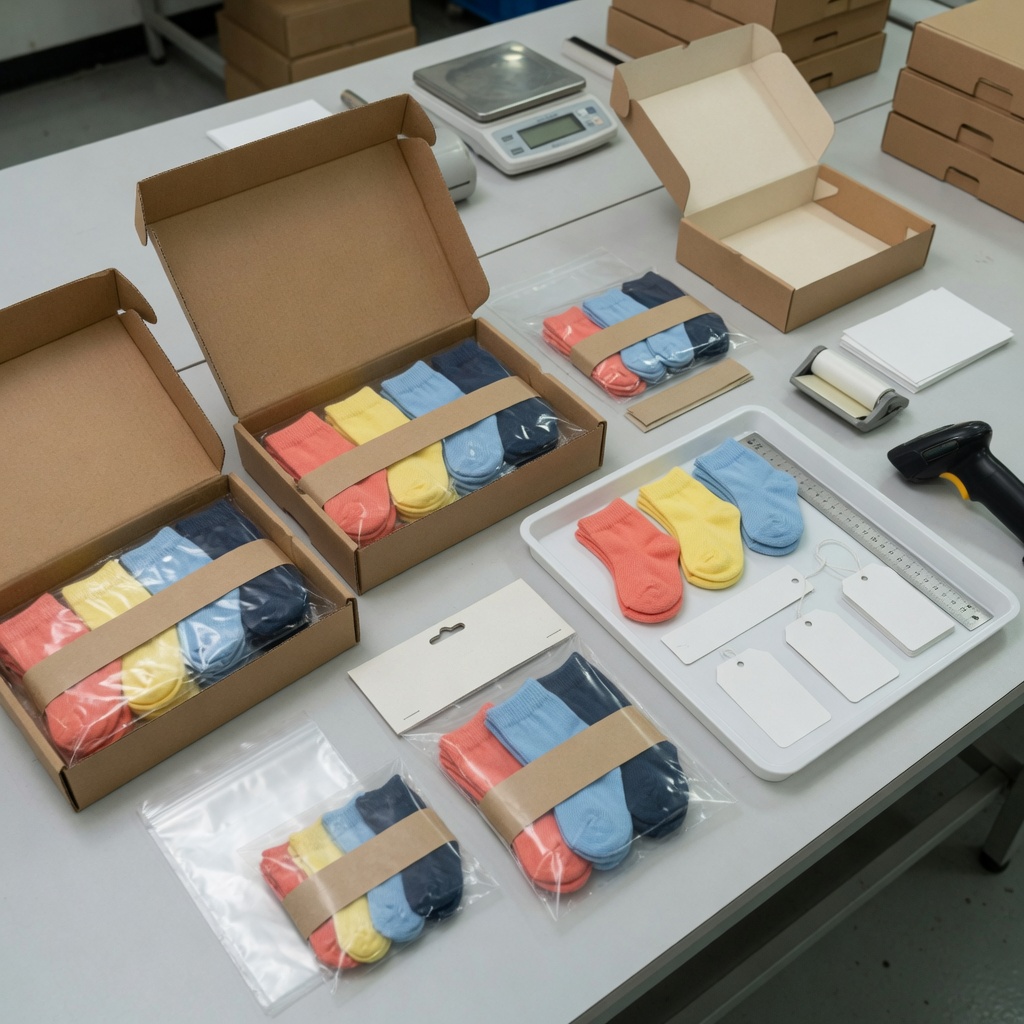
For a Malaysia-bound kids sock order, packing should be quoted as part of each SKU rather than left under a generic custom-packing promise. The kids sock OEM packing requirements in the RFQ should define the sellable pack, pair and design assortment, packaging components, component construction, artwork revision, barcode mapping, packing checks and master carton. Require the supplier to return each field as compliant, exception proposed or buyer input required so omitted details do not become unreviewed defaults.
The supplied evidence supports a limited set of format options and packing checkpoints. BEZENTO lists multipacks, polybags, paper bands, hangtags, custom boxes and retail-ready combinations, and describes checks for size group, pair count, barcode, multipack configuration and carton marks (BEZENTO). CJ Socks describes labels, tags and cartons and states that its packing QC checks for thread and dust (CJ Socks). EGE Socks describes header cards, bands, gift boxes, printed polybags and mixed-design multipacks (EGE SOCKS).
These are supplier-published descriptions of their respective offerings or practices. They do not establish Malaysian legal requirements, universal packing specifications, climate-performance thresholds or acceptance limits. Those conditions must be issued by the buyer and confirmed for the current quotation.
Malaysia kids sock packing requirements for quotation
A comparable packing quotation needs a measurable supplier return for every applicable decision. A statement that custom packing is available does not identify what is included in the price or what will be approved before production.
| Packing decision | Buyer-issued RFQ input | Required supplier return | Approval evidence |
|---|---|---|---|
| Sellable pack | Pairs per pack and the exact size, colour and design assortment for each SKU | Returned pack map showing the proposed assortment | Packed sample matching the approved pack map |
| Component set | Required bag, band, header card, hangtag, label, box or combination | Packing bill of materials naming every component and the party responsible for it | Approved component set tied to the active SKU revision |
| Component construction | Finished dimensions, units, material description, print surfaces, closure or attachment method and buyer-set tolerances | Proposed construction, tolerances and a clear exception list | Component samples and assembled-pack approval |
| Artwork | Buyer-approved copy, artwork files, colour references and revision identifier | Dieline, print method, copy placement and proof | Approved final proof linked to the SKU revision |
| Barcode | Buyer-issued code file, SKU mapping, position and verification method | Code reproduced on the final substrate with the agreed verification result | Buyer-approved result linked to the artwork and packed SKU |
| Pack assembly | Pair orientation, folding, presentation and mixed-design sequence | Packing work instruction or reference sample | Approved packed sample |
| Packing QC | Defect categories, pass conditions, sampling instruction and required records | Inspection method, record format and exception process | Agreed packing-QC attachment to the purchase order |
| Master carton | Inner-pack assortment, buyer-set mass limit and required marks | Carton dimensions, board description, gross mass, net mass, assortment and final marks | Approved cartonization sheet and marked-carton proof |
| Change control | Active revision for each packing component | Written acknowledgement of the revision and any proposed substitution | Documented reapproval after a material, construction, artwork or pack-count change |
The supplier return should distinguish included work from separate component, printing, tooling and assembly charges. It should also identify unresolved dielines, buyer-supplied artwork, component sourcing responsibilities and any constraint that could change the quoted packing basis.
Packing formats supported by the supplied evidence
Use the cited pages to identify possible formats, not to infer a finished specification. The RFQ still needs to lock construction and approval evidence for the selected format.
| Source context | Published statement retained for this RFQ | RFQ use and evidence boundary |
|---|---|---|
| BEZENTO | The page lists multipacks, polybags, paper bands, hangtags, custom boxes and retail-ready combinations. | These may be presented as selectable formats. The page does not establish dimensions, material tolerances, prices or suitability for a particular Malaysia-bound SKU. |
| CJ Socks | The page describes labels, tags and cartons within its packaging offer. | The RFQ can require coordinated component ownership and revision control. The page does not establish a component specification or destination rule. |
| EGE SOCKS | The page describes header cards, bands, gift boxes, printed polybags and mixed-design multipacks. | These descriptions can inform the format field. The page does not establish that a listed format is suitable for every product, route or retailer. |
For a polybag, lock finished dimensions, material, thickness, tolerance, closure, print or label surface, pack orientation and pair count. For a band, header card, hangtag or label, lock finished dimensions, substrate, print faces, attachment method, artwork revision and product orientation. For a box, lock internal and external dimensions, board construction, opening method, insert, print surfaces and product fit. For a multipack, lock the exact pair sequence, design assortment, component hierarchy and outer identifier.
If the supplier, buyer or another nominated party supplies a component, state who controls final artwork, delivers approved material to the packing line, verifies identifiers and replaces rejected components. The quotation should not leave those responsibilities implied.
Packing QC requirements and release evidence
BEZENTO describes packing-stage checks for size group, pair count, barcode, multipack configuration and carton marks (BEZENTO). CJ Socks separately states that its packing QC checks for thread and dust (CJ Socks). These citations support the checkpoint names, but they do not supply a sampling level, defect classification or pass threshold.
The buyer should convert each applicable checkpoint into a stated condition and required record:
| Checkpoint | Buyer-set condition | Supplier evidence and hold action |
|---|---|---|
| Pair count | The sellable pack contains the approved quantity and complete pairs | Record the count and hold an affected SKU when it differs from the approved pack map |
| Assortment | Sizes, colours and designs match the approved SKU assortment | Record the assortment by SKU and segregate mixed or unidentified packs |
| Size identification | The product size group matches the attached or printed identifier | Compare the packed sample with the approved SKU record and block mismatches |
| Barcode | The buyer-issued code maps to the correct SKU and passes the agreed method on the final substrate | Link the result to the code file, artwork revision and packed SKU; reverify after a relevant change |
| Artwork | Copy, placement, orientation and revision match the approved proof | Retain the approved production reference and remove obsolete artwork from use |
| Attachment or closure | The component uses the approved assembly method | Record the assembly check and obtain reapproval after a construction change |
| Cleanliness | The pack meets the buyer-defined visual condition for loose thread and dust | Record the inspection and segregate nonconforming packs for disposition and reinspection |
| Multipack composition | Pair sequence and design mix match the approved pack map | Check composition before final closure and segregate packs that cannot be verified |
| Carton contents and marks | Inner-pack assortment and carton marks match the approved cartonization sheet | Retain a closed-carton record and marked-carton image; hold cartons with unidentified contents or unapproved marks |
| Exceptions | Nonconforming packs follow the agreed identification, segregation, disposition and reinspection process | Maintain an exception log and close applicable exceptions before shipment release |
No sampling standard or acceptance level is assigned here because the supplied evidence does not establish one. The buyer should state the method and pass conditions in the RFQ or purchase order rather than rely on an undocumented supplier default.
Example assumptions for a Malaysia packing quote
Every exact value below is an editorial example assumption for an illustrative Malaysia-bound kids sock SKU as of the buyer-entered RFQ issue date. None is stated by the cited supplier pages. Each value must be replaced or confirmed in the current supplier quotation, measurable component return and approved packed sample.
| Example value and scope | As-of context and source status | Supplier verification required |
|---|---|---|
| 3 pairs per sellable inner pack for the illustrative SKU | As of the buyer-entered RFQ issue date; editorial RFQ assumption, not a value from the cited sources | Confirm capacity, assortment, component construction, price and barcode mapping |
| 50 mm finished width x 80 mm finished height for the illustrative SKU's hangtag | As of the buyer-entered RFQ issue date; editorial RFQ assumption, not a value from the cited sources | Return the finished dimensions, tolerance, substrate, dieline and attachment method |
| 30 micrometres nominal film thickness for the illustrative SKU's individual polybag | As of the buyer-entered RFQ issue date; editorial RFQ assumption, not a value from the cited sources | Confirm material, nominal thickness, tolerance, closure and finished dimensions |
| 48 inner packs per master carton x 3 pairs per inner pack = 144 pairs per master carton for the illustrative cartonization calculation | As of the buyer-entered RFQ issue date; editorial example calculation, not a value from the cited sources | Confirm actual pack fit, carton dimensions, gross mass, net mass and final assortment |
These values are quotation prompts, not released specifications. Approval depends on the supplier's returned construction and evidence for the same SKU and artwork revision.
Malaysia destination packing requirements
The supplied sources do not provide Malaysian statutory text, a mandatory label language, customs-document rules, prescribed carton marks or route-performance thresholds. The RFQ should therefore separate buyer-approved destination inputs from supplier production data without presenting either as a legal requirement established by these sources.
| Destination field | Buyer-controlled input | Supplier return and approval control |
|---|---|---|
| Sales destination and receiving entity | Malaysia and the buyer-approved receiving entity | Reproduce the approved destination details on the carton-mark proof where instructed |
| Consumer-facing copy | Final wording, language and placement approved by the buyer's Malaysia compliance owner | Return exact artwork placement on each applicable component before printing |
| Country-of-origin wording | Buyer-approved wording based on the actual manufacturing origin | Confirm the origin information before artwork approval and do not reuse another SKU's wording without review |
| Barcode-to-SKU map | Final code file, SKU assignment and verification method | Reproduce and verify the code on the final substrate; reapprove after a code, substrate, position or artwork change |
| Carton marks | Buyer-issued fields, format and placement | Return a final marked-carton proof tied to the purchase order and assortment |
| Route and storage conditions | Conditions supplied by the buyer or its logistics owner | Propose a packing response and supporting evidence against those stated conditions |
Do not infer a film barrier, desiccant, storage limit or other climate-related performance claim merely from the Malaysia destination. Such a requirement needs a buyer-issued condition, an agreed evaluation method and a supplier result. Any requested certification should be assessed from its current document, holder and stated scope; no certification is implied by the cited pages.
Practical RFQ checklist for packing requirements
Apply this checklist separately to every quoted kids sock SKU. An unchecked item remains open and should not be treated as a supplier-approved default.
- [ ] Identify the SKU, size group, colourway, design assortment and active specification revision.
- [ ] State the required pairs per sellable pack and the exact sequence for any mixed-design multipack.
- [ ] List every required bag, band, header card, hangtag, label, box, insert and master carton in the packing bill of materials.
- [ ] Assign sourcing responsibility for every component to the buyer, supplier or other nominated party.
- [ ] Specify finished component dimensions with units, material descriptions, buyer-set tolerances, closures and attachment methods.
- [ ] Attach the active artwork files, approved copy, colour references and revision identifiers for each printed component.
- [ ] Issue the barcode-to-SKU map and state the required position and verification method on the final substrate.
- [ ] Define sock orientation, folding, pair matching, presentation and pack-assembly sequence.
- [ ] State packing-QC checkpoints, defect categories, pass conditions, sampling instructions, record format and hold procedure.
- [ ] Provide buyer-approved Malaysia destination copy, country-of-origin wording and carton-mark fields where applicable.
- [ ] State any buyer-issued route or storage condition that requires a proposed packing response; do not infer climate thresholds from destination alone.
- [ ] Require the supplier to return carton construction, internal assortment, dimensions, gross mass, net mass and final marks.
- [ ] Require separate disclosure of component, printing, tooling and assembly charges, including exclusions and quantity constraints.
- [ ] Ask the supplier to mark every checklist line as compliant, exception proposed or buyer input required.
- [ ] Obtain the dieline, artwork proof, component samples, assembled packed sample, barcode result and marked-carton proof required for approval.
- [ ] Confirm that the quotation, artwork, packing bill of materials, packed sample, QC criteria and cartonization sheet use the same SKU revision.
- [ ] Close or formally disposition every packing exception before shipment release.
The completed checklist should be attached to the quotation or purchase order with document identifiers for the supporting evidence. A general statement such as custom packing available does not close any checklist item.
Compare supplier quotes on the same packing basis
Commercial comparison is reliable only when suppliers price and evidence the same component set.
| Comparison field | Required quotation return |
|---|---|
| Packing bill of materials | Every bag, band, card, tag, label, box and carton, including the responsible party and active revision |
| Price basis | Component, printing, tooling and assembly charges, with inclusions and exclusions stated |
| Component constraints | Any minimum quantity, artwork dependency or timing constraint that affects the quoted packing option |
| Proof and sample route | Dieline, artwork proof, component sample and assembled packed-sample stages, including the approving party |
| Barcode evidence | Verification method and result on the final packing substrate for the quoted SKU |
| Packing QC | Applicable checkpoints, buyer-set conditions, sampling instruction, record format and exception handling |
| Cartonization | Inner-pack assortment, carton construction, dimensions, gross mass, net mass and approved marks |
| Substitution control | Written process for proposed material, construction, artwork, identifier or pack-count changes |
Release the packing specification only when the quotation, packing bill of materials, approved artwork, barcode result, packed sample, packing-QC criteria and cartonization sheet identify the same SKU revision. A pending destination field, unpriced component or unapproved substitution keeps the packing requirements open.
Source context, methodology and limitations
Author context. The ZheSock author profile identifies Vincent Xi as an Editorial Author. The profile does not document factory visits, laboratory testing, certifications, client outcomes or personal production experience, so no first-person experience claim is made.
Source contexts. BEZENTO is used only for its published descriptions of packing formats and checks involving size group, pair count, barcode, multipack configuration and carton marks (BEZENTO). CJ Socks is used only for its descriptions of labels, tags and cartons and its statement about checks for thread and dust (CJ Socks). EGE Socks is used only for its descriptions of header cards, bands, gift boxes, printed polybags and mixed-design multipacks (EGE SOCKS).
Methodology. Explicit packing-component and packing-QC statements were retained from the supplied pages, attributed to the page that states them and translated into buyer inputs, supplier returns, checklist actions and approval evidence. Unsupported dimensions, tolerances, acceptance thresholds and Malaysia-specific rules were excluded. Exact values appear only as clearly labelled editorial assumptions or calculations requiring confirmation in the current supplier quote.
Limitations and verification. The cited pages are supplier-published descriptions, not independent test reports or Malaysian legal guidance. They do not establish destination copy, statutory warnings, component dimensions, film thickness, carton capacity, mass limits, climate performance, sampling levels or defect classifications. The buyer's designated Malaysia compliance and logistics owners should confirm applicable destination content and route conditions. Check exact values against the current quote, approved components, packed sample and cartonization result. Reapprove material substitutions, revised artwork, identifier changes and changed pack counts before release.
Discuss Your Requirements
Review our manufacturing capabilities, then share your specifications for a supplier-fit review.