Kids Sock Sourcing Customization Options for Europe
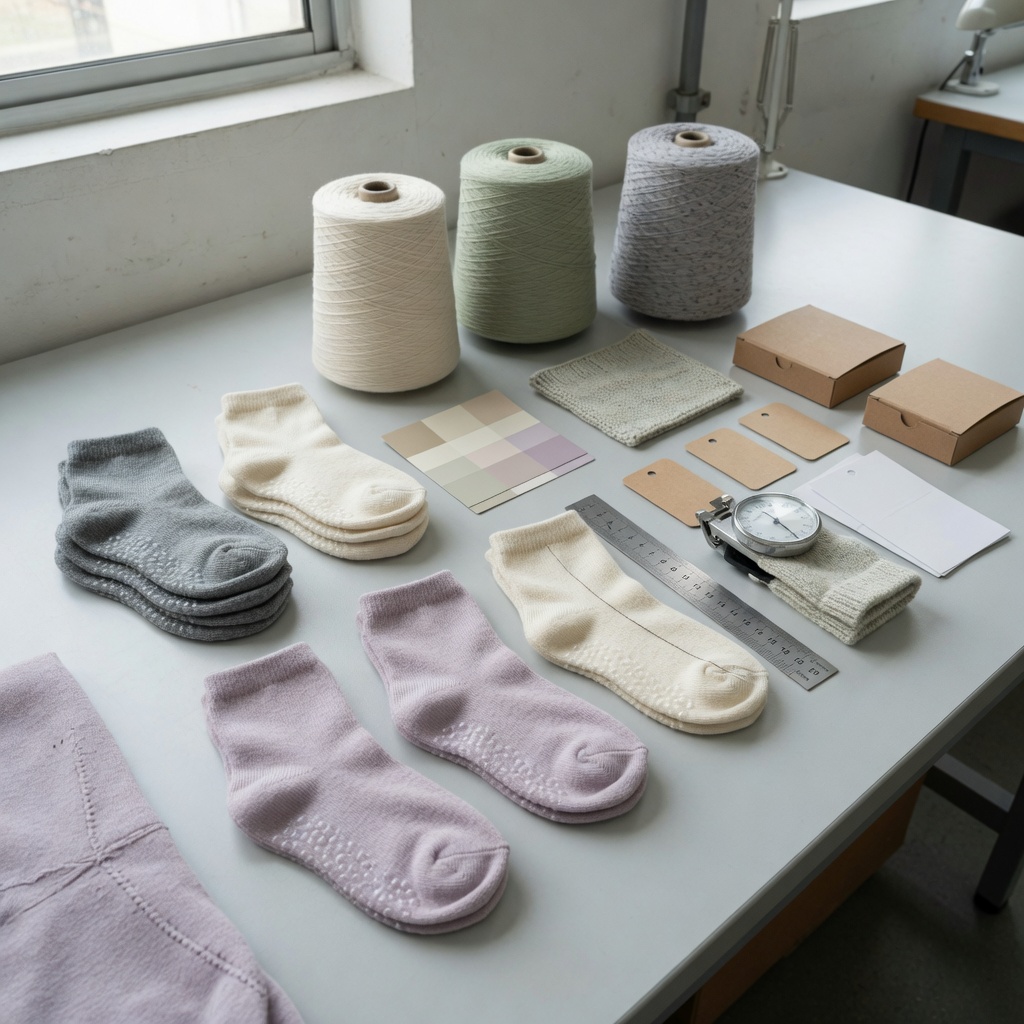
Kids Sock Sourcing Customization Options for European Buyers
By Vincent Xi, Editorial Author, ZheSock
Kids sock sourcing customization options for European procurement include fibre and yarn, Pantone colour with knitted lab dips, millimetre size and fit, knit construction, silicone anti-slip, logo method, and packaging that can carry EU, EEA, or UK fibre and traceability information. Those six RFQ blocks are the answer European B2B buyers need before branded kids sock quotes can be compared: each lever changes unit cost, calendar, and whether the goods can be placed on the named first-placement market.
Public OEM and ODM listings for kids socks describe those levers. They do not share one minimum order quantity (MOQ) or one production calendar. Choose the path first, then issue a single RFQ.
- Artwork-led custom path (one catalog listing): 100 pairs MOQ and 7–14 calendar days turnaround, as stated on the Sockrates custom baby socks page. Units: pairs and calendar days. Scope: that listing only. As-of: undated catalog page, not independently dated in this article. Reconfirm in the quote.
- Reserved-yarn OEM path (one catalog listing): flexible MOQ from 2,000 pairs with mixed sizes, 15-day sampling, and 60–90 day bulk production, as stated on the FutureStitch children's socks page. Same units, listing-only scope, and undated-page as-of rule. Those figures are not a European industry average and are not ZheSock offers.
Certified yarn, silicone grips, or a country-specific hang tag can take the shorter catalog path out of contention. This page stays on kids sock sourcing customization options for European B2B buyers: what to specify, which trade-offs are measurable, and what to verify before a purchase order. It does not treat the EU, EEA, and UK as one legal zone.
Customization options that belong in a European kids sock RFQ
Group the first RFQ into six blocks. Quotes that omit a block are not comparable.
Fibre, yarn, and hand-feel. State fibre percentages by weight using the legal names that will appear on the consumer label, yarn grade (for example combed cotton), elastane in cuff and body, and face construction (plain knit, terry, rib). Cited children's OEM pages list cotton and polyester blends and treat premium or organic cotton as a selectable yarn on at least one custom program (FutureStitch children's socks; Sockrates custom baby socks). Softness, breathability, and durability remain marketing aims until a method, tolerance, and report are named. On an EU or EEA fibre label, do not substitute mill names such as nylon or spandex for the legal names polyamide and elastane.
Colour and pattern. Yarn-dye, piece-dye, jacquard, cartoon or seasonal prints, and photo-real prints are different processes. If brand colour is contractual, require Pantone codes plus a knitted lab dip. One custom program states full Pantone matching and non-toxic dyes as options (Sockrates custom baby socks). "Non-toxic" is not a test method; name REACH-relevant or UK REACH-relevant limits and laboratory methods on the same line.
Size and fit. Map age bands and EU shoe sizes to finished foot length, cuff height, and stretch opening in millimetres. OEM listings describe custom sizing from newborns to growing children by age and shoe size, and mixed-size orders appear on more than one program (FutureStitch children's socks; Jixingfeng OEM kids socks).
Construction and function. Specify heel and toe reinforcement, toe-close method, and toddler non-slip grips when the SKU is indoor. One OEM page lists reinforced heels and toes, non-slip grips, moisture-wicking styles, and lace or fashion variants as selectable features (Jixingfeng OEM kids socks). Treat those as process options, not as proven wear results.
Branding method. Knit-in, print, embroidery, and hang-tag-only brand are not interchangeable for wash durability or for small-part risk on younger age grades. State placement, artwork format, and whether any 3D part will be used on socks intended for children under 36 months.
Packaging and private label. Hang tags, header cards, polybags, and gift boxes must reserve space for legal fibre names, care, importer or responsible-person identity, batch code, and any national packaging marks. Manufacturer listings describe hang tags, gift boxes, branded retail packs, labels, and header cards (FutureStitch children's socks; Sockrates custom baby socks). Those are pack formats, not proof that a default tag meets the first-placement country kit.
Freeze those six customization options first. Tests, AQL, and Incoterms then prove the chosen options are deliverable.
Europe product rules that change the kids sock spec, not a single certificate
Kids socks sold as apparel are normally textiles, not toys, unless they are designed or presented with play value that pulls them into toy law. Do not use EN 71 as a stand-in for fibre labelling or chemical restrictions. Ordinary children's socks are also not PPE unless a protective function is claimed. The duties below change the RFQ. They are not mill marketing language, and they are not interchangeable across Europe.
EU. Fibre names and composition labelling for textile products made available in the EU are set by Regulation (EU) No 1007/2011. The fibre label must use the regulation's fibre names and must be in the official language or languages of the Member State where the product is made available, unless that Member State provides otherwise. Use that regulation's own manufacturing tolerances; do not write an unofficial mill tolerance into the RFQ that conflicts with the named instrument.
Chemical restrictions for dyes, residuals, and next-to-skin clothing sit primarily in REACH (Regulation (EC) No 1907/2006). Annex XVII entries that commonly affect kids sock programs include Entry 43 (certain azo colourants; listed aromatic amines at 30 mg/kg, unit milligrams per kilogram of the textile component, scope the Annex XVII azo restriction, source Entry 43) and Entry 72 (selected CMR substances in clothing, related accessories, and other skin-contact textiles, including socks as apparel). Entry 72 has applied since 1 November 2020 (Commission Regulation (EU) 2018/1513), including a formaldehyde limit of 75 mg/kg in the restricted clothing/textile category. Name the entries and methods in the quote rather than a generic "REACH compliant" line.
From 13 December 2024, the General Product Safety Regulation (EU) 2023/988 applies to consumer products placed on the EU market (that regulation's application date). It requires a safe product, identifiable economic operators, and traceability, including an EU-established responsible person where the manufacturer is not established in the EU. GPSR does not replace REACH or Regulation (EU) No 1007/2011, and it does not by itself create a CE mark for ordinary socks.
EEA. Regulation (EU) No 1007/2011 and REACH are EEA-relevant textile and chemical files for Iceland, Liechtenstein, and Norway, but they still require a country-level label language check. Do not assume that GPSR's EU application date of 13 December 2024 automatically applies in the same form in every EEA state; confirm the EEA instrument in force for the first-placement state named in the RFQ.
UK. Great Britain does not treat EU CE marking as the default conformity route for ordinary consumer socks. Fibre composition labelling follows UK textile-labelling rules (Textile Products (Labelling and Fibre Composition) Regulations 2012 and related retained law). Chemicals follow UK REACH, which is not automatically the same dossier as EU REACH, including for Entry 43 or Entry 72 analogues. Northern Ireland may follow selected EU goods rules under the Windsor Framework. Do not reuse one label file for GB, NI, and EU placements without a review.
Country overlays. Packaging and extended-producer-responsibility marks are not fully harmonised. France's household-packaging sorting information (Triman / Info-tri in commercial practice) can change hang tags and polybags even when the sock meets EU fibre and REACH rules. Name the first-placement country in the RFQ so the mill prints the correct label kit. A France-ready pack is not evidence that the same file is correct for GB-only or for another EU Member State.
Legal requirements (fibre names, restricted substances, general safety, importer identity) are not the same as a mill's own practice (in-house "hypoallergenic" language, or voluntary schemes such as GOTS). One OEM page states skin-friendly cotton blends that "meet international safety and hypoallergenic standards" (Jixingfeng OEM kids socks). That sentence is not a standard number. Ask for the named method and a current report covering the bulk yarn and dye lot.
Material, dye, and documentation trade-offs
Cited children's OEM pages start from cotton-rich blends, with polyamide or polyester and elastane added for recovery. That choice changes shrinkage, pilling, and print uptake. If the brand needs an organic claim, one listing names GOTS organic cotton as an option (Sockrates custom baby socks). GOTS is a voluntary chain-of-custody standard. Accept it only when the yarn lot is covered by a current scope certificate and transaction certificate. A mill's own organic wording is not a GOTS claim.
Write dye and residual requirements as REACH Annex XVII conformity for relevant entries and/or UK REACH as the placement market requires, plus the brand restricted-substance list (RSL), and name methods (for example EN ISO 14362 for certain azo dyes; EN ISO 105 series for colourfastness). Those ISO methods are buyer-specified test methods, not a substitute for the legal instruments above. For kids' next-to-skin use, add colourfastness to perspiration and, where the retailer file requires it, saliva as quote line-items rather than as implied law. For Pantone matching, state illuminant, a numeric Delta-E limit, and knitted-dip approval. Paper chips do not predict terry or heather. Example matching rule (assumption to verify in the supplier quote, not a mill default): CIEDE2000 of 1.5 under D65/10° on a knitted dip of the bulk yarn and stitch.
Silicone anti-slip dots are a second bill of materials. Include the grip compound in the chemical file against the brand RSL and the REACH or UK REACH restrictions that apply to that component, and state a wash-cycle target. Example wash target (assumption to verify in the quote, not a legal limit): 20 cycles under a named ISO 6330 procedure, with photos of remaining dots. Decorative prints and DTG inks add their own tests. Tighter chemical and organic documentation can raise MOQ because mills will not split certified lots. Faster uncertified colour can quote shorter and then fail European retailer onboarding.
Example fibre line (assumption to verify in the supplier quote, not a mill claim): 80% cotton / 17% polyamide / 3% elastane by weight. Replace it with the mill's knit-able blend and the legal fibre names that will appear on the EU, EEA, or UK label for the named first-placement market.
Size runs, construction, and functional features
Ask for a measurement chart with age band, EU shoe-size range, unstretched and stretched foot length in millimetres, cuff height, leg opening, and a numeric tolerance to confirm. Example tolerance (assumption to verify in the quote, not a factory standard): ±3 mm on unstretched foot length.
OEM pages describe custom sizing from newborns through growing kids (FutureStitch children's socks). One custom program states that newborn to youth sizes can be combined in one order (Sockrates custom baby socks). Combining sizes helps a European e-commerce curve only if the size ratio is written in pairs. A mixed-size starting lot of 2,000 pairs, as stated on the FutureStitch listing, is not eight equal buckets unless the RFQ says so.
Tech-pack construction lines that change price and complaints: gauge or cylinder description; heel/toe reinforcement yarn; toe close (linked vs overlocked) and seam on top or under; rib versus terry zones; elastane in arch and cuff; toddler grip map (full sole vs heel-and-ball). Cartoon and seasonal patterns listed as private-label design options should be separate artwork SKUs.
Example assortment (to verify in the quote, not a factory promise): eight EU size breaks × 250 pairs = 2,000 pairs, matching one published mixed-size starting MOQ of 2,000 pairs. If the curve is heavy on EU 23–26, that equal split is wrong and the mill should re-quote.
Private-label packaging for EU, EEA, and UK retail
Specify primary pack type; language set for first-placement markets; fibre composition using legal fibre names under Regulation (EU) 1007/2011 (EU, and EEA where that regulation applies) or UK fibre-labelling rules (GB); care symbols; name and address of the EU responsible person or importer for EU placement, and the UK equivalent for GB placement; batch or lot code; and destination packaging marks (France is a frequent extra household-pack step, not a Europe-wide mark).
OEM listings mention hang tags, gift boxes, header cards, and labels. Those are process options, not proof that the default tag meets French sorting rules or a UK importer-address rule. Approve a packaging sample in the bulk material. Incoterms must match who actually places the socks on the named market: EXW or FOB does not move EU GPSR or GB importer duties onto the mill unless the contract says so and that party is established where the rule requires.
Kids sock sourcing customization options: MOQ, sampling, and lead time
| Customization lever | What to specify | Measurable trade-off | Verify before purchase order |
|---|---|---|---|
| Colour / Pantone | Pantone codes; knitted lab dip; Delta-E; illuminant | Extra dip rounds add calendar days | Signed knitted dip; dye-lot hold; REACH-relevant or UK REACH dye file |
| Fibre / yarn | Fibre % by weight in legal names; yarn grade; organic claim if any | Certified lots can raise MOQ and yarn lead time | Current certificates if GOTS or similar is claimed; shrinkage method |
| Size assortment | EU size, mm length, pairs per size | Pair MOQ can be met while the hero size is short | Cylinder list; whether leftover sizes are billable |
| Anti-slip grips | Dot map; wash cycles; age grade | Extra process and chemical file | Photos after the stated wash count; grip compound in the RSL pack |
| Logo / pattern | Knit-in, print, or embroidery; placement | Print paths can quote lower pairs but change ink tests | Strike-off wash test; small-part review if 3D parts for under 36 months |
| Packaging | Dieline; languages; importer/responsible person; sorting marks | Printed packs often have a separate MOQ | Packaging sample; country variant |
| Quantity | Pairs per colourway and size | Published children's programs in this research: 100 pairs on one custom baby/youth listing; from 2,000 pairs mixed sizes on one OEM listing | Written confirmation after your colour/size split |
| Calendar | Sample date; bulk ex-works date | Supplier-stated 7–14 day or 15-day sample windows and 60–90 day bulk on one OEM listing are not fabric-reservation dates | Written path: tech-pack freeze → dip → PPS → bulk |
The 100-pair, 7–14 day custom path on the Sockrates listing is consistent with an artwork- and knit/print-led program (Sockrates custom baby socks). The 2,000-pair mixed-size OEM path with 15-day sampling and 60–90 day bulk on the FutureStitch listing is consistent with a reserved-yarn program (FutureStitch children's socks). If the European retailer needs certified yarn, silicone grips, and a France-compliant hang tag, the short path may drop out of the quote. Neither calendar is a fabric-reservation date until the mill writes the freeze sequence against this construction.
RFQ checklist for European kids sock procurement
Every item should return a yes, a number with unit, or a file name.
- Silhouette: ankle / crew / knee; indoor anti-slip or not.
- Age grade and EU shoe-size run, with pair ratio per size.
- Finished measurements in millimetres, with tolerances to confirm.
- Fibre composition in legal names and percent by weight (replace any example blend in the quote).
- Yarn grade (combed, carded, organic) and whether a named voluntary standard is required.
- Colour list as Pantone; state if heather is allowed.
- Lab-dip rules: knitted dip, revision count, freeze date, illuminant, Delta-E.
- Pattern method: jacquard, screen, DTG, or knit-in logo.
- Heel/toe reinforcement: yes/no and yarn type.
- Toe close and seam placement.
- Toddler grip map, colour, wash-cycle target, and grip compound in the chemical file.
- Branding: on-sock logo versus pack-only; any 3D part for under 36 months.
- Confirmation the SKU is apparel, not presented as a toy, unless a toy file is intentionally in scope.
- Packaging dieline: pack type, fibre label, care, batch code.
- Official language(s) of the textile fibre label for each first-placement Member State, EEA state, GB, and/or Northern Ireland.
- First-placement markets listed separately: named EU member state(s), EEA state(s), GB, and/or Northern Ireland — not "Europe" as one line.
- Name and address of the EU responsible person or importer for EU placement, and the GB equivalent where goods are placed on the GB market.
- Chemical file: EU REACH and/or UK REACH statement as the market requires, including named Annex XVII entries where relevant; brand RSL; report date policy; named methods.
- If GOTS or another voluntary standard is requested: certificate numbers and whether the bulk yarn lot is in scope.
- Quantity in pairs per colourway and per size, not only a grand total.
- Samples: size-run sample, pre-production sample, packaging sample in bulk materials.
- Lead time in calendar days from PPS approval to ex-works; do not rely on catalog 7–14 day or 15-day sample claims without applying them to this construction.
- AQL and defect list: holes, dye spots, missing grip dots, measurement, label errors.
- Carton assortment and mixed-size billing rules.
- Incoterms, payment, which party places goods on the named market, and which party pays third-party textile-lab tests.
Evidence basis, method, and limits
Author. Vincent Xi, Editorial Author. Profile: https://www.zhesock.com/authors/vincent-xi/. This page does not claim mill visits, laboratory tests, years of factory work, awards, or named customer results.
Source contexts. (1) Public OEM/ODM children's-sock and custom baby/youth manufacturer listings that describe customization, pair MOQs, and day counts: FutureStitch children's socks, Jixingfeng OEM kids socks, and Sockrates custom baby socks. Those URLs are third-party catalog pages used as examples of published levers, not as ZheSock SKUs or endorsements. (2) Named EU, EEA-relevant, and UK instruments on textile fibre labelling, chemicals, and general product safety, plus national packaging overlays such as France's household-packaging sorting information.
Method. Options on the cited listings were mapped to RFQ fields. Legal duties are taken from the named regulations and kept separate from mill marketing language. Exact pair, day, mg/kg, and calendar-date figures are reproduced with unit, scope, and source or are labelled as example calculations/assumptions to verify in the supplier quote. Listing MOQs and lead times are catalog claims on undated pages; they are not independently dated here.
Limits. Catalog MOQs age quickly and may exclude extra colourways, grips, or certified yarn. Voluntary marks are invalid without a document on the bulk lot. EU 1007/2011 labelling does not by itself place goods in GB. GPSR (EU application from 13 December 2024) does not replace REACH and should not be copied onto an EEA or GB file without a market-specific check. French packaging marks do not apply automatically to a GB-only shipment. UK REACH is not an EU REACH dossier. Require a written quote, signed lab dip, PPS, and chemical file before bulk.
Discuss Your Requirements
Review our manufacturing capabilities, then share your specifications for a supplier-fit review.