Kids Sock Sourcing Packing Requirements for United Arab Emirates Procurement
By Vincent Xi, Editorial Author
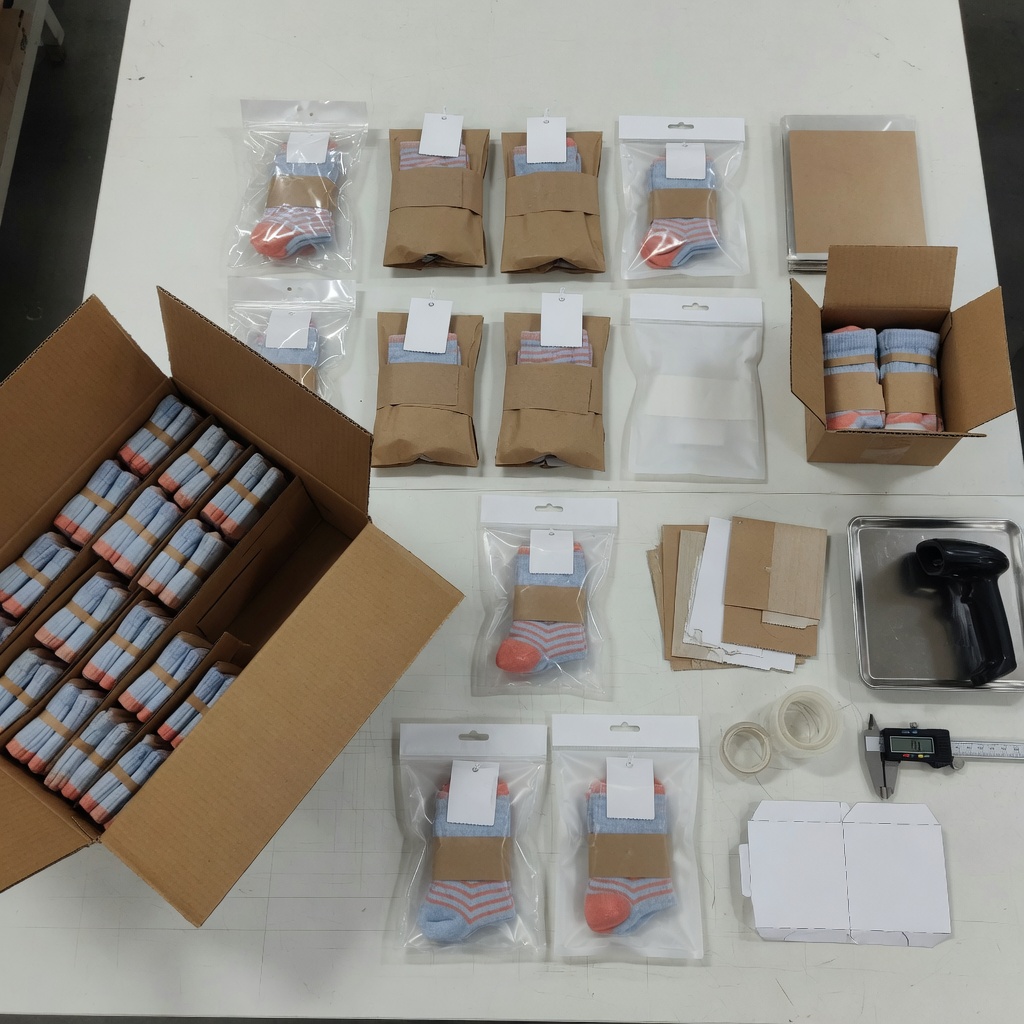
For United Arab Emirates kids sock procurement, lock the pack-out before asking suppliers to price the order or prepare production-intent samples. A SKU-level matrix should define the retail format, pairs per sellable unit, approved assortment, packaging material and construction, controlled artwork data, inner-pack and master-carton quantities, measurement basis, quote breakdown, approval evidence, and change control.
Require suppliers to return measurements from physical packed samples, itemized packaging costs, and every deviation from the RFQ. Keep artwork approval separate from approval of the packaging material, assembled retail pack, and trial master carton.
The supplied evidence supports packaging-format examples and undated carton benchmarks. It does not establish a UAE-specific packaging rule, mandatory label wording, customs-document set, duty or tax rate, climate-performance threshold, freight rate, or delivery interval. Destination-controlled fields therefore remain pending until the UAE buyer's importer or appointed customs broker confirms them for the actual product and shipment.
Set kids sock sourcing packing requirements for United Arab Emirates RFQs
Use the following pack-out matrix as a procurement control, not as a legal standard. Attach the completed version to the RFQ, sample request, purchase order, and production release so that every supplier quotes the same packaging basis.
| Pack-out field | Buyer controls | Supplier returns | Release evidence |
|---|---|---|---|
| SKU and assortment | Style reference, size grading, design reference, pairing, folding, orientation, and permitted mixed assortment | Confirmation by SKU, with substitutions and deviations identified | Packed sample and assortment record |
| Retail unit | Package format, pairs per sellable unit, material, construction, finish, closure, and buyer-defined tolerance | Filled and closed dimensions, gross packed mass, measurement method, and observed results | Assembled production-intent sample and measurement record |
| Artwork and data | Controlled dieline, artwork version, barcode data, SKU, size, and buyer-approved destination fields | Proof reproducing supplied data and marking unresolved fields as pending | Approved proof and scan result from the packed sample |
| Inner pack and master carton | Pack quantities, assortment rule, carton construction, sealing, dimensional limits, mass limits, and required marks | Trial pack-out, external and usable internal dimensions, net mass, gross mass, and orientation | Trial master carton and pack-out record |
| Commercial return | Packaging materials, printing, conversion, assembly, setup, MOQ, unused-material treatment, samples, lead time, and delivery term | Itemized dated quote with currency, validity, assumptions, exclusions, and deviations | Buyer-approved quote aligned with the matrix |
| Change control | Fields that cannot change without written approval | Deviation request identifying affected SKUs, cost, schedule, measurements, and supporting evidence | Revised proof, sample, or carton record approved before use |
Assign a separate matrix row to each SKU or permitted mixed assortment. During proofing, keep unresolved content visibly marked as pending rather than allowing the supplier to infer it.
For comparable measurements, require the supplier to:
- Measure the retail package filled and closed, using the buyer's stated dimensional unit.
- Report retail-package gross mass in the buyer's stated mass unit.
- Distinguish master-carton external dimensions from usable internal dimensions.
- Distinguish carton net mass, gross mass, and packaging-only mass where requested.
- Identify whether each quantity means pairs, sellable units, inner packs, or master cartons.
- Record the measuring instrument, sample quantity, observed results, buyer-defined tolerance, and treatment of damaged or incomplete samples.
These are editorial RFQ controls, not claims about a cited supplier's measurement practice.
Choose a quote-ready retail pack
Taken together, the supplied EGE Socks and SaySock excerpts identify header cards, multipack bands, gift boxes, polybags, sleeve wraps, hang tags, and pouches as available packaging formats. The EGE Socks excerpt also describes mixed-design multipacks for children's ranges. These are format examples from commercial sources, not commitments for a specific UAE order.
| Format under review | RFQ variables that require a decision | Approval evidence |
|---|---|---|
| Bulk polybag | Pairs per bag, material description, construction, closure, finished dimensions, and required declarations | Applicable material document, sealed sample, and measurement record |
| Header card or hang tag | Dieline, substrate, attachment method, hanging orientation, artwork version, and barcode position | Printed proof, attached sample, hanging review, and scan result |
| Sleeve or multipack band | Pairs per unit, sock orientation, material, overlap or closure, and approved assortment | Assembled sample, gross packed mass, measurements, and assortment check |
| Pouch or gift box | Construction, material, closure, inserts, finish, and buyer-defined condition criteria | Finished pack and trial-carton record |
| Mixed-design multipack | Permitted design and size combinations, substitution rule, and sellable-unit barcode | Open-pack count, visual assortment record, and scan result |
A format name is not a complete packing specification. The quote still needs material, construction, dimensions, closure, artwork, assortment, cost, MOQ, lead time, and approval fields.
Do not place a recycled-content, environmental, safety, performance, or certification statement on production artwork unless a current supporting document identifies the issuer, claim, applicable product or packaging material, validity, and order scope. A packaging option shown on a commercial page is not evidence of certification for the buyer's order.
Measure carton packing requirements before comparing quotes
The supplied Global Sock page is the only supplied source containing quantitative packaging benchmarks. Its publication and retrieval dates were not supplied, so its figures are undated comparison references rather than UAE requirements or current supplier commitments:
- The undated Global Sock source gives 60-120 pairs per master carton as a benchmark whose scope varies by sock type.
- The undated Global Sock source gives 60 cm long by 40 cm wide by 30 cm high for its modular-carton example. The supplied excerpt does not state whether these are internal or external measurements.
- The undated Global Sock source reports a 17% shipping-weight reduction for its comparison of a kraft sleeve with a recycled-PE polybag. The supplied excerpt does not disclose the baseline pack, sample definition, order quantity, measurement method, SKU assortment, or shipping route.
Using the undated Global Sock modular-carton dimensions, the editorial calculation is 60 cm x 40 cm x 30 cm = 72,000 cubic centimetres, or 0.072 cubic metres per example carton. This is geometric volume derived from the cited measurements. It does not establish usable internal volume, packed utilization, dimensional weight, or freight chargeable volume.
Do not use the cited capacity range, dimensions, or weight comparison as the supplier's proposed pack-out. Require a trial carton containing the actual approved retail packs and obtain:
- Sellable-unit and pair counts.
- External and usable internal dimensions measured on a stated basis.
- Net, gross, and requested packaging-only masses.
- Pack orientation, closure method, and observed product condition.
- Measurement records linked to the applicable SKU assortment.
Use measured RFQ values for these editorial procurement calculations:
- Shipped pairs per carton = sellable units per carton multiplied by pairs per sellable unit.
- Geometric carton volume = carton dimensions measured on the same basis multiplied together.
- Packaging mass per shipped pair = measured packaging mass per carton divided by accepted pairs per carton.
- Packaging-adjusted cost per shipped pair = retail packaging, assembly, setup allocation, and carton allocation divided by accepted shipped pairs.
- Carton utilization = measured occupied pack volume divided by usable internal carton volume under the supplier's disclosed method.
Do not select a carton count until the resulting package shape, carton closure, dimensions, masses, assortment accuracy, and visible product condition have been measured and approved.
Control United Arab Emirates packing requirements for label and carton data
The supplied EGE Socks excerpt advises B2B buyers to confirm HS classification, Incoterms, accurate size grading, and destination-specific labeling or safety expectations. The supplied Global Sock excerpt includes PO, SKU, origin, HS, and QR information in an export-carton example. These source statements identify fields for review; they do not prove that every field is mandatory on every UAE retail pack or carton.
| Data group | Buyer-side control | Supplier evidence |
|---|---|---|
| Retail identity | Supply approved style, SKU, size, design, and sellable-unit data | Proof matched to the controlled pack-out matrix |
| Barcode | Supply the required symbology, encoded data, placement, and acceptance method | Scan result from the fully packed production-intent sample |
| Composition, care, and destination content | Approve current wording when the buyer requires these fields | Printed proof reproducing the approved content without inferred wording |
| Country of origin | Confirm the actual manufacturing origin and approve corresponding wording | Proof and production record using the verified origin |
| HS classification | Obtain current confirmation from the UAE importer or appointed customs broker using actual product facts | Quote or document field populated only from buyer-approved data |
| Carton routing and traceability | Define required PO, SKU, quantity, carton sequence, lot, batch, QR, and routing fields | Carton proof and production pack-out record |
Do not copy classification, origin wording, or carton data from a generic example. Keep pending fields visible during proofing and resolve them before releasing production artwork.
No supplied UAE government source establishes mandatory wording, placement, duty, tax, customs documentation, packaging certification, or a climate-related packaging threshold for this RFQ. Verify these matters for the actual product and shipment rather than presenting them as generic requirements.
Compare packaging quotes, landed-cost inputs, and delivery
The supplied SaySock excerpt states that packaging choice can affect MOQ, lead time, and carton packing. Convert those commercial variables into an itemized supplier return rather than accepting an unexplained packed-unit price.
Require each quote to state:
- Currency, validity end date, and the kids sock specification covered.
- Sock price separated from retail-package material, printing, conversion, and assembly.
- Dieline, tooling, plate, setup, artwork, and revision charges where applicable.
- Packaging MOQ in the supplier's stated unit and the cost or disposition of unused printed material.
- Proof, sample, revision, and trial-carton charges.
- Inner-pack and master-carton costs, including requested inserts or dividers.
- Price effects for solid assortments and buyer-approved mixed assortments.
- Measured retail-unit dimensions and gross mass from the proposed physical sample.
- Sellable units and pairs per carton, external dimensions, usable internal dimensions, net mass, and gross mass from the trial pack-out.
- Packaging-material and pack-out lead times, each tied to a named approval trigger in the dated quote.
- The requested Incoterms rule, named place, applicable edition, included scope, and exclusions.
- Every deviation from the RFQ matrix and its effect on cost, MOQ, schedule, measurements, and carton packing.
The EGE Socks source advises buyers to confirm Incoterms. It does not establish that a particular rule or edition applies or that a cited supplier follows a particular practice. The buyer must therefore control the selected rule, named place, and edition in the RFQ and quote.
For a UAE landed-cost comparison, give the current supplier quote, selected delivery term, measured package dimensions, carton count, masses, and shipment assumptions to the buyer's logistics provider, importer, or customs broker. The supplied evidence does not support a UAE duty, tax, port charge, freight rate, document fee, or delivery interval, so none should be inserted as a generic value.
A packaging-related delivery commitment should identify the approval trigger, packaging-material completion, pack-out completion, handover point, and responsible party in the supplier's dated quote.
Practical RFQ checklist for United Arab Emirates packing requirements
Use this checklist before issuing the RFQ and repeat it before purchase-order release. Mark an item complete only when the requirement is recorded in the controlled pack-out matrix or the requested evidence is attached. This checklist is an editorial procurement control, not a statement of UAE law or a supplier's standard practice.
Before sending the RFQ
- [ ] Create a separate pack-out entry for every SKU and permitted mixed assortment.
- [ ] State whether each quantity means pairs, sellable units, inner packs, or master cartons.
- [ ] Select the retail package format and define its material, construction, finish, closure, and permitted substitutions.
- [ ] State the pairs per sellable unit, folding method, sock orientation, size assortment, and design assortment.
- [ ] Attach the controlled dieline and artwork version, with unresolved destination fields marked as pending.
- [ ] Define which retail and carton data the buyer will supply, including barcode, SKU, size, origin, PO, routing, and traceability fields where applicable.
- [ ] Ask the UAE importer or appointed customs broker to confirm classification, destination wording, and shipment-document fields for the actual product.
- [ ] Specify the required measurement units, measurement basis, buyer-defined tolerances, and treatment of damaged or incomplete samples.
- [ ] Define inner-pack and master-carton quantities, construction, sealing, orientation, dimensional limits, mass limits, and required marks.
- [ ] State the requested Incoterms rule, named place, applicable edition, included scope, and exclusions.
Before comparing supplier returns
- [ ] Confirm that each quote identifies its currency, validity end date, covered SKUs, assumptions, exclusions, and deviations.
- [ ] Require separate prices for socks, retail-package materials, printing, conversion, assembly, setup, samples, and cartons.
- [ ] Confirm the packaging MOQ unit and the cost or disposition of unused printed packaging.
- [ ] Obtain filled-and-closed retail-package dimensions and gross mass from a physical production-intent sample.
- [ ] Obtain trial-carton pair count, sellable-unit count, external dimensions, usable internal dimensions, net mass, gross mass, closure, and orientation.
- [ ] Compare packaging-adjusted cost using the same accepted pack quantity and measurement basis for every supplier.
- [ ] Send current quote, delivery-term, carton, mass, and shipment inputs to the buyer's logistics provider, importer, or customs broker for UAE landed-cost review.
- [ ] Reject inferred destination wording, unsupported certification claims, unexplained packed-unit prices, and undeclared RFQ deviations.
Before releasing production
- [ ] Approve the dieline and data proof without treating that approval as acceptance of the physical packaging material or pack-out.
- [ ] Approve a printed packaging sample for material, finish, cut, fold, closure, attachment, and supplied data.
- [ ] Approve a fully packed retail sample for dimensions, mass, presentation, assortment, closure, and barcode scan result.
- [ ] Approve a trial master carton using the actual retail packs and the RFQ measurement basis.
- [ ] Verify current documents for any recycled-content, environmental, safety, performance, or certification claim intended for production artwork.
- [ ] Record packaging-material completion, pack-out completion, handover point, responsible party, and other delivery milestones in the dated supplier quote.
- [ ] Require written approval and revised evidence before any material, artwork, assortment, quantity, construction, or carton change is used.
Approve samples and production pack-out
Treat data proofing, physical retail-pack approval, master-carton approval, and production pack-out as separate release decisions.
| Approval gate | Evidence to review | Hold release when |
|---|---|---|
| Dieline and data proof | Dimensions, artwork version, barcode data, SKU, size, origin field, and buyer-supplied destination content | A field is inferred, unresolved, misplaced, or inconsistent with the matrix |
| Printed packaging sample | Material, finish, cut, folds, seal, closure, attachment, and applicable material documents | Construction, material, or supplied data differs from the approved specification |
| Fully packed retail sample | Finished dimensions, gross mass, scan result, product presentation, closure, and assortment | A result falls outside the buyer-defined tolerance or approved assortment |
| Trial master carton | Actual retail-unit count, pair count, orientation, dimensions, masses, closure, and condition under the stated review method | Measurements or quantities do not match the RFQ or approved retail sample |
| Production pack-out | Approved-reference identifier, packaging batch, carton records, and disclosed deviations | A material, artwork, assortment, or pack-quantity change lacks written approval |
State in the purchase order that artwork approval does not approve unreviewed materials, finished dimensions, assembly, assortment, or carton packing. Require revised evidence and written approval before any proposed substitution is used.
Methodology, source context, and limitations
Methodology: Factual product and packaging statements were limited to the supplied commercial excerpts. Quantitative benchmarks were transcribed with their source scope and undated status. The carton-volume result was derived by multiplying the cited dimensions and converting the geometric volume to cubic metres. The RFQ matrix, formulas, checklist, approval gates, and verification controls are editorial procurement recommendations, not legal requirements, physical test results, or claims about a supplier's standard practice.
| Supplied source | Context used | Inference excluded |
|---|---|---|
| Global Sock | Undated carton-capacity benchmark, modular-carton dimensions, packaging-weight comparison, and export-carton data example | No UAE requirement, current quote, usable carton volume, freight rate, or universal packing result |
| EGE Socks | Kids packaging formats, mixed-design multipacks, and advice to confirm grading, classification, Incoterms, and destination expectations | No commitment for the buyer's SKU, UAE legal determination, certification, or mandatory commercial term |
| SaySock | Packaging formats and stated effects on MOQ, lead time, and carton packing | No quoted MOQ, lead time, price, carton quantity, or UAE delivery commitment |
| Vincent Xi author profile | Vincent Xi's identity and role as Editorial Author | No basis for a factory visit, physical test, sourcing transaction, certification, or customer-outcome claim |
Author and experience note: The approved Vincent Xi author profile identifies Vincent Xi as Editorial Author. It does not document first-hand factory visits, physical packaging tests, sourcing transactions, certifications, or customer outcomes, so no first-hand experience claim is made.
Limitations and verification: No physical kids sock pack, trial carton, supplier quote, freight invoice, laboratory report, customs ruling, or UAE government source was supplied. Publication and retrieval dates were not provided for the commercial excerpts. Before purchase-order release, verify the pack-out against a current dated supplier quote, production-intent retail samples, a trial master carton, buyer-confirmed logistics limits, and advice from the UAE importer or appointed customs broker. Verify every numeric carton and cost field, actual manufacturing origin, product classification, destination wording, barcode data, documentary claim, selected Incoterms rule and edition, named place, and delivery milestone. Do not infer certification without a current document covering the relevant product or packaging material and intended order.
Discuss Your Requirements
Review our manufacturing capabilities, then share your specifications for a supplier-fit review.