Kids Sock Wholesale Supplier Customization Options for Europe
By Vincent Xi, Editorial Author. Profile: https://www.zhesock.com/authors/vincent-xi/
European buyers cannot compare factory quotes on kids socks until the specification is frozen. Yarn blend, age-grade sizing, branding method, grip or seamless construction, and packaging copy all change knitting setups, dye lots, labeling plates, and the documents an importer must keep. Kids sock wholesale supply for a retail or brand program is a specification package, not a single SKU.
This page is limited to kids sock wholesale supplier customization options for orders bound for named countries in Europe. It uses three public manufacturer listings as source context, then converts published MOQs, sampling windows, production calendars, color counts, and packaging claims into trade-offs, a decision table, and an RFQ checklist. Chemical, fiber-labeling, and importer-identification rules are not identical across the EU, the EEA, and the UK, and they can differ again by destination country. Do not write a generic “Europe” line on the RFQ.
Lock customization first, then compare price. Named destination countries (EU member states, EEA countries, and/or the UK); size bands with foot length in centimetres and pair ratio; fiber blend and color count; logo method and placement; seamless toe and any anti-slip polymer; packaging components and who legally signs the copy. Only after that freeze should a buyer compare MOQ, unit price, Incoterm, and calendar. Published pair-count headlines are not comparable unless those options match. Every number below states its unit, scope, and source page. Treat each figure as a historical published example to reconfirm on a dated, specification-attached supplier quote.
Customization options that change kids sock wholesale supply cost and calendar
The three cited OEM pages publish overlapping menus rather than one standard kids program: age-based sizing, private-label logos and patterns, premium cotton blends, and branded packaging; full customization of fabrics, sizes, colors, and packaging, including cotton-spandex blends, non-slip grips, and organic 95% cotton labels; and materials, lengths from no-show to thigh, 100 yarn colors, patterns, embroidery, supports, and custom labels/packaging. Those menus are itemized with pair counts and calendars in the published-ranges section below. FutureStitch children’s socks OEM listing Jingsourcing sock manufacturer page OKSOX custom socks factory
From a cost and calendar standpoint, the splits that matter are simple color-and-logo work on a stock construction versus new yarn, a new needle setup, or an engineered pattern; how many sizes share one knitting program; branding method (knit-in jacquard, embroidery, silicone, or labels only); and packaging (plain polybag versus printed header card, hangtag, or inner box with multi-language copy).
Evidence snapshot (unit, scope, as-of, source). The Jingsourcing sock manufacturer page lists mid-quality kids and baby socks around USD 0.5 per pair (unit: US dollars per pair; scope: mid-quality kids/baby socks as described on that page; as-of: publication date not stated on the excerpt). Jingsourcing sock manufacturer page The OKSOX custom socks factory page lists from USD 1.2 per pair with a published 5–7 day production window (unit: US dollars per pair and days as printed; scope: custom socks including children’s sizes; as-of: publication date not stated on the excerpt). OKSOX custom socks factory Those two price examples are not like-for-like: they sit on different MOQ, speed, and specification assumptions, they are not converted to EUR, and neither is a landed cost in Europe. Freight, duty, import VAT or the equivalent charge in the named destination, testing, and any retailer chargeback for labeling errors still sit outside the factory-page figure.
Lead-time examples are equally spread and must be read as published website windows, not as working-day commitments unless the quote says so. Sampling is listed at 5–7 days on the Jingsourcing page and the OKSOX page, and at 15 days on the FutureStitch children’s socks OEM listing; bulk production is listed from 5–7 days (OKSOX), 10–40 days (Jingsourcing), and 60–90 days (FutureStitch). FutureStitch children’s socks OEM listing Jingsourcing sock manufacturer page OKSOX custom socks factory A back-to-school or festive program in Europe cannot treat the shortest published window as a commitment if the same order also needs new lab dips, custom silicone grips, and legally reviewed copy for more than one destination. Extra yarn colors or jacquard patterns usually raise either MOQ or unit price. Low published MOQs often sit next to higher per-pair examples. Short production windows may exclude yarn dyeing or a custom last. Safety-related phrases such as OEKO-TEX, non-toxic dyes, or organic cotton labels appear as available options on some listings; they are not automatic inclusions and they are not a substitute for destination-market chemical due diligence.
Age-grade sizing, last shape and length options for kids sock programs in Europe
Wholesale kids socks are sold in age bands or by size rather than one-size-fits-all. One cited manufacturer lists age-based sizing among its children’s sock OEM options. FutureStitch children’s socks OEM listing Buyers for Europe should still convert those bands into a graded measurement chart: foot length in centimetres, cuff height, and stretch circumference. “2–4 years” is not a last shape and will not by itself control size-related returns at retail.
Length options on another factory page run from no-show to thigh-high. OKSOX custom socks factory That published range is a menu, not a default assortment. For everyday school or grocery socks, crew or ankle with a defined cuff is usually the core SKU; longer lengths matter more for fashion or sports kids lines. Specify length in centimetres and attach a photo of the intended last or a physical benchmark sock. Size assortment ratios—how many pairs in each band—must be written into the RFQ because they affect knitting efficiency and leftover inventory. Do not assume a factory’s default kids ratio matches demand in the named destination countries. Request a size spec sheet with tolerances and approve a full size-run sample, not only the middle size. Illustrative EU size bands a buyer might use (for example a 23–26 versus 27–30 split) remain an assumption until the factory confirms the last and the ratio in writing.
Seamless toes, listed on more than one of the cited pages, can change linking time and should be treated as a specified construction choice, not a free upgrade. Six sizes, four colors, and a jacquard logo will not land at the simplest published MOQ even if a homepage shows a low pair count for “simple custom.”
Yarn, color, construction and functional add-ons
Materials listed across the three pages include premium cotton blends, cotton-spandex, and organic 95% cotton labels. Elastane percentage determines recovery after wash: specify both any cotton claim and the exact blend, then ask for mill documents that will match the bulk lot. Do not treat a label claim as proof of the sock body yarn. An “organic 95% cotton labels” line on a factory page is a packaging/label option unless the quote states the same claim for the sock body.
Color is a volume driver. One factory page states 100 yarn colors (unit: yarn color count as published; scope: OKSOX custom socks menu, including children’s sizes; as-of: publication date not stated on the excerpt). OKSOX custom socks factory That figure is useful for design freedom, but each additional color is typically a new dyeing lot or yarn purchase, which can lift MOQ or extend the calendar. Control color with Pantone references or physical lab dips, not only digital mock-ups. Ask whether the dye chemistry is compatible with the tests required by the retailer or by the importer’s policy for the named EU, EEA, or UK destination. “Non-toxic dyes” remains a marketing phrase until a report names the method, the lot, and the article tested.
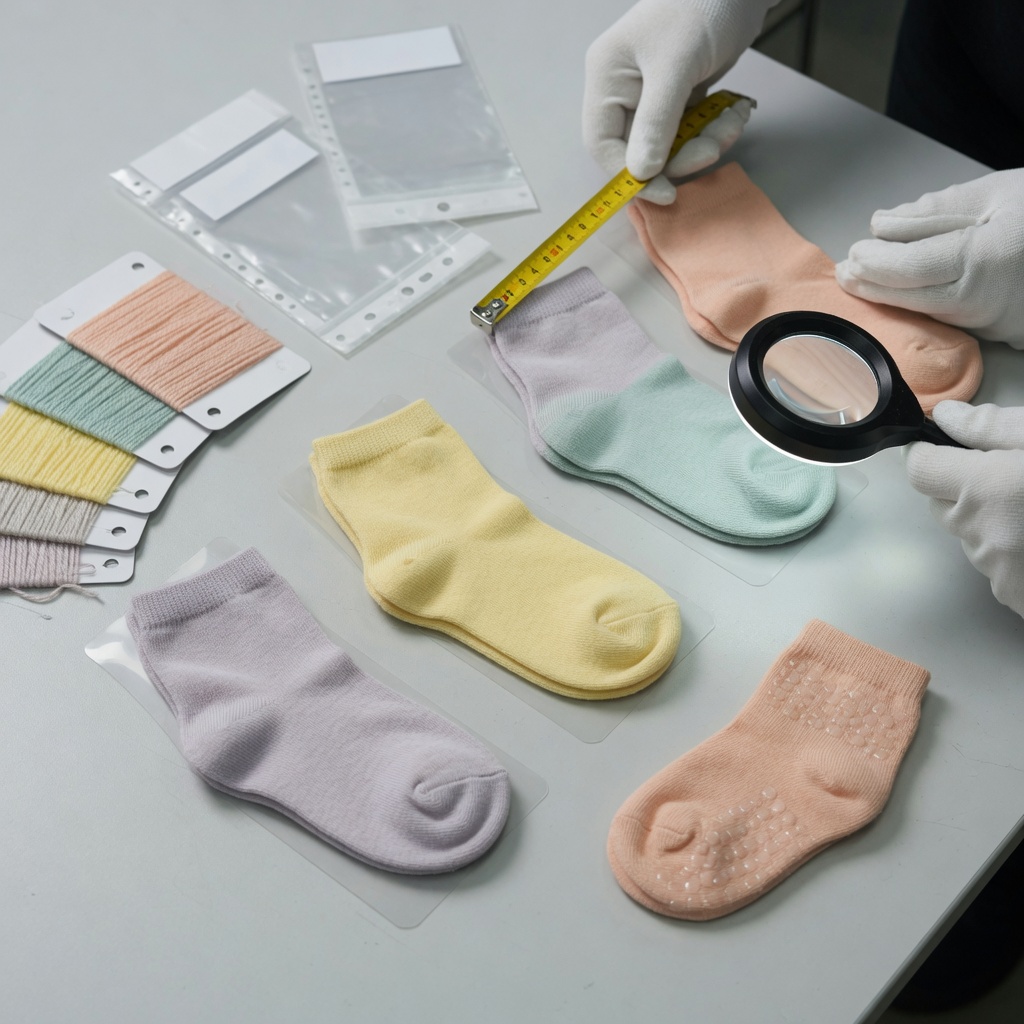
Construction details that appear in the listings include seamless toes, anti-slip grips, and an ultra-soft hand-feel. Anti-slip silicone or similar dots add a printing step and a polymer that belongs in the chemical test plan. Functional add-ons such as supports, listed on one page, change knitting and are more relevant for older kids sports socks than for infants. OKSOX custom socks factory A fully custom yarn-dyed jacquard with silicone grip and seamless toe will sit at the complex-MOQ and longer-lead-time end of the published ranges. A stock cotton-spandex construction with a simple printed logo and a polybag can sit at the simple-custom end. Decide that split in the RFQ rather than discovering it after a low headline MOQ is quoted.
Branding, labels and packaging for EU, EEA and UK destinations
Private-label logos, patterns, embroidery, custom labels, and branded packaging are listed as available. Methods differ in durability, cost, and child-safety profile. A knitted-in jacquard logo has no extra part to detach. A sewn woven label must have soft edges. A silicone logo must be checked for composition and wash adhesion. One page lists free design proofs in 4–24 hours with unlimited revisions (unit: hours as published; scope: OKSOX digital design proofs; as-of: publication date not stated on the excerpt). Digital proofs are a start, not a substitute for a physical pre-production sample that has been washed on a kids cycle. OKSOX custom socks factory
Packaging is where territorial differences inside Europe show up most clearly for a kids sock wholesale supply program. Fiber-content labeling, care symbols, and importer or responsible-person identification follow different instruments in the EU (with EEA alignment checked per named EEA country) versus the UK. Some retailers add language or extra warnings by country. The RFQ should list every destination country and state who writes and legally signs off the copy. Typical components described on the manufacturer pages are branded packaging, custom labels, bags, cards, and hangtags. Barcodes and any sustainability icons must match claims the brand is actually allowed to make in that destination. Do not assume one artwork file covers EU placement, EEA placement, and UK placement.
Do not treat an OEKO-TEX mention on a factory page as covering packaging inks or the silicone grip. One cited page lists OEKO-TEX certifications among kids and baby sock features. Jingsourcing sock manufacturer page That is a private test mark, not an EU, EEA, or UK legal requirement. If the buyer wants the mark, demand the current certificate PDF, product class (buyers often look for class I for baby articles, but that must be verified on the document), year, and whether the tested article is the same construction, yarn, and dye as the bulk order. Map any private mark to EU/EEA chemical due diligence and to UK chemical due diligence separately. Never imply that a website claim is a certification of the shipment.
Published MOQ, sampling and production ranges from OEM factory pages
Three public listings give the following example ranges. Units and scope are as stated on each page. No publication date was provided in the excerpts used for this editorial, so treat the figures as historical published examples to be reconfirmed on a dated quotation. They are not offers from ZheSock.
- FutureStitch children’s socks OEM listing: MOQ from 2,000 pairs (unit: pairs; scope: children’s socks OEM as listed), 15-day sampling and 60–90 day production, with age-based sizing, private-label logos and patterns, premium cotton blends and branded packaging; as-of date not stated on the excerpt. FutureStitch children’s socks OEM listing
- Jingsourcing sock manufacturer page covering kids and baby socks: simple custom MOQ 200–300 pairs, complex from 1,000 pairs; samples in 5–7 days and production 10–40 days; mid-quality around USD 0.5 per pair; cotton-spandex, organic 95% cotton labels, OEKO-TEX certifications and non-slip grips; full customization of fabrics, sizes, colors and packaging; as-of date not stated on the excerpt. Jingsourcing sock manufacturer page
- OKSOX custom socks factory including children’s sizes: MOQ as low as 20–50 pairs, free design proofs in 4–24 hours, 5–7 day production from USD 1.2 per pair; materials, lengths from no-show to thigh, 100 yarn colors, patterns, embroidery, supports and custom labels/packaging; as-of date not stated on the excerpt. OKSOX custom socks factory
These ranges are not a ranking. They show why a buyer who only asks “what is your MOQ for custom kids socks” receives incomparable answers. Complexity—number of colors, new yarn, embroidery versus print, packaging print—is the hidden variable. A program for Europe that needs six sizes, four colors, jacquard, and a legally reviewed hangtag in more than one language will not land at the 20-pair, 5-day end of the spectrum. Sampling is the control point: approve construction, hand-feel, color, logo placement, grip, and packaging together, then freeze the spec.
Buyer decision table for matching customization complexity to order volume
| Customization lever | What the buyer for Europe must specify | Illustrative published example (unit, scope, source; as-of date not stated on excerpt) | Main trade-off | Verification step |
|---|---|---|---|---|
| Yarn / blend | Cotton %, elastane %, any organic or origin claim | Cotton-spandex blends; organic 95% cotton labels (Jingsourcing kids/baby socks page) | Softness and claim vs price, pilling and chemical profile | Mill COA plus test report on the bulk yarn |
| Number of colors | Pantone refs, lab-dip rounds, shared vs exclusive yarn | 100 yarn colors available (OKSOX custom socks page) | Design range vs dyeing MOQ and leftover yarn | Signed lab dips before knitting |
| Size grading | Age bands plus foot length (cm), EU and/or UK size map, assortment ratio | Age-based sizing (FutureStitch children’s socks page) | Fit and returns vs knitting efficiency | Full size-run samples on the production last |
| Logo / pattern method | Technique, placement, max dimensions, kid-safe edges | Private-label logos and patterns; embroidery (FutureStitch and OKSOX pages) | Durability and look vs extra process and MOQ | Strike-off plus wash/abrasion on a kids cycle |
| Anti-slip / seamless | Grip polymer, position, toe linking method | Anti-slip grips and seamless toes (FutureStitch and Jingsourcing pages) | Toddler comfort vs extra print or knit time | Physical sample plus composition declaration |
| Packaging and copy | Components, languages, fiber %, importer/responsible person, barcode | Branded packaging and custom labels (all three cited pages) | Retail readiness vs artwork time; EU vs EEA vs UK rules | Artwork proof plus legal check per destination country |
| Order structure | Simple vs complex, per-color and per-size MOQ | Simple 200–300 pairs / complex from 1,000 (Jingsourcing); from 2,000 pairs (FutureStitch); 20–50 pairs (OKSOX) | Cash and warehouse vs unit price | Itemized quote with validity date |
| Calendar | Sample loops, bulk, including factory national holidays | Samples 5–7 days or 15 days; bulk 5–7, 10–40 or 60–90 days (three pages) | Season vs air-freight risk | Written calendar with spec-freeze dates |
Every row is a line the buyer should turn into the purchase order. The table is a comparison aid, not a specification and not a quote.
Practical RFQ checklist for kids sock wholesale supply customization options
Use this list so factory replies can be compared. Every item should appear in the written quote or the attached spec pack.
- Name destination countries separately (each EU member state as needed for language, each EEA country, and the UK if in scope) so labeling and chemical due diligence can be scoped; do not write only “Europe,” and do not assume one artwork file covers EU, EEA and UK placement.
- State target age bands, EU and/or UK size equivalents, foot-length range in centimetres, cuff height, stretch circumference, and the pair ratio per size.
- Specify fiber content by percentage, any organic or recycled claim, whether the claim applies to the sock body or only to labels, and request mill documents that will match the bulk lot.
- Give Pantone or physical standards for each color; state how many lab-dip rounds are included and who pays extra rounds.
- Define sock length (crew or ankle height in centimetres), cuff type, terry or plain knit, boarded pair weight in grams, left/right versus symmetric, and whether the toe is seamless.
- Describe anti-slip: polymer type if known, coverage, and whether it is required for the age group; require a composition declaration for the grip.
- Attach vector logo files; state method (jacquard, embroidery, print, silicone, woven label), placement and maximum height; require kid-safe edges on any sewn part.
- List packaging components (bag, card, hangtag, inner/outer carton) and who supplies legally approved copy, fiber %, care symbols, barcode and importer/responsible-person identification for each destination.
- Ask which tests the factory will provide on the bulk lot and on which article: chemical (scoped separately for EU/EEA placement and for UK placement), colorfastness, pilling, stretch recovery. Name a private mark such as OEKO-TEX only if you require it, and demand the current certificate with class and article description.
- Define sample policy: number of pairs, sizes, whether they are knitted on the production machine, wash instructions, and a written approval form.
- Request MOQ broken down by color and by size, plus price breaks, in the Incoterm you will actually use for delivery into the named destination; state currency (do not treat a USD website example as a EUR landed cost).
- Request a production calendar from PO to FOB, CIF or DAP, highlighting yarn dyeing, knitting, linking, boarding, packing and national holidays at origin; require the quote to state whether day counts are working days or calendar days.
- State inspection: AQL level, who inspects, whether a third party is allowed, packing-list format, and carton markings for the named warehouse.
- Require a document pack: commercial invoice, packing list, certificate of origin, test reports, and any fiber or organic transaction certificates that match the bulk lot.
- Confirm that unlimited digital proofs do not replace physical pre-production sample sign-off before bulk knitting.
How the data was derived. MOQ, price-example, color-count, sampling and production figures were extracted from the public OEM/wholesale pages of three sock manufacturers that list children’s or kids sock customization. They are source context for typical published spreads, not current quotations, not factory audits, and not ZheSock offers. Day counts are transcribed as printed; the excerpts did not state working days versus calendar days.
Limitations / what to verify. Published ranges move with cotton, energy, season and factory loading. The excerpted pages did not supply a publication date, so every pair count, day count and US-dollar figure is a historical website example, not a live offer. A USD 0.5 per pair or USD 1.2 per pair figure is not a landed cost in Europe and is not converted here to EUR. Website language such as OEKO-TEX or “non-toxic” is not authorization to place goods on the EU market, in an EEA country, or on the UK market. UK rules and EU/EEA rules must be checked separately, and country-language or retailer extras must be checked per destination. Factory size names may not match lasts used in Europe. Always obtain a dated, specification-attached quotation and retain signed pre-production samples.
Vincent Xi, Editorial Author. Profile: https://www.zhesock.com/authors/vincent-xi/
Discuss Your Requirements
Review our manufacturing capabilities, then share your specifications for a supplier-fit review.