Kids Sock Wholesale Supplier Material Options for Canada
By Vincent Xi | Editorial Author
Author experience note: The Vincent Xi author profile documents his name and Editorial Author role only. It does not document first-hand product testing, supplier audits, factory inspections, certifications, or production work; no such experience is claimed here.
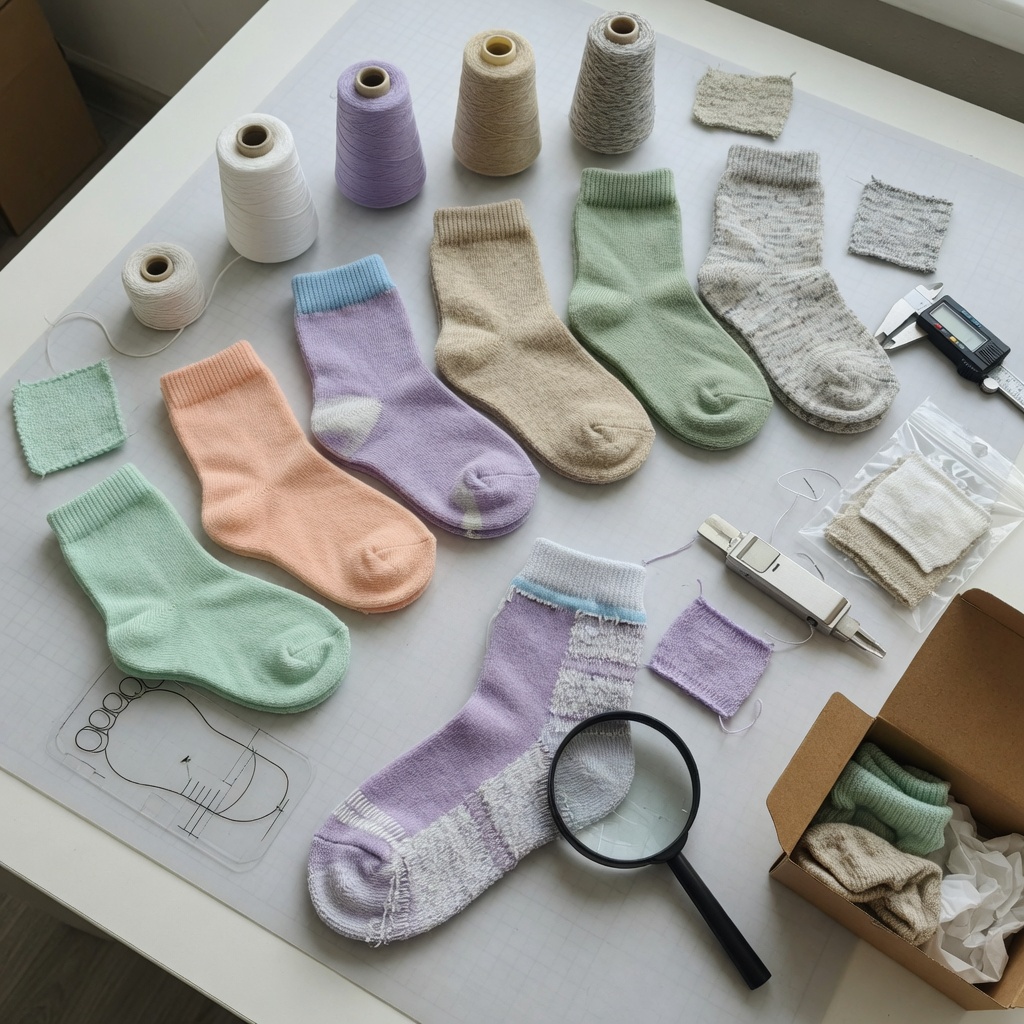
Canadian wholesale buyers evaluating kids sock wholesale supplier material options need quotations that describe the finished construction, not merely a fibre headline. The supplied commercial sources identify cotton, polyester, nylon, spandex, wool, bamboo fibre, and blends as candidate material families. They do not establish a best-performing blend or verify any current ZheSock composition, minimum order quantity, price, test result, certification, production method, or delivery schedule.
The procurement decision is therefore narrow: require each supplier to return a complete, revision-controlled material specification, then compare samples and prices only when the quoted constructions and commercial scopes are equivalent.
Canada Material Options for a Kids Sock Supplier RFQ
The MeetSocks material guide names cotton, polyester, nylon, spandex, wool, bamboo, and blends. The OKSOX wholesale page advertises cotton as its default material and names wool, bamboo fibre, nylon, and polyester as options. The Cmax supplier overview discusses cotton, bamboo fibre, and blends in a commercial kids-sock context.
These pages support a candidate list, not an independent performance ranking.
| Candidate material family | What the supplied sources support | What the supplier should return |
|---|---|---|
| Cotton-inclusive construction | Cotton is named by MeetSocks, OKSOX, and Cmax | Complete finished-sock composition, composition basis, yarn description, count system, ply, finishes, and material placement by sock zone |
| Polyester-inclusive construction | Polyester is named by MeetSocks and OKSOX | Complete composition, yarn form, finishes, placement, and a sample linked to the quoted revision |
| Nylon-inclusive construction | Nylon is named by MeetSocks and OKSOX | Complete composition and a construction map showing every nylon-containing zone |
| Spandex-inclusive construction | Spandex is named by MeetSocks | Complete composition, elastic-yarn construction, placement, and buyer-defined stretch or recovery results for the quoted sample |
| Wool-inclusive construction | Wool is named by MeetSocks and OKSOX | Complete composition, wool description, yarn construction, treatments, proposed care process, and relevant finished-sample results |
| Bamboo-fibre blend | Bamboo or bamboo fibre is named by MeetSocks, OKSOX, and Cmax | Exact generic fibre identity, complete composition, yarn description, finishes, and scope-matched evidence for any associated claim |
| Blend using the sourced material families | Blends are discussed by MeetSocks and Cmax | Complete composition, yarn schedule, zone map, finishes, requested tolerances, and separately identified alternatives |
Hold a quotation when constituents are missing, percentages cannot be reconciled, the composition basis is unclear, or a material is described only with marketing language. The same hold should apply when the quoted construction cannot be matched to an identified sample or when substitutions remain unrestricted.
Source-Reported Material Figures and Their Limits
The figures below are reported by the cited commercial pages. They are not Canada-specific specifications, market benchmarks, independent test results, keyword metrics, or ZheSock commitments.
| Source-reported figure | Unit and scope | Date or as-of context and source | Appropriate RFQ use |
|---|---|---|---|
| 95% of socks | Percent of the sock population referenced by MeetSocks; the supplied excerpt does not define its geography, denominator, sample, or derivation | MeetSocks, undated supplied page excerpt; no publication, update, or retrieval date was provided | Preserve only as source-reported wording. Do not use it to rank materials or select a Canadian assortment |
| 75% cotton and 3% spandex | Percent by composition in an illustrative blend reported by MeetSocks; the composition basis and remaining constituents are not provided | MeetSocks, undated supplied page excerpt; no publication, update, or retrieval date was provided | Use as an example of why a supplier must return the complete composition. Do not treat the partial blend as an approved formula or calculate the missing content |
| 21s-40s | Source-reported s yarn-count notation for a discussed range; the count system, ply, conversion basis, and intended construction are not defined in the supplied excerpt | MeetSocks, undated supplied page excerpt; no publication, update, or retrieval date was provided | Prompt the supplier to identify the count system, count, ply, fibre, and yarn construction before comparison |
| 20-50 pairs | Pairs in the advertised starting custom-sock order range on OKSOX; material, design, colour, size, packaging, and quotation conditions are not established in the supplied excerpt | OKSOX, undated supplied page excerpt; no publication, update, or retrieval date was provided | Request a current, material-specific minimum order quantity. Do not apply the advertised range to ZheSock, another supplier, or a Canadian order |
These figures describe different subjects and cannot be combined into a material recommendation. Current applicability should be checked in a dated supplier response tied to the proposed construction.
Material Specification for Comparable Supplier Quotes
The following fields are buyer-requested controls for a material RFQ. They are not claims about an existing supplier process.
| RFQ field | Required supplier return | Hold condition |
|---|---|---|
| Finished-sock composition | Every generic fibre identity, each declared percentage, declaration basis, requested tolerance, and whether the declaration covers the whole sock or specified zones | Constituents are missing, totals cannot be reconciled, or zone applicability is unclear |
| Yarn schedule | Fibre identity, count system, count, ply, spun or filament form, covered-yarn construction where applicable, and supplier yarn reference | A count is returned without its system or the yarn cannot be matched to the sample |
| Material placement | Yarn used in the body, sole, heel, toe, cuff, arch, seam, reinforcement, and other distinct zones | The construction map conflicts with the composition or physical sample |
| Dyes and finishes | Dyes, washes, softeners, coatings, treatments, and functional finishes included in the quotation | A finish is omitted, described only by a marketing term, or changed without review |
| Sample identity | Material revision, construction revision, size, colour reference, finish, submission stage, and sample identifier | The sample cannot be linked unambiguously to the technical return and quotation |
| Test or claim evidence | Named method and edition, laboratory identity, tested sample revision, care and conditioning process, measurement location, sample quantity, result unit, measured results, buyer threshold, and disposition | The return states only passed, omits measured results, or concerns a different article, material, finish, or revision |
| Substitution request | Existing and proposed materials, affected zones, reason, commercial effect, schedule effect, and proposed retesting | A material, yarn, finish, construction, or production-site change is made before written buyer review |
The buyer should choose evaluations that match the intended kids-sock program and proposed claims. Relevant decision fields may include finished dimensions after the selected care process, stretch and recovery at specified locations, seam review, pilling or abrasion at named zones, and colour performance. Listing a field does not establish that any material has met a threshold.
When a supplier proposes certification wording, request a current document that matches the document holder, material or product, manufacturing scope, relevant site, and validity period. Do not infer certification from a fibre name, logo, expired document, or report covering a different construction.
Practical RFQ Checklist for Canadian Kids Sock Material Options
Use this checklist for each material option so the technical return, sample, and commercial quotation can be reviewed as one package. An unchecked or inconsistent item is a reason to hold the option for clarification rather than fill the gap with an assumption.
Buyer inputs to send
- [ ] State the Canadian delivery destination and the requested quotation currency, delivery term, and named place.
- [ ] Identify the intended sock style, child size range, colour allocation, packaging configuration, and requested material alternatives.
- [ ] Assign an RFQ reference, material revision, construction revision, and requested quote-validity period.
- [ ] State which sock zones require separate material identification, including the body, sole, heel, toe, cuff, arch, seam, and reinforcement zones where applicable.
- [ ] List any buyer-selected sample evaluations, methods, result units, measurement locations, care process, acceptance thresholds, and required evidence.
- [ ] Identify any product claim the supplier is being asked to substantiate; do not treat the requested claim as established before evidence review.
Supplier technical return
- [ ] Return every generic fibre identity and declared percentage, with the declaration basis and applicability to the whole sock or named zones.
- [ ] Confirm that all declared percentages reconcile to the stated composition and explain any constituent not shown in the initial material description.
- [ ] Provide the yarn count system, count, ply, spun or filament form, covered-yarn details where applicable, and supplier yarn reference.
- [ ] Map each yarn and material to the relevant sock zones and identify reinforcement separately.
- [ ] Disclose dyes, washes, softeners, coatings, treatments, and functional finishes included in the quoted construction.
- [ ] Identify the finished sample by material revision, construction revision, size, colour reference, finish, submission stage, and sample code.
- [ ] Attach scope-matched measured results for any tested property or proposed claim, including the method edition, laboratory identity, tested sample revision, care and conditioning process, sample quantity, result unit, and disposition.
- [ ] Provide current documents for any certification wording and identify the document holder, covered material or product, relevant site, validity period, and manufacturing scope.
- [ ] List every proposed alternative separately instead of silently replacing a requested fibre, yarn, finish, construction, or production site.
Supplier commercial return
- [ ] State the material-specific minimum order quantity by design, colour, child size allocation, and packaging configuration.
- [ ] Tie the unit price to the returned composition, yarn schedule, construction map, finish, and sample revision.
- [ ] Itemize development, sampling, setup, testing, packaging, finish, and material-surcharge charges instead of leaving their inclusion unclear.
- [ ] State quote date, validity period, payment terms, exclusions, material procurement assumptions, production assumptions, delivery term, and named place.
- [ ] Show the cost and schedule effect of each proposed material or construction alternative.
- [ ] Confirm that substitutions require written buyer review before implementation.
Buyer release check
- [ ] Confirm that the technical return, identified sample, test evidence, and quotation all carry the same material and construction revision.
- [ ] Confirm that competing prices cover equivalent compositions, finishes, testing, packaging, and delivery scope before comparing them.
- [ ] Record unresolved gaps, the responsible party, requested correction, and disposition for each held item.
- [ ] Keep Canada-specific labelling, compliance, import, landed-cost, and logistics decisions pending unless supported by current, transaction-specific evidence from an appropriately qualified source.
- [ ] Release the material option for commercial comparison only after all required technical and quote fields are complete and internally consistent.
Material Sample and Quote Approval
Technical screen: Keep the offer on hold until the composition, yarn schedule, zone map, finishes, tolerances, and sample identifier are complete and internally consistent.
Sample review: Evaluate a coded finished sample made to the quoted material and construction revision. Define the method, result unit, sample quantity, acceptance threshold, decision owner, and disposition before treating a result as approval.
Quote comparison: Compare unit prices only when competing quotations cover equivalent compositions, yarn definitions, finishes, sample stages, testing, packaging, and delivery scope. Missing technical or service fields make the prices non-equivalent.
Production control: Link the approved specification and retained reference sample to the purchase documents. Require written review before changing fibre composition, yarn construction, stretch yarn, dye process, finish, reinforcement placement, construction revision, or production site.
Canada Quote Scope for Material Options
For a Canadian material quotation, ask the supplier to state:
- The buyer-specified Canadian delivery destination.
- Quote currency, quote date, validity period, payment terms, exclusions, delivery term, and named place.
- A unique material and construction revision for each quoted option.
- Material-specific minimum order quantity by design, colour, size allocation, and packaging configuration.
- Unit price tied to the returned composition, yarn schedule, construction map, and sample revision.
- Separate charges for development, samples, setup, testing, packaging, finishes, and material surcharges.
- Material procurement, sampling, production, and shipment assumptions that affect the quotation.
- The cost and schedule effect of each proposed alternative or substitution.
The supplied material pages do not provide authoritative evidence for Canadian bilingual labelling, product compliance, import treatment, landed cost, or logistics performance. No conclusion on those subjects should be drawn from this source set. Keep them pending until current, transaction-specific evidence is obtained from an appropriately qualified source.
A material option is ready for commercial comparison only when its technical return, identified sample, evidence scope, and quotation describe the same construction. Otherwise, request a corrected return rather than filling gaps with assumptions.
Evidence Method and Limitations
Source contexts
The MeetSocks material guide is a commercial educational page used only for its explicitly named material families and source-reported composition, yarn, and prevalence figures. The OKSOX wholesale page is a commercial supplier page used only for its advertised material choices and starting order range. The Cmax supplier overview is a supplier-authored overview used only for the material categories attributed to it. The Vincent Xi author profile supports the visible author name and Editorial Author role only.
How the information was derived
The supplied page excerpts were screened for explicit material names, composition figures, yarn-count notation, minimum-order wording, source type, and claim scope. A factual statement was retained only when it could remain attached to its supplied URL and original commercial context. No performance property was inferred from a fibre name, no missing blend constituent was calculated, and no supplier-specific figure was generalized to ZheSock or the Canadian market.
The specification fields, checklist, approval controls, and quote requirements are procurement recommendations for collecting comparable supplier evidence. They are not measured outcomes, legal conclusions, standards requirements, or descriptions of a company's established practice.
Limitations and what to verify
The supplied excerpts do not provide publication or retrieval dates, complete datasets, independent comparative tests, a complete illustrative blend, a defined yarn-count system, current quotations, or authoritative Canada-specific regulatory and logistics evidence. They do not establish ZheSock's current materials, minimum order quantities, pricing, lead time, manufacturing practices, test performance, certifications, capacity, or customer outcomes.
Before placing an order, verify the complete fibre composition, declaration basis, generic fibre identities, yarn-count system and ply, construction by zone, dyes and finishes, sample-to-production consistency, applicable test methods and measured results, claim substantiation, document holder and validity scope, material-specific minimum order quantity, quotation inclusions, and Canadian transaction requirements.
Discuss Your Requirements
Review our manufacturing capabilities, then share your specifications for a supplier-fit review.