Novelty Sock Sourcing Material Options for UAE Procurement
By Vincent Xi, Editorial Author
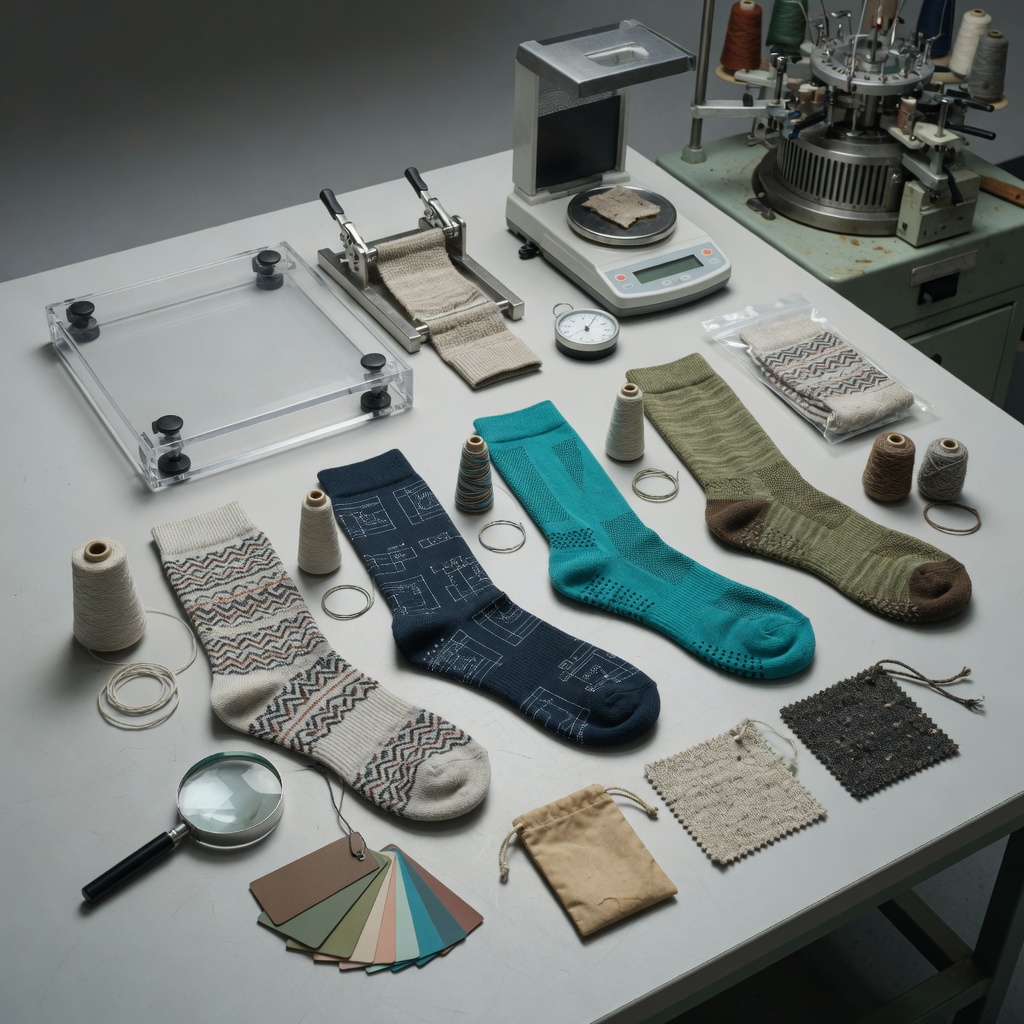
For United Arab Emirates B2B buyers, novelty sock sourcing material options should be compared as quote-specific systems, not isolated fiber names. The useful unit of comparison is the proposed finished sock: complete composition, material by sock zone, knit or print construction, artwork route, identified physical sample, acceptance method, price boundary, and controlled substitutions.
The supplied sources support candidate directions rather than a universal material ranking. SOXFUN recommends combed cotton for everyday or gift styles and polyester for athletic styles (source). Anemon describes jacquard knitting and digital printing on what it calls bamboo fabric (source). Socksmith presents rayon-from-bamboo, merino-blend, recycled-cotton, and recycled-wool examples from its own assortment (source). None of these statements proves an industry-wide performance hierarchy or another supplier's capability.
The cited pages do not provide verified United Arab Emirates duties, taxes, customs documentation, labeling rules, climate-performance thresholds, landed-cost inputs, or delivery periods. Those fields require separate, current evidence before purchase-order approval.
Evidence Boundaries for the Material Decision
| Source context | Supported use | Procurement boundary |
|---|---|---|
| SOXFUN supplier page | Supplier recommendations for combed cotton and polyester, listed yarn directions, and a starting bulk MOQ | Confirm every recommendation and commercial term for the selected blend, artwork, sizes, colors, packaging, and quote date |
| Anemon patterned-sock sourcing page | Supplier descriptions of jacquard, digital printing on supplier-described bamboo fabric, artwork-color limits, MOQ, and physical-sampling time | Treat these as statements about Anemon's described program, not universal specifications, performance results, or another factory's limits |
| Socksmith wholesale guide | Material examples from Socksmith's own assortment, including rayon from bamboo with nylon and spandex, a merino blend, recycled cotton, and recycled wool | Do not transfer an assortment composition, claim, or performance implication to a custom quote or another supplier |
| Vincent Xi author profile | Visible author name and Editorial Author role | Does not support claims about factory work, product testing, certification audits, production trials, or customer outcomes |
Material Options for United Arab Emirates Novelty Sock RFQs
| Intended product | Source-bounded candidate | What the source supports | Required RFQ evidence |
|---|---|---|---|
| Everyday or gift style | Combed cotton as a lead-fiber candidate | SOXFUN recommends combed cotton for these uses | Complete blend, zone schedule, yarn and construction basis, pair mass, finished measurements, and an identified physical sample |
| Athletic novelty style | Polyester as a candidate | SOXFUN recommends polyester for athletic styles | Full composition, supporting fibers, wear-zone construction, physical sample, and results against buyer-defined recovery, surface, and care criteria |
| Outdoor novelty style | Supplier-proposed merino blend | Socksmith shows a merino blend in its own outdoor assortment | Exact blend, yarn specification, finished weight, care protocol, sample identity, and buyer-selected dimensional-change and appearance evidence |
| Detailed image or tonal artwork | Digital print on a fully disclosed substrate | Anemon presents digital printing on supplier-described bamboo fabric | Generic fiber names, blend percentages, print-process declaration, final-material print sample, and pre-care and post-care appearance records |
| Repeating knitted motif | Supplier-proposed blend compatible with jacquard | Anemon describes jacquard as knitting the pattern into the sock | Yarn and zone specification, machine or gauge basis, color placement, technical knit-out, and inspection of the face and inside construction |
| Recycled-content assortment | Recycled cotton or recycled wool as candidate directions | Socksmith presents products using those descriptions in its own assortment | Complete composition, source identity, lot traceability, current claim documents, final-material sample, and written substitution controls |
A material label is not an awardable specification. Return a bid for clarification when it omits supporting fibers, assigns no materials to sock zones, uses a substitute material in the sample, leaves changes uncontrolled, or supplies documents that cannot be matched to the quoted product and production scope.
Bamboo-related wording needs particular care. Socksmith describes its own bamboo socks as rayon from bamboo blended with nylon and spandex (source). That assortment example cannot complete another bidder's missing composition. Require each bidder to state generic fiber names, percentages, supporting fibers, substrate, finish, and the zones in which each material is used.
RFQ Fields That Make Material Options Comparable
The following fields are buyer-defined procurement controls. The cited sources do not provide universal pass values, a shared test protocol, or UAE-specific acceptance thresholds. State the required method and tolerance in the RFQ, or require a supplier proposal for written approval.
| RFQ field | Supplier return | Award control |
|---|---|---|
| Finished composition | Generic fiber names and percentages by mass for the finished sock, with separate declarations for zones using different blends | Link the declaration to the approved sample and purchase order |
| Zone schedule | Material and construction for cuff, leg, heel, toe, sole, motif, and elastic-bearing areas | Treat an undisclosed zone change as a material substitution |
| Yarn and construction | Fiber identity, linear-density value and unit, ply or covering structure, finish, source reference, machine or gauge basis, and cuff, heel, and toe construction | Match the quoted construction to the technical sample record |
| Finished measurements and pair mass | Buyer-defined measurement points in millimeters, mass in grams per finished pair, conditioning basis, sample results, and proposed bulk tolerances | Use an identified sample and signed measurement sheet as the inspection reference |
| Stretch and recovery | Method, extension basis, applied load, hold period, cycle basis, recovery interval, result unit, and proposed pass value | Reject reports that omit sample identity, construction, size, care history, or test date |
| Care and dimensional change | Care protocol, measurement points, pre-care values, post-care values, calculation method, and acceptance limit | Test the proposed bulk material, construction, finish, and artwork process |
| Surface performance | Buyer-selected abrasion or pilling method, tested zone, endpoint or rating basis, specimen identity, and acceptance criterion | Do not convert marketing adjectives into pass criteria |
| Artwork route | Jacquard or digital print, artwork revision, color references, placement dimensions, proposed material, and disclosed compromises | Approve a final-material knit-out or printed sample before bulk production |
| Physical sample identity | Material lot, yarn reference, construction, size, artwork revision, process, finish, care status, and packaging basis | Identify and retain the approval sample; record any authorized replacement |
| Material and sourcing claims | Exact claim wording, current supporting document, issuer, holder, scope, validity, and traceability record | Do not approve claims from supplier marketing copy alone |
| Commercial and change terms | MOQ basis, quantity breaks, surcharges, sample and setup charges, packaging, currency, quote date, validity, delivery boundary, and approval requirements for changes | Compare bids at the same commercial boundary and prohibit unapproved substitutions |
Practical RFQ Checklist for United Arab Emirates Material Options
Use this buyer-defined checklist before requesting final bids. It does not establish United Arab Emirates regulatory values or supplier capabilities. Local import, tax, labeling, landed-cost, and delivery requirements remain separate verification items.
Before releasing the RFQ
- [ ] Identify every SKU, size range, color arrangement, artwork revision, packaging configuration, and intended use included in the request.
- [ ] State whether each design requires jacquard knitting, digital printing, or a supplier proposal for the artwork route.
- [ ] Attach the artwork and mark motif placement, color references, orientation, and areas where image distortion or show-through must be evaluated.
- [ ] Define the required generic fiber names and require blend percentages by mass for the finished sock.
- [ ] Require a zone schedule covering the cuff, leg, heel, toe, sole, motif, and elastic-bearing areas.
- [ ] List the buyer-selected measurement, care, dimensional-change, recovery, surface, and appearance methods or ask the bidder to propose them for written approval.
- [ ] State the named delivery place and require bidders to identify the delivery boundary, freight responsibility, packaging basis, and quoted exclusions.
Required supplier return
- [ ] Provide the complete composition, zone schedule, yarn details, construction basis, finish, and proposed material source reference for each option.
- [ ] Identify all supporting fibers rather than returning only a lead-fiber or marketing name.
- [ ] Confirm the artwork process and disclose material, construction, color, placement, or detail compromises before sampling.
- [ ] Quote the MOQ basis, quantity breaks, material surcharges, setup charges, sample charges, testing costs, inspection costs, packaging costs, currency, issue date, and validity period.
- [ ] Separate material procurement, artwork review, physical sampling, revisions, bulk production, inspection, and shipment milestones.
- [ ] Supply a physical sample record showing the material lot, yarn reference, construction, size, artwork revision, process, finish, care status, and packaging basis.
- [ ] Return results with the method, specimen identity, test date, conditioning or care history, result unit, and proposed acceptance limit.
- [ ] Provide current, scope-matched documents for any material, recycled-content, sourcing, or certification-related claim included in the bid.
- [ ] Disclose production origin, proposed shipment documents, carton dimensions, net weight, gross weight, and shipment-volume basis.
- [ ] Accept a written change-control term covering material, yarn, source, construction, finish, artwork process, color, dimensions, packaging, and production location.
Before supplier award and purchase-order release
- [ ] Compare only bids normalized to the same material, artwork, packaging, testing, inspection, and delivery boundary.
- [ ] Match the quotation, physical sample, technical sheet, test records, and claim documents to the same proposed product.
- [ ] Record unresolved United Arab Emirates import, labeling, landed-cost, tax, clearance, and domestic-delivery fields as pending until supported by current evidence.
- [ ] Identify and retain the approved physical sample and its signed measurement, material, construction, artwork, and care records.
- [ ] Resolve every conflict among the supplier webpage, quotation, sample, report, claim document, and purchase order in writing.
- [ ] Release the purchase order only after the approved composition, zone schedule, construction, artwork revision, sample identity, acceptance criteria, packaging, delivery boundary, and change process agree.
Match Material Options to the Artwork Process
Anemon describes jacquard as a process in which the pattern is knitted into the sock (source). This supports considering jacquard for a knitted motif, but it does not establish a universal blend, machine limit, motif size, or durability result.
For a jacquard bid, request the proposed yarns, construction basis, color placement, smallest proposed motif, and any artwork compromises. Review the physical knit-out for motif placement, color boundaries, inside construction, visible yarn carries or floats, and appearance under the buyer's stated extension condition.
Anemon also presents digital printing on supplier-described bamboo fabric for detailed imagery (source). The page does not establish comparative wash performance between digital print and jacquard. Evaluate a printed sample made with the proposed bulk substrate and process. Record pre-care and post-care appearance, dimensional change, image distortion, show-through under extension, surface feel, transfer, staining, and color change against buyer-defined criteria.
Material and artwork approval should refer to the same physical sample. A digital rendering cannot verify blend, knit structure, print substrate, finish, dimensions, pair mass, or appearance under extension.
Supplier-Reported Numbers for Quote Verification
These are supplier-specific data points, not market benchmarks. Each value needs confirmation in a current quote for the selected material, design, size range, color arrangement, and packaging.
| Reported value | Unit, scope, date context, and source | RFQ action |
|---|---|---|
| Up to 6 colors per horizontal sequence | Unit: colors per horizontal sequence. Scope: Anemon's described patterned-sock program. Date context: the cited page displays no publication date. Source: Anemon | Confirm against the submitted artwork and ask the bidder to define the sequence orientation |
| Up to 18 colors per vertical sequence | Unit: colors per vertical sequence. Scope: Anemon's described patterned-sock program. Date context: the cited page displays no publication date. Source: Anemon | Confirm the current limit and inspect a physical knit-out using the proposed material |
| Minimum order of 1,500 pairs per SKU | Unit: pairs per SKU. Scope: Anemon's stated MOQ for its described program. Date context: the cited page displays no publication date. Source: Anemon | Clarify whether the MOQ applies by material, design, color, size, packaging, or another configuration |
| Physical sampling stated as 7-14 days | Unit: days. Scope: Anemon's stated physical-sampling stage. The source does not specify calendar or working days. Date context: the cited page displays no publication date. Source: Anemon | Define the start event, completion event, calendar basis, material-procurement assumptions, and revision time in the quote |
| Starting bulk MOQ of 25 pairs per design | Unit: pairs per design. Scope: SOXFUN's stated starting bulk MOQ. Date context: the cited page displays no publication date. Source: SOXFUN | Reconfirm for the chosen material, artwork, sizes, colors, packaging, and quote date |
Do not average these values or derive a typical MOQ. A bidder should separate material procurement, artwork review, physical sampling, revisions, approval, bulk production, inspection, and transit in its dated schedule.
Verify Material and Sourcing Claims
The Socksmith page uses FSC-related sourcing language and references an OEKO-TEX scheme for part of its own assortment (source). The Anemon page also refers to an OEKO-TEX scheme for its own yarns (source). These are supplier-page statements, not proof of a scheme's formal requirements or current coverage for another supplier, a newly quoted sock, a production facility, or a shipment lot.
Before accepting a material or sourcing claim, obtain the current document, issuing organization, holder's legal name, covered fibers or products, covered facilities and processes, validity information, and relevant traceability records. Approve the intended claim wording separately. If the document cannot be matched to the quoted material and production scope, remove the claim from the specification, labeling, packaging, and commercial material.
United Arab Emirates Quote Boundary for Material Options
The supplied evidence does not verify United Arab Emirates import charges, taxes, customs procedures, labeling content, or domestic delivery costs. Their absence from a supplier page does not establish that no requirement or cost applies.
For each material option, request a quotation that states:
- Currency, issue date, validity period, quantity basis, and price breaks.
- Complete blend, zone, yarn, construction, and artwork assumptions used for pricing.
- MOQ basis and surcharges linked to material, color, artwork route, size mix, or packaging.
- Sampling, setup, testing, inspection, packing, and documentation charges.
- Delivery term, named handover place, and allocation of freight responsibility.
- Production origin and the shipment documents the supplier proposes to provide.
- Pack quantity, carton dimensions, net weight, gross weight, and shipment-volume basis.
- Material procurement, sampling, production, inspection, and shipment milestones.
- Every amount included in or excluded from the quoted delivery price.
Normalize bids to the same scope before comparing material prices. Maintain a separate landed-cost record for applicable freight, insurance, duty, tax, clearance, and inland-delivery inputs. Each input should have a current source, effective date, currency basis, calculation owner, and approval status before the purchase order is released.
Material RFQ Award Gates
| Gate | Advance only when | Stop condition |
|---|---|---|
| Bid eligibility | The bid discloses complete composition, differing sock zones, yarn and construction basis, artwork route, commercial boundary, and change controls | Missing blend, undisclosed zones, or uncontrolled substitutions |
| Sample identity | The physical sample uses the proposed bulk material, construction, size, artwork process, finish, and care state | Sample material or process differs from the quote without written approval |
| Technical approval | Buyer-selected methods and acceptance criteria are applied to the identified sample | Report scope, sample identity, test basis, or result unit is missing |
| Claim approval | Current documents cover the quoted material, product, process, and intended wording | Supplier-page language is the only support |
| Commercial approval | Material-specific MOQ, surcharges, sampling, packaging, delivery boundary, and exclusions are normalized | Bids are compared across different commercial scopes |
| Purchase-order lock | The order identifies the approved composition, zone schedule, construction, artwork, sample, test criteria, claim documents, quote, packaging, inspection plan, and change process | A production-defining document remains unapproved or contradictory |
Evidence Method, Limitations, and Author Basis
Methodology: The supplied pages were reviewed according to their stated commercial context: Socksmith as a wholesale assortment guide, Anemon as a patterned-sock sourcing page, and SOXFUN as a supplier capability page. Material statements were retained only as attributed recommendations, assortment examples, process descriptions, or supplier-reported commercial values. Numerical values were transcribed with their units, program scope, displayed date status, source, and procurement limitation. RFQ recommendations were derived as buyer controls and were not presented as measured product performance.
Limitations: The evidence set contains no matched laboratory samples, common test protocol, equivalent supplier quotations, independently verified production capabilities, verified ZheSock manufacturing terms, or verified UAE regulatory and landed-cost data. It does not establish comparative durability between jacquard and digital print, universal material performance, a market-wide MOQ, or current certification coverage for a new order. The cited Anemon and SOXFUN pages display no publication date, and commercial webpages can change.
What to verify before ordering: Obtain a dated quotation, complete material and zone schedule, final-material physical sample, approved test plan and results, current scope-matched claim documents, bulk inspection controls, and independently sourced United Arab Emirates import, labeling, landed-cost, and delivery requirements. Resolve conflicts among webpages, quotations, samples, reports, claim documents, and the purchase order in writing before bulk approval.
Author basis: Vincent Xi is identified by ZheSock as an Editorial Author. That profile is the sole basis for the byline and role. It does not support a first-hand factory visit, wear test, production trial, laboratory test, certification audit, or customer-outcome claim.
Discuss Your Requirements
Review our manufacturing capabilities, then share your specifications for a supplier-fit review.