Novelty Sock Sourcing Packing Requirements for Canada RFQs
By Vincent Xi, Editorial Author
Experience basis: The approved author profile identifies Vincent Xi as an Editorial Author. It does not document factory, sourcing, testing, inspection, or procurement experience, so no first-hand experience claim is made.
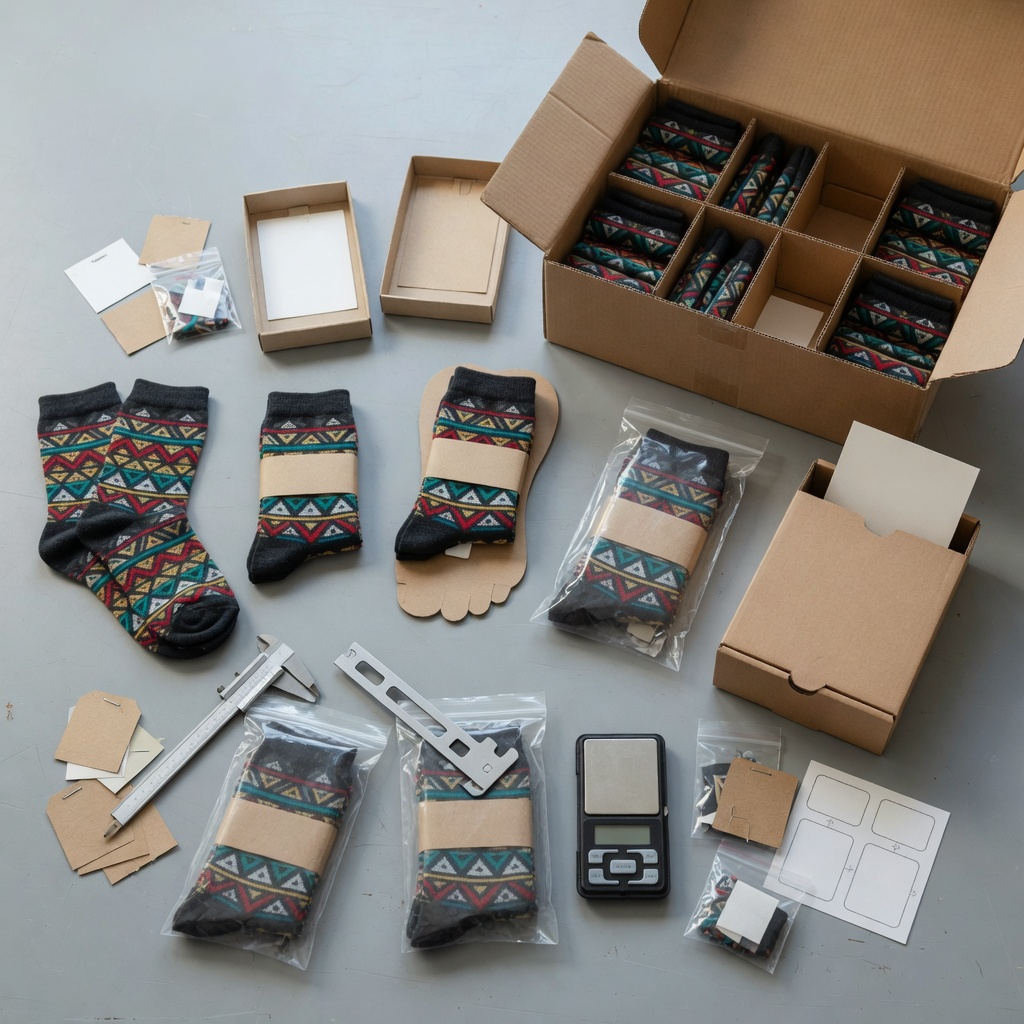
For Canadian B2B buyers, novelty sock sourcing packing requirements should operate as an RFQ acceptance schedule, not a list of package names. Fix the sock reference, fold, visible design face, presentation component, individual outer pack, assortment, and master carton. Then require each supplier to return material descriptions, measured dimensions and mass, packed quantities, quote inclusions, controlled artwork identifiers, and sample evidence against that same baseline.
Ask bidders to price the baseline pack consistently and show gift-ready alternatives as separate quote lines. State the Canadian destination and required delivery basis, but do not assume the supplier can determine Canadian label copy, language treatment, or import costs. The buyer should control approved copy and obtain the applicable Canadian legal or channel review before artwork release.
The supplied SaySock private-label guidance identifies packaging tier, labels, barcodes, carton logic, sales channel, quantity, and destination as request inputs. The supplied JingSourcing packaging overview provides a commercial taxonomy of sock-packaging formats. These pages support the RFQ fields below; they do not establish a supplier's current capability, Canadian compliance, or ZheSock practice.
Canada Packing Requirements: Fix the RFQ Baseline
Attach the same packing schedule to every quotation request. A supplier return is comparable only when it refers to the specified novelty-sock reference and pack configuration.
| Requirement | Buyer issues | Supplier returns | Release evidence |
|---|---|---|---|
| Sock-to-pack basis | Product reference, size range, construction variation relevant to packed bulk, fold sequence, visible face, compression limit, measurement points, and tolerances | Exact sock reference used, finished packed width, height, and depth in millimetres, plus fit exceptions by SKU | Physical sample made with the intended sock and approved fold |
| Presentation component | Band, tag, hangtag, card, support, hook, or insert; required material, finish, dimensions, attachment, and position | Material identification, finished dimensions, print route, attachment method, setup charge, and unit-price inclusion | Structural fit sample followed by an approved printed sample |
| Individual outer pack | No outer pack or a specified bag, card, sleeve, or carton-style gift pack; required material, closure, opening, finish, and print coverage | Finished dimensions in millimetres, material description, closure method, packed-unit price, and identified exceptions | Approved sample showing fit, closure, appearance, and cleanliness |
| Assortment | Quantity by SKU or pattern, sequence, separation, orientation, and identification method | Assortment map, packed quantities, divider or liner proposal, and unresolved quantity conflicts | Count and assortment record tied to inspected cartons |
| Master carton | Construction, pack-out, orientation, closure, marks, and buyer-set dimension or mass limits | Packed quantity, external dimensions in millimetres, net and gross mass in kilograms, carton count, and internal arrangement | Production-equivalent carton with measurement, mass, count, closure, and condition records |
| Quote scope | Currency, price denominator, quote date, validity, delivery basis, and named Canadian place | Separate prices for baseline packing and optional formats, plus setup, sampling, assembly, carton, and delivery inclusions or exclusions | Completed inclusion schedule tied to the quoted pack configuration |
The JingSourcing packaging overview lists tags, paper bands, cardboard supports for no-show styles, shaped novelty tags, OPP bags, zipper bags, paper cards, sleeves, and carton-style gift packs. Use these names only as format options. Availability, material, dimensions, print route, price, and feasibility still require confirmation in the active quotation.
A format label such as paper band or gift box is not a complete packing requirement. The RFQ also needs material identity, finished dimensions, fit, attachment or closure, print coverage, assortment logic, and carton pack-out.
Practical Canada Packing Requirements RFQ Checklist
Send this checklist with the product specification and require the bidder to complete every item against the same novelty-sock and packaging configuration. A bidder should mark an unavailable item as not offered and explain the exception instead of leaving the field blank.
Product and pack definition
- [ ] Identify the novelty-sock product reference, size range, material specification, SKU or pattern list, and order quantity by SKU.
- [ ] Define the required fold sequence, visible design face, orientation, compression limit, and buyer-set dimensional tolerances.
- [ ] Select the baseline presentation component and state its material, finish, finished dimensions, attachment method, position, and print coverage.
- [ ] Define the individual outer pack, including material, opening, closure, finish, insert, ventilation or sealing condition where applicable, and required fit.
- [ ] State the assortment sequence, SKU separation method, inner-pack arrangement where used, and required quantity reconciliation.
Artwork and variable data
- [ ] Issue buyer-approved artwork files with revision identifiers and identify the approval authority.
- [ ] Supply approved barcode type, encoded value, dimensions, placement, orientation, and required verification method.
- [ ] Supply any buyer-confirmed Canadian bilingual copy as controlled artwork, including the approved language versions, hierarchy, and placement.
- [ ] Require the supplier to identify print method, colour-control method, printable area, setup requirements, and any artwork limitations before sampling.
- [ ] Require rejected labels or components to be isolated, replaced, and reinspected under a documented process.
Measurements and carton return
- [ ] Require finished packed-unit width, height, and depth in millimetres for the intended sock and complete pack.
- [ ] Require packed-unit gross mass in grams, including all presentation components, inserts, attachments, and the individual outer pack.
- [ ] Require master-carton external dimensions in millimetres and net and gross mass in kilograms for a production-equivalent pack-out.
- [ ] Require packed quantity by SKU, inner pack where used, master carton, and total carton count.
- [ ] Require a carton arrangement showing orientation, dividers or liners, closure method, unused space, and protection against movement or compression.
Commercial and Canadian delivery scope
- [ ] State the quotation currency, price denominator, quote date, validity period, delivery basis, and named Canadian place.
- [ ] Require separate quote lines for baseline packing, each optional format, setup, printing, samples, assembly, cartons, and delivery-related charges.
- [ ] Require written inclusions and exclusions for freight, insurance, import or clearance charges, taxes, brokerage, and final delivery.
- [ ] Require the bidder to identify provisional values, their calculation basis, and the point at which measured or documented values will replace them.
Sample, change, and release controls
- [ ] Require a structural fit sample made with the intended sock before printed-pack approval.
- [ ] Require a printed packed sample tied to the controlled artwork and variable-data revisions.
- [ ] Require a production-equivalent carton return with dimensions, mass, quantity, assortment, closure, and visible-condition records.
- [ ] Define the inspection evidence, acceptance authority, deviation process, and written production-release requirement.
- [ ] Require a written change request for any material, dimension, print route, artwork position, data, pack count, assortment, or carton change.
- [ ] Require every change request to state its effect on price, timing, measurements, samples, inspection, and Canadian delivery data.
Before award, reconcile the completed checklist with the quotation, samples, artwork register, and carton return. Do not compare a baseline quote from one bidder with an optional gift-pack quote from another bidder as though the scopes were equivalent.
Require Measured Packing Returns
Every measured value should carry a unit, measurement basis, sample identifier, measurement date, and status. Use clear statuses such as supplier-proposed, sample-verified, or production-verified so an estimate cannot be mistaken for release evidence.
| Data return | Unit and scope | Required basis |
|---|---|---|
| Finished packed-unit width, height, and depth | Millimetres per packed pair or sales unit | Intended sock and complete proposed pack, measured at buyer-defined points |
| Presentation-component dimensions | Millimetres per finished component | Component measured before attachment and after packing where fit can alter its shape |
| Packed-unit gross mass | Grams per packed pair or sales unit | Complete individual pack, including inserts and attachments |
| Master-carton external dimensions | Millimetres per closed carton | Production-equivalent carton using the proposed internal arrangement |
| Master-carton net and gross mass | Kilograms per packed carton | Approved product quantity, packaging components, dividers or liners, and closed carton |
| Pack-out | Pairs or packed units by SKU, inner pack where used, and master carton | Approved assortment map reconciled to the physical carton arrangement |
| Quote identity | Currency, denominator, quote date, validity, delivery basis, and named place | Current quotation for the same product and packaging configuration |
Do not release production from measurements taken on an unfinished sock, a substitute sock, or a different packaging format. If a final value is unavailable during quotation, mark it provisional and specify when a physical measurement becomes mandatory.
Control Artwork, Barcode, and Canadian Label Inputs
The SaySock private-label guidance supports including labels and barcodes in a private-label request. It does not determine which Canadian labeling, language, consumer-packaging, environmental-claim, customs, provincial, or retailer requirements apply to a particular novelty-sock program.
The Canadian buyer should supply legally and commercially approved copy. If qualified Canadian legal or channel review determines that bilingual copy applies, provide each approved language version, its placement, hierarchy, artwork revision, and approval authority. Do not delegate the legal determination or translation approval to the packaging supplier.
Use buyer-authored control fields for barcode and variable data:
- Barcode type and approved encoded value.
- Artwork and data revision identifiers.
- Label dimensions, placement, and orientation.
- Buyer-defined placement tolerance.
- Required verification method and acceptance result.
- Required verification-record format.
- Isolation, replacement, and reinspection process for rejected labels.
Do not use a visual proof or informal scan as release evidence unless the buyer's specified method expressly permits it. If an external standard or channel manual applies, identify the current document, edition, method, acceptance threshold, and required record in the purchase specification. That buyer-selected requirement is distinct from a supplier's own practice and does not prove certification.
Compare Packing Cost and Canadian Delivery Scope
The figures below come only from the supplied DeadSoxy wholesale novelty-sock article. DeadSoxy is a commercial wholesale source rather than an independent Canadian market study. Its currency and publication date are not identified in the supplied evidence, so the figures are not current Canadian quotes, landed-cost inputs, or guaranteed outcomes.
| Source-reported point | Unit, scope, date context, and source | RFQ use |
|---|---|---|
| Gift-packaging increment | $0.30 or more per pair in an unidentified dollar currency, scoped to an individually gift-packaged wholesale novelty-sock pair; publication date unavailable in the supplied evidence. Source: DeadSoxy. | Treat only as historical commercial context. Request the current packed-unit difference, currency, quote date, and inclusions from each bidder. |
| Potential retail premium | $2-$3 per retail pair in an unidentified dollar currency, scoped to a possible premium for a gift-packaged novelty-sock pair; publication date unavailable in the supplied evidence. Source: DeadSoxy. | Do not assume this premium applies in Canada or covers packaging and delivery costs. Validate it with current buyer-controlled channel evidence. |
| Opening-order suggestion | Two to three dozen pairs per pattern, scoped to the source's suggested opening quantity for a novelty-sock pattern; publication date unavailable in the supplied evidence. Source: DeadSoxy. | Use only to test whether pattern-level quantities reconcile with the proposed assortment and carton plan. It is not a packing requirement or supplier minimum. |
Do not convert the unidentified dollar amounts into Canadian dollars without confirming the original currency and recording the exchange-rate source and comparison date. Use current quotation and logistics evidence in consistent calculations:
Quoted packed-unit delta = optional packed-unit quote - baseline packed-unit quote
Quoted order packing delta = quoted packed-unit delta x ordered packed units
Carton volume per packed unit = measured external carton volume / verified packed units in that carton
Buyer comparison total = quoted packed goods + verified freight + verified import or clearance charges + verified final-delivery charges
These formulas are editorial comparison methods, not market data. Populate them only with the active quote, approved pack-out, current logistics evidence, and buyer-approved finance or import inputs.
For delivery to Canada, require the quote to state the delivery basis and named place. The inclusion schedule should distinguish baseline packing, optional packaging, setup, printing, samples, assembly, cartons, freight, insurance, import or clearance charges, taxes, brokerage, and final delivery. The supplied sources provide no current Canadian rates, tariff treatment, or tax determination.
Approve the Packed Sample and Carton
A flat artwork proof does not establish physical pack fit, fold stability, attachment pressure, closure fit, or carton arrangement. Require physical evidence tied to the intended sock and controlled artwork data.
| Release stage | Required evidence | Hold condition |
|---|---|---|
| Structural fit | Intended sock, proposed fold, presentation component, outer pack, packed dimensions, and identified provisional materials | Substitute product or component is used without being identified and approved |
| Printed packed sample | Approved artwork revision, approved label data, finished component, attachment, closure, placement, and appearance | Copy, language version, artwork revision, data, material, or position differs from the buyer-controlled file |
| Barcode release | Encoded data, type, dimensions, position, orientation, verification result, and rejected-label disposition | Required result or traceable verification record is missing |
| Carton approval | Approved assortment, internal arrangement, packed quantity, external dimensions, net mass, gross mass, closure, marks, movement, and visible condition | Values are estimated from another format or do not reconcile with the order assortment |
| Production and shipment release | Approved sample identifiers, inspection criteria, completed records, accepted deviations, and written release authority | A component, dimension, artwork revision, packed quantity, assortment, or carton arrangement has changed without approval |
Require a written change request before any material substitution, dimensional change, print-route change, artwork movement, data revision, pack-count change, or carton rearrangement. The request should show the effect on price, timing, dimensions, mass, samples, inspection, and delivery data.
Award rule: Compare only quotations tied to the same product and pack baseline. Return incomplete quotations for clarification instead of filling missing components or costs with assumptions. Release production only when the packed sample, carton return, controlled artwork, quote scope, and inspection records agree.
Methodology and Source Context
Source-reported facts were separated from buyer-authored procurement controls. Packaging formats and request inputs were retained only within the scope stated by the supplied pages. Commercial figures were attributed with their units, scope, unavailable date context, unidentified currency, and source limitations. The RFQ tables, checklist, formulas, evidence gates, and hold conditions are editorial methods for comparing supplier returns; they are not claims about a supplier's capability, compliance, or usual practice.
| Source | Evidence used | Not treated as evidence of |
|---|---|---|
| Vincent Xi author profile | Author name, Editorial Author role, and profile URL | First-hand factory, sourcing, testing, inspection, or procurement experience |
| JingSourcing packaging overview | Commercial taxonomy of tags, bands, supports, bags, cards, sleeves, and carton-style packs | Canadian compliance, independent material assessment, current pricing, or a shortlisted supplier's capability |
| SaySock private-label guidance | Request inputs covering packaging tier, labels, barcodes, carton logic, channel, quantity, and destination | ZheSock capability, Canadian legal advice, certification, or independently verified manufacturing practice |
| DeadSoxy wholesale article | Attributed commercial statements about gift-pack cost, a possible retail premium, and an opening quantity | Current Canadian prices, Canadian demand, guaranteed margin, or an active supplier quotation |
No factory test, supplier audit, physical sample review, quote comparison, logistics-rate study, or independent Canadian market study was supplied as evidence.
Limitations and What to Verify
The cited evidence does not provide current Canadian-dollar prices, verified package dimensions, material gauges, supplier minimums, setup or tooling charges, lead times, freight rates, duties, taxes, tariff treatment, defect thresholds, barcode acceptance results, or transit-test results. Verify these through current quotations, approved samples, inspection instructions, logistics records, import records, and qualified advisers.
The cited sources do not establish whether bilingual labeling or any other Canadian packaging rule applies to a particular novelty-sock program. Verify requirements against the product claims, packaging material, province, channel, importer arrangement, and destination before approving artwork or production.
No cited source proves ZheSock's current packaging materials, machinery, capacity, pricing, certifications, inspection results, or ability to supply a requested format. Confirm every requested component, dimension, cost, timing commitment, and pack-out through the active quotation, physical samples, controlled approvals, and production records.
Do not infer certification from a supplier statement or an undated document. When a standard, test, or certification is relevant, obtain a current document identifying the applicable product, facility, process, edition, method, acceptance threshold, validity, and scope. Keep that external requirement separate from the supplier's own operating practice.
Discuss Your Requirements
Review our manufacturing capabilities, then share your specifications for a supplier-fit review.