Novelty Sock Sourcing Quality Control Inspection: Canada RFQ
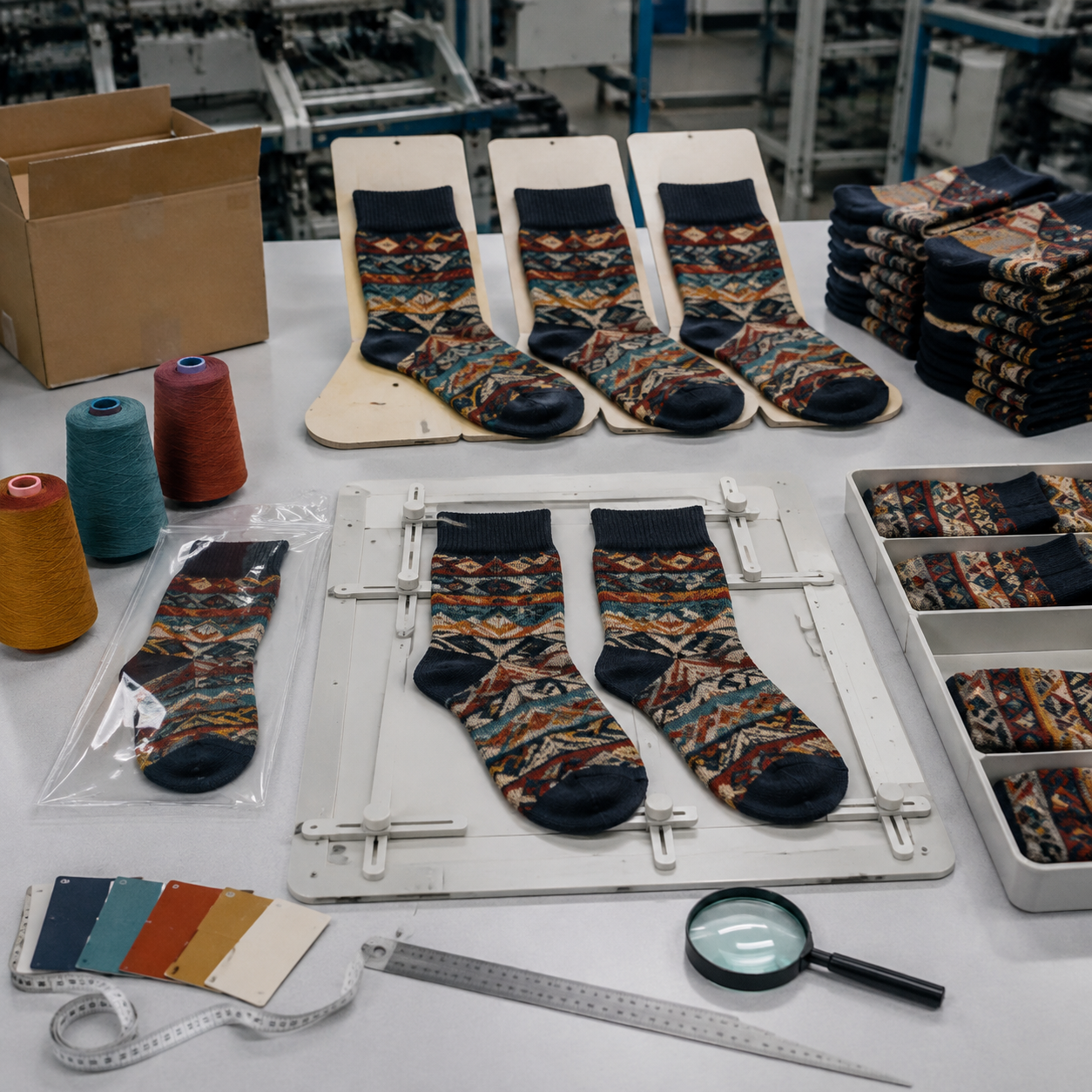
By Vincent Xi, Editorial Author
For Canadian B2B buyers, this novelty sock procurement brief is designed to support an RFQ and shipment-release decision. It converts artwork, construction, dimensions, workmanship, packaging, and lot requirements into evidence that a buyer can review before approving production or dispatch.
The evidence base is deliberately limited. The cited manufacturing article identifies quality-control categories such as raw-material checks, in-line monitoring, yarn consistency, knit density, dimensional accuracy, colourfastness, finished-product checks, and visible defects. The cited wholesale guide reports commercial benchmarks and discusses pre-production samples. Neither source proves how ZheSock or a prospective supplier operates, and neither establishes Canada-specific product, import, or labelling requirements.
Author basis: The Vincent Xi author profile identifies Vincent Xi as an Editorial Author. It does not document first-hand factory, laboratory, inspection, procurement, or product-use experience, so this article makes no such claim.
Canada RFQ gates for novelty sock quality control inspection
Treat these as buyer-defined controls to include in the RFQ or purchase order, not as statements about a supplier's current practice.
| Decision gate | Evidence to request | Hold condition | Decision owner |
|---|---|---|---|
| Quote comparison | Requirement-response matrix by SKU, disclosed deviations, quantity allocation, and itemized sample, testing, inspection, reinspection, and corrective-work charges | Materials, variants, inspection scope, exclusions, or deviations remain undefined | Buyer procurement authority |
| Bulk-production approval | Controlled specification, artwork, colour reference, measurement schedule, packaging file, pre-production sample record, and document-precedence rule | References conflict, approval is conditional, or a substitution remains unresolved | Named buyer approver |
| Inspection readiness | Purchase-order reference, offered quantity by SKU and variant, production-lot identifiers, sampling instructions, and required documents | The quantity cannot be reconciled or the lot is incomplete, inaccessible, mixed without disclosure, or unidentified | Buyer or appointed inspection coordinator |
| Shipment release | Raw measurements, defect records, sample-selection record, photographs, packaging findings, document references, corrective-action status, and written disposition | Required evidence is missing, an unapproved change is found, or a nonconformance remains open | Buyer role named in the purchase order |
Require the bidder to mark each RFQ line as compliant, deviating, or not applicable. A blank response should remain unresolved rather than being treated as acceptance.
Build an inspectable novelty sock RFQ
| Control area | Buyer requirement | Supplier response to request | Procurement purpose |
|---|---|---|---|
| SKU identity | Design, colourway, size, quantity, pair configuration, packaging configuration, and buyer SKU | Supplier reference, accepted allocation, minimum-order rule, and permitted combinations | Keep prices, samples, inspection findings, and corrective actions tied to the correct variant |
| Document control | Governing specification, artwork, colour reference, packaging file, revision status, and precedence rule | Revision acknowledgement plus a conflict and deviation list | Prevent an obsolete file or uncontrolled sample from becoming the production reference |
| Construction and material | Sock format; cuff, leg, heel, foot, toe, and toe-closure construction; fibre composition by component; yarn reference; and substitution rule | Proposed construction, available material evidence, and explicit deviations | Hold any unapproved material or construction change |
| Motif and colour | Controlled artwork, motif direction, repeat, placement landmarks, comparison reference, viewing condition, and permitted variation | Knit interpretation, proposed comparison method, and sample evidence | Replace subjective similarity with a repeatable comparison |
| Dimensions | Characteristic, landmarks, product condition, method, tool, target, unit, permitted variation, rounding rule, and applicable SKU | Completed measurement schedule and method acknowledgement | Make every dimensional result reproducible and reviewable |
| Knit and workmanship | Count area and method where knit density is required, yarn reference, and defined conditions for holes, skipped stitches, loose yarn, snags, contamination, heel placement, and toe closure | Proposed process records, inspection evidence, and acknowledged defect definitions | Ensure the inspection uses the RFQ's method and defect language |
| Pair consistency | Comparison method for dimensions, colour, motif position, orientation, construction, and pairing | Pairing method and proposed evidence | Prevent individually acceptable socks from being released as a mismatched pair |
| Packaging | Approved artwork revision, folding, pairing, fastener, barcode-check method, assortment, inner pack, carton pack-out, and protection requirements | Packaging materials, pack-out proposal, and revision acknowledgement | Keep packaging disposition separate from physical-product disposition |
| Product claims and tests | Claim, test method, sample identity, acceptance criterion, report scope, issuer, document date, and validity requirement | Current scoped report or notice that evidence is unavailable | Prevent an unsupported statement, logo, or expired document from being treated as certification |
| Lot and change control | Production-lot definition, traceability fields, and changes requiring prior approval | Proposed lot structure and change-notice process | Isolate affected goods when a change or defect is identified |
| Inspection and release | Sampling instructions, report content, nonconformance remedies, cost responsibility, and release authority | Written acknowledgement, proposed report format, and responsible parties | Keep completion, inspection status, and shipment authorization as separate decisions |
Measurement schedule
Use a separate line for each characteristic that can affect acceptance.
| Field | Required entry |
|---|---|
| Characteristic | Cuff width, leg length, foot length, heel position, toe-closure position, motif placement, knit density, or another specified feature |
| Product identity | SKU, size, colourway, pair identity, sample identity, and production-lot reference |
| Product condition | Relaxed, mounted, stretched, conditioned, or another precisely defined state |
| Method | Start and end landmarks, alignment, tension or loading rule, and handling procedure |
| Tool control | Tool type, unit, resolution, identification, and any status record required by the buyer |
| Acceptance values | Target, lower and upper limits or permitted variation, and rounding rule |
| Evidence | Raw reading for each sampled item, inspector record, and a scale-referenced photograph when required |
| Disposition | Buyer-defined defect class and the applicable sampling decision rule |
For a symmetric tolerance, calculate the lower limit by subtracting the permitted variation from the target and the upper limit by adding it. Use that calculation only when the buyer's specification expressly defines a symmetric tolerance. Record asymmetric limits separately, and do not infer a numerical tolerance from an approved sample.
Commercial benchmarks to verify in the supplier quote
These are source-reported comparison points, not ZheSock terms, supplier commitments, standards, or product acceptance values.
| Reported configuration | Source-reported data point | RFQ use |
|---|---|---|
| Standard designs using stock colours | 500-1,000 pairs per SKU, reported by the VelonSocks wholesale guide, whose page is dated January 20, 2025 | Ask each bidder for the actual pair quantity per SKU and all permitted size or colour combinations |
| Custom designs or custom colours | 1,000-3,000 pairs per design, reported by the VelonSocks wholesale guide, whose page is dated January 20, 2025 | Require design-level and variant-level quantity allocation in the quote |
| Jacquard patterns or logos | 2,000-5,000 pairs per design, reported by the VelonSocks wholesale guide, whose page is dated January 20, 2025 | Verify whether motif construction changes quantity, sample, testing, or inspection terms |
| Inspection, testing, and certification in the source's price model | 3%-5% of wholesale price for that combined component, reported by the VelonSocks wholesale guide, whose page is dated January 20, 2025 | Request actual itemized charges and inclusions instead of applying the percentage as a supplier-price assumption |
Every quote should identify the quantity unit, applicable SKU or design, combination rules, currency, quote date, validity period, delivery basis, exclusions, and responsibility for samples, tests, inspection, reinspection, and corrective work. Verify every commercial value in the written supplier quote before award.
Convert quality categories into inspection evidence
The DeadSoxy manufacturing article, whose page displays the publication date February 15, 2026, discusses raw-material inspection, in-line monitoring, finished-product checks, yarn consistency, knit density, dimensional accuracy, colourfastness, and visible defects. The controls below translate those source-reported categories into buyer-issued evidence requests; they do not establish a ZheSock or supplier procedure.
| Inspection characteristic | Controlled criterion | Evidence to require | Release question |
|---|---|---|---|
| Product identity | SKU, size, colourway, motif orientation, pair configuration, packaging version, and lot code | Quantity reconciliation, product and label photographs, sample identity, and lot records | Does the inspected product match the ordered variant and identified lot? |
| Dimensions | Buyer-defined landmarks, condition, method, target, unit, limits, and rounding rule | Item-level raw readings tied to the sampled SKU and lot | Do the readings meet the written limits without relying on a pass-only summary? |
| Colour and motif | Approved reference, viewing condition, comparison method, placement landmarks, repeat, orientation, and stretch condition | Reference identity, comparison findings, and photographs tied to sampled items | Was conformity judged against the controlled reference and method? |
| Knit density and yarn consistency | Defined count area, method, unit, product condition, yarn reference, and permitted variation | Raw count or observation record, sample identity, and defect photographs where applicable | Was the agreed method used for the correct variant and lot? |
| Construction and workmanship | Defined conditions for cuff, heel, toe closure, holes, skipped stitches, loose yarn, snags, contamination, and knit inconsistency | Defect description, location, count, classification, affected SKU, and clear image | Does each defect class meet the buyer's stated decision rule? |
| Pair matching | Permitted variation in dimensions, colour, motif position, orientation, and construction within a pair | Side-by-side pair record and any resulting defect entry | Can every sampled pair be judged by the same controlled rule? |
| Material or property claim | Required composition or property, verification method, sample identity, criterion, date, and document scope | Supplier record or current scoped test report specified by the buyer | Does the evidence cover the product, order, date, scope, and claim at issue? |
| Packaging | Approved revision, pairing, folding, barcode method, assortment, pack-out, and carton requirements | Packaging photographs, buyer-required scan results, counts, and carton findings | Does the packaging match the approved file and order-specific pack-out? |
Terms such as good colour, standard size, premium yarn, acceptable motif, and normal workmanship are not inspectable criteria. Replace them with a controlled reference, a method, a unit where applicable, a permitted variation, an evidence requirement, and a disposition rule.
Control sampling, samples, and nonconformance
The supplied evidence does not select an inspection sampling standard. If the buyer chooses one, the RFQ should identify the current document and edition, lot treatment, inspection level, defect classes, decision inputs, sample-selection method, and automatic-hold conditions. Keep a buyer-selected requirement distinct from a supplier's internal practice, and do not imply certification without a current document covering the relevant product, claim, date, and scope.
Define the production lot before calculating or selecting the inspection sample. Record the purchase order, SKU, colourway, size, production period, and any buyer-required material or dye-lot identifiers. Materially different production groups should not be pooled without written buyer instructions.
The VelonSocks wholesale guide, whose page is dated January 20, 2025, discusses pre-production samples in a wholesale sourcing context. That supports asking whether a sample is available and how it is priced, but it does not establish a prospective supplier's sample policy. Record the approved sample's identity, material and colour references, measurements, packaging revision, approval status, approval date, and authorized approver. State which visual attributes the sample governs and which requirements remain numerical or document-based.
An inspection report should contain the controlled document references, lot reconciliation, sample-selection record, item-level measurements, defect details, photographs, packaging findings, supporting document references, corrective-action status, and buyer-authorized disposition. When goods are sorted or reworked, require completion evidence for the full quantity included in the corrective-action scope. Rechecking only the initially observed defective units does not establish disposition of the remaining affected goods.
Canada-bound novelty sock shipment release
The supplied sources do not establish Canadian bilingual-labelling, product-compliance, customs, tax, landed-cost, or logistics requirements. This article therefore prescribes none of those details. Any requirement for the Canada-bound order should be validated separately through an appropriate authoritative source and then issued as a controlled buyer requirement with its own evidence and approval authority.
Keep physical novelty sock acceptance within the documented inspection scope. An inspection pass is not proof of an unstated Canadian requirement. Completed commercial or import documents also do not prove that dimensions, motif placement, construction, pairing, workmanship, or packaging passed inspection.
Authorize shipment only when the report identifies the correct lot, follows the agreed sampling instructions, includes the required raw evidence, resolves every nonconformance, and carries written approval from the named buyer authority. Otherwise, keep the lot on hold and apply the purchase order's corrective-action or reinspection terms.
Novelty sock quality control inspection RFQ checklist
- [ ] Identify every buyer SKU, design, colourway, size, quantity, pair configuration, and packaging configuration.
- [ ] Require minimum-order and quantity allocation by SKU or design, including permitted combination rules.
- [ ] Attach controlled specifications, artwork, colour references, packaging files, revisions, and a document-precedence rule.
- [ ] Define construction and fibre composition by component and prohibit unapproved substitution.
- [ ] Define motif placement, dimensions, knit checks, workmanship, and pair matching with methods and decision rules.
- [ ] Identify changes to material, construction, machinery, subcontracting, artwork, or packaging that require approval.
- [ ] Control the pre-production sample identity, governed attributes, status, retained reference, and approval authority.
- [ ] Define production-lot boundaries and traceability identifiers before sampling.
- [ ] State the sampling instructions, report fields, defect classes, decision limits, selection method, and hold conditions.
- [ ] Require current scoped evidence for each product, test, or certification claim included in the order.
- [ ] Define sorting, rework, replacement, credit, reinspection, completion evidence, and cost responsibility.
- [ ] Itemize sample, testing, inspection, reinspection, and corrective-work charges in the quote.
- [ ] Attach only separately validated Canada-market requirements; do not ask the supplier or inspector to infer them.
- [ ] Name the buyer role authorized to approve, hold, reject, and release the lot.
Methodology, source map, and limitations
Methodology: Source-attributed statements were separated from buyer-defined procurement controls. The manufacturing source's quality categories were converted into RFQ fields, inspection evidence, and release questions without asserting a supplier process. Commercial figures were retained only with their reported unit, configuration scope, displayed source date, direct citation, and an instruction to verify the value in the supplier quote.
| Source context | Supported use | Excluded inference |
|---|---|---|
| Vincent Xi author profile | Author name, role, and profile URL | Factory, testing, inspection, sourcing, or product-use experience |
| DeadSoxy manufacturing quality-control article | Source-reported inspection stages and quality categories used to structure evidence requests | Any ZheSock or supplier procedure, capability, tolerance, result, test status, or certification |
| VelonSocks wholesale buying guide | Source-reported minimum-order ranges, the source's price-model percentage, and discussion of pre-production samples | Any ZheSock or supplier quantity, price, sample policy, lead time, inspection charge, or commercial commitment |
Limitations and verification: The supplied evidence does not verify a ZheSock or prospective supplier capability, material, construction, product dimension, tolerance, inspection result, test result, certification, minimum order, price, lead time, corrective-action outcome, or Canada-specific requirement. It does not select a sampling standard or establish product-specific acceptance values. Before award and release, verify commercial terms in the written quote, validate the final specification and controlled sample, confirm sampling instructions with the appointed inspection party, obtain current scoped evidence for each claim, and resolve Canada-market requirements through appropriate authoritative sources.
Discuss Your Requirements
Review our manufacturing capabilities, then share your specifications for a supplier-fit review.