Novelty Sock Wholesale Supplier Packing Requirements for New Zealand Buyers
By Vincent Xi, Editorial Author
For a New Zealand retailer, distributor, or importer comparing supplier quotes, novelty sock wholesale supplier packing requirements should be issued as a controlled schedule with the RFQ. A line such as retail packaging included does not identify the sale unit, packaging components, artwork scope, folding method, inner quantities, export-carton configuration, measured freight data, or delivery handoff covered by the price.
Ask each supplier to mark every field as Confirmed, Alternative, Excluded, or Pending buyer approval. Keep the sock price, packaging components, printing or setup, application labour, samples, inspection, cartons, and freight assumptions separately identifiable. Quotes are comparable only when they cover the same packing scope and state their exceptions.
This article is limited to packing specifications, quote comparison, sample evidence, and award controls for a New Zealand novelty sock order. It does not represent that a cited business supplies a particular component, meets a New Zealand requirement, or can achieve an unstated measurement.
Author evidence note: The Vincent Xi author profile identifies Vincent Xi as Editorial Author. It does not provide a basis for a first-hand factory visit, product test, certification, or customer outcome, and no such experience is claimed here.
Practical RFQ Checklist for New Zealand Packing Requirements
Attach this checklist to the RFQ and require a written response against every item. A blank field should be treated as unresolved rather than included by implication.
- [ ] Identify the RFQ revision, purchase-order reference, buyer-selected quote currency, quote-validity period, New Zealand destination postcode, and requested responsibility handoff.
- [ ] State the total pair quantity and allocation by novelty sock SKU, size, design, and colour reference.
- [ ] Define the sale unit as an individual pair or buyer-specified assortment, then list every packaging component included in that unit.
- [ ] Specify the retail format, material, finish, closure, folding method, sock orientation, visible design area, and buyer-defined presentation tolerances.
- [ ] Require the supplier to mark each requirement Confirmed, Alternative, Excluded, or Pending buyer approval and explain every variance.
- [ ] Provide controlled artwork filenames, buyer revision references, colour references, print method, trim, bleed, safe area, and approval responsibility.
- [ ] Request an assembled pre-production pack rather than relying only on a flat artwork proof.
- [ ] Request measured finished-pack length, width, and depth in millimetres and packed mass in grams, tied to the approved sample revision.
- [ ] Define pairs per inner, assortment sequence, protective material, inner identification, and treatment of incomplete quantities.
- [ ] Define pairs per export carton, permitted SKU mix, carton closure, buyer-required strength specification, and maximum acceptable gross weight.
- [ ] Require measured closed-carton dimensions in millimetres, net and gross weights in kilograms, final carton count, and a packing diagram.
- [ ] Supply the buyer-approved label content matrix and require the supplier to return exact copy, placement, and proof references.
- [ ] Where barcodes are required, provide the approved SKU mapping and require an applied-code proof plus decoded result for each applicable SKU.
- [ ] Request draft commercial-invoice and packing-list formats reconciled with SKU descriptions, quantities, package counts, dimensions, weights, origin data, and New Zealand delivery details.
- [ ] Separate packaging components, printing or setup, variable labels, application labour, samples, inspection, export cartons, and freight assumptions in the quote.
- [ ] Record permitted substitutions, evidence required for approval, non-conformance handling, and the buyer role authorised to release bulk packing.
Return the RFQ for clarification if the sale unit, component scope, assembled-sample status, carton quantity, measured dimensions, gross weight, label responsibility, cost allocation, or New Zealand handoff remains undefined. Completion of this checklist supports commercial comparison but does not establish legal or regulatory compliance.
New Zealand Novelty Sock Packing Requirements: RFQ Schedule
The SaySock wholesale supplier guidance supports treating order quantity, SKU mix, carton planning, destination, packaging, labels, and delivery assumptions as supplier-discussion inputs. The schedule below converts those categories into buyer-controlled RFQ fields. It does not validate the capability, price, minimum order, lead time, or compliance status of a supplier under review.
| RFQ field | Buyer requirement | Supplier return and release evidence |
|---|---|---|
| Order and SKU allocation | State total pairs and the allocation by novelty sock SKU, size, design, or colour reference | Confirm the allocation, packing constraints, remainder treatment, and any mixed-pack proposal in a reconciled allocation table |
| Sale unit | Define an individual pair or buyer-specified assortment and list every component included in that unit | Return a component list, finished sale-unit description, packing diagram, and assembled sample plan |
| Retail presentation | Specify the packaging format, fold points, visible design area, cuff and toe direction, hanger orientation, closure, and any buyer-defined alignment tolerance | Return an assembled presentation drawing or sample and identify every variance |
| Packaging materials | Specify the material type, finish, colour, closure, and nominal thickness or board mass where required | Provide a controlled material specification or data sheet for the quoted component |
| Finished retail pack | Request external length, width, and depth in millimetres and packed mass in grams | Measure an assembled sample and return a dated record identifying the sample revision and measuring equipment |
| Artwork | State the controlled file name, buyer revision, print method, colour reference, trim, bleed, and safe area | Return a proof tied to the quoted component and revision for buyer approval |
| Variable label data | List candidate size, fibre, care, origin, importer, distributor, or retailer fields and assign a data owner to each | Return exact copy and placement; release only against the buyer-approved content matrix and proof |
| Barcode control | Supply the approved SKU mapping, symbology, position, and acceptance instruction where barcodes are required | Return the applied-code proof and decoded result for every applicable SKU |
| Inner packing | Define pairs per inner, assortment sequence, protective material, and inner identification | Confirm the count, external dimensions, mixed-SKU treatment, and packing diagram |
| Export carton | Define pairs per carton, SKU mix, closure, buyer-required strength specification, and maximum acceptable gross weight | Return fully closed external dimensions in millimetres, net and gross weights in kilograms, and final carton count |
| Carton marks | Provide approved purchase-order, SKU, quantity, carton-sequence, destination, and handling fields | Return a mark proof populated from final order data and a packed-carton image |
| New Zealand handoff | Name the handoff or delivery point, destination postcode, requested window, responsibility transfer, and excluded charges | State the quote basis, included service, validity, freight assumptions, and exclusions in writing |
| Packing documents | Provide buyer-requested product descriptions, SKU references, package counts, weights, dimensions, origin data, and delivery details | Return draft commercial-invoice and packing-list formats reconciled with the order and packing schedule |
| Sample and inspection | Define the attributes covered by approval, the approval owner, packing checks, tolerances, evidence format, and corrective action | State the sample status, inspection responsibility, timing, and report format |
Return the response for clarification when the sale unit, component scope, carton quantity, measured dimensions, gross weight, label responsibility, or New Zealand handoff remains undefined. These are commercial comparison controls, not representations of legal sufficiency.
Retail Packing Requirements by Format
The Sockswise packaging-options page provides category examples of sock packaging formats and production details that can be confirmed before packing. Use those examples to structure the RFQ, not as evidence that the supplier being evaluated offers a format or meets the buyer's specification.
| Format under review | Packing specification to issue | Quote and approval control |
|---|---|---|
| Belly band | Material, finish, flat and assembled dimensions, closure, placement, fold, and visible novelty design area | Confirm whether printing, assembly, application labour, and an assembled sample are included |
| Header card with clear bag | Card and bag materials, component dimensions, hanger geometry, sealing method, sock orientation, and label position | Identify the card, bag, printing, sealing, and application scope separately |
| Plain clear bag | Material, dimensions, closure, sock orientation, and buyer-approved label or warning treatment where applicable | State who performs any later labelling or repacking and where that work occurs |
| Retail box | Board specification, flat and erected dimensions, finish, closure, insert, print scope, and sock orientation | Confirm whether the quote covers flat components or erected packs and require measured packed dimensions and mass |
Do not approve a format name alone. Approve the component specification, controlled artwork, assembled presentation, and supplier-returned measurements. Hold environmental, recyclability, material-origin, or certification wording until current evidence covers the actual component, claim scope, and relevant entity.
New Zealand Label and Packing-Document Checks
Create a content matrix for the New Zealand order before releasing artwork. For each candidate field, record the proposed wording, package location, data owner, evidence source, source or access date, approval owner, and status. The supplier should reproduce approved content rather than infer it from packaging prepared for another destination.
The FTC textile and wool labelling guidance is United States business guidance. It is retained only as a jurisdictional contrast showing why wording or placement guidance from another market should not be treated as evidence for New Zealand. It does not establish a New Zealand requirement.
The supplied sources do not determine which label fields, warnings, wording, placement, or permanence rules apply to the actual novelty sock product in New Zealand. Before artwork release, the buyer's compliance owner should verify each proposed field against a current applicable New Zealand official source, qualified professional advice, customs-broker instructions, and the relevant retailer manual where needed. Record the applicable scope and decision rather than relying on an undated packaging example.
Request draft commercial-invoice and packing-list layouts for reconciliation. Compare their descriptions, SKU references, quantities, package counts, net and gross weights, carton dimensions, origin data, and New Zealand delivery details with the purchase order and approved packing schedule. This is a buyer-requested data check; neither document is presented here as proof that every import or sales-channel requirement has been met.
Example Packing Calculation for a New Zealand RFQ
Status of every value below: each value is a buyer-created example assumption for one hypothetical New Zealand RFQ, as of that RFQ's issue date. None is a sourced supplier minimum, capability, price, test result, or shipment record. Verify every input, measurement, result, and rounding rule in the supplier quote before approval.
| Data point | Example assumption and derivation | Required quote verification |
|---|---|---|
| SKU allocation | Assume 2,400 pairs per hypothetical New Zealand order across 6 SKU lines per hypothetical order. Equal allocation gives 400 pairs per SKU line for that order. | Confirm the order total, each SKU allocation, remainder treatment, and effect on the packing price |
| Inner and carton count | Assume 12 pairs per inner bundle for that order and 120 pairs per export carton for that order. This gives 10 inner bundles per carton and 20 export cartons per 2,400-pair order. | Confirm the actual inner quantity, carton quantity, mixed-carton treatment, and final carton count |
| Carton and shipment volume | Assume each fully closed carton measures 50 cm long by 40 cm wide by 35 cm high for that order. Multiplication gives 0.070 cubic metres per carton; multiplied by 20 cartons per order, the example shipment volume is 1.40 cubic metres per hypothetical order. | Return measured external dimensions and confirm whether bulging, rounding, and the final carton count are included |
| Gross shipment weight | Assume 14 kg gross weight per packed carton for that order. Multiplied by 20 cartons per order, the example total is 280 kg gross weight per hypothetical order. | Return measured gross weight per carton and the reconciled total shipment weight |
The calculation method divides total order pairs by SKU lines for allocation and by pairs per carton for carton count. Carton volume multiplies fully closed external length, width, and height. Shipment volume and gross weight multiply verified per-carton values by the final carton count.
Do not book freight from these assumptions. Require the supplier and selected freight provider to confirm accepted measurement units, charging basis, rounding method, quote validity, responsibility handoff, and excluded origin or New Zealand destination charges. Keep freight quotes with different handoff points or service scopes separate.
Packing Sample and QC Release
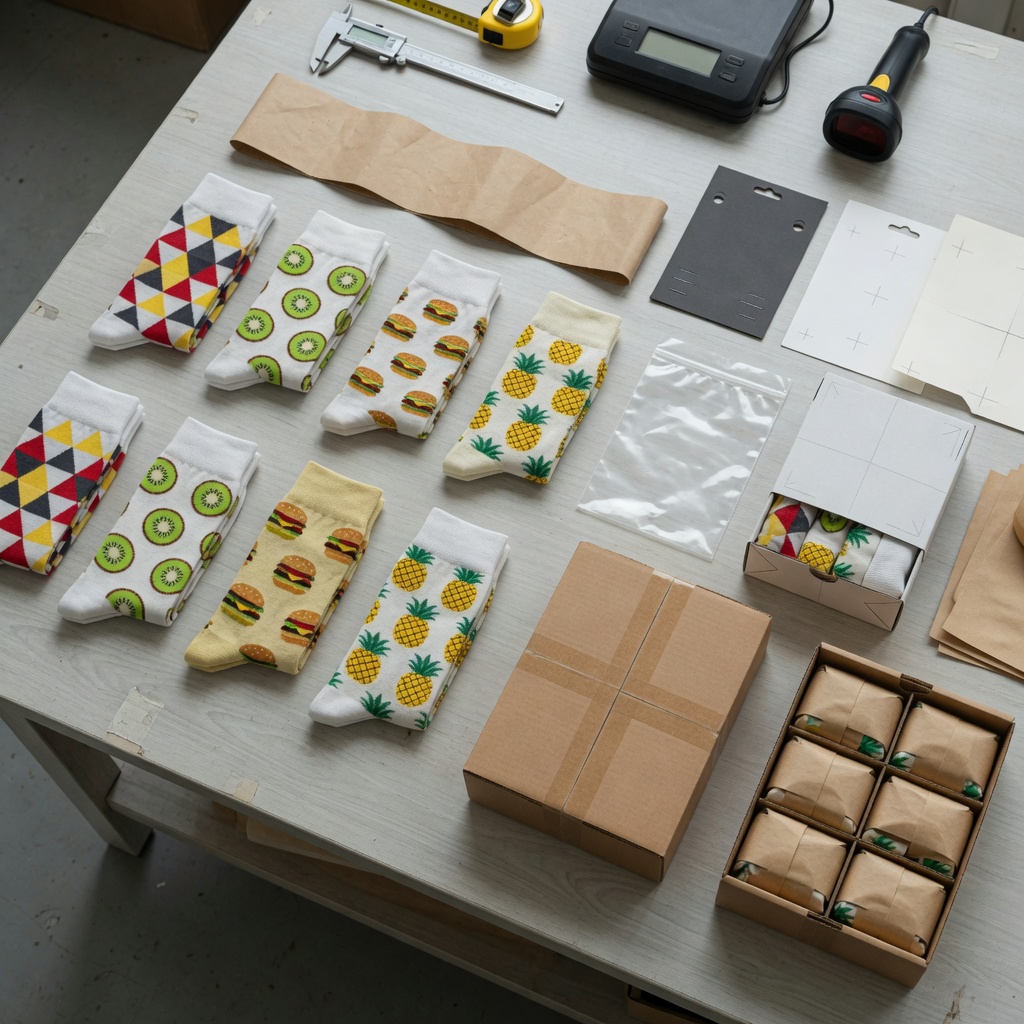
Use an assembled pre-production retail pack as the approval object for material, construction, artwork, folding, and presentation. The approval record should identify the controlled reference and state whether it covers material, colour reference, external dimensions, packed mass, fold, orientation, closure, label position, variable data, and visible condition. Treat a flat proof as artwork evidence only.
Before bulk packing release, require evidence appropriate to the attribute being checked:
- An assembled sample for component fit, fold, orientation, closure, and visible presentation.
- A controlled proof and approved content matrix for artwork and variable label data.
- A decoded scan reconciled with the buyer's SKU master where a barcode is required.
- A count record for sale units per inner and per export carton.
- A dated measurement record for finished pack dimensions, carton dimensions, net weight, and gross weight.
- A packed-carton image for visible condition, closure, marks, and carton sequence.
- Reconciled draft documents for descriptions, quantities, package counts, origin data, and New Zealand delivery details.
Photographs can support visible-condition and placement checks, but they should not be the sole evidence for dimensions, weight, decoded barcode data, or concealed quantities. Record substitutions and non-conforming packs separately and hold release until the buyer accepts the proposed disposition in writing.
Compare Packing Quotes and Record the Award
Require suppliers to return the same schedule, with the buyer requirement, supplier response, variance, included price, exclusion, evidence reference, and approval status shown for each field.
Classify the response as Comparable when the sale unit, components, artwork scope, inner packing, carton data, New Zealand handoff, and exclusions match the requested basis. Use Conditional when identified and priced assumptions still await specified evidence. Use Not comparable when core measurements, responsibilities, components, or exclusions remain undefined.
Compare packed cost per sale unit using separately stated packaging components, printing or setup, variable labels, application labour, export cartons, samples, and inspection. Include freight only when the handoff point, service scope, measurement basis, and exclusions align.
The award record should identify the approved packing-schedule revision, artwork revision, assembled-sample status, quoted measurements, inspection instruction, and permitted substitutions. Reference the same controlled items in the purchase order so that an alternative component or revised carton plan cannot be treated as approved by implication.
Methodology, Source Use, and Limitations
| Source context | How it was used | Boundary |
|---|---|---|
| Vincent Xi author profile | Supports the visible author name, Editorial Author role, and profile URL | Does not support additional credentials or first-hand manufacturing, testing, or customer claims |
| SaySock wholesale supplier guidance | Supports the use of quantity, SKU mix, carton planning, destination, packaging, labels, and delivery assumptions as wholesale RFQ inputs | Does not prove a supplier's capability, commercial terms, or New Zealand compliance |
| Sockswise packaging options | Supports considering packaging formats and confirming component, artwork, folding, dimension, label, carton, and shipping details | Does not make a format mandatory or prove that another supplier offers it |
| FTC textile and wool labelling guidance | Provides a jurisdiction-specific contrast for label review | Is not New Zealand legal evidence and was not applied as such |
The editorial method converted source-supported categories into buyer-defined RFQ fields, checklist items, and approval evidence without inferring supplier performance. The numerical scenario was derived only from the explicitly labelled buyer assumptions: allocation by division, carton count by division, carton volume by multiplication, and shipment totals by multiplying verified per-carton values by final carton count.
The cited evidence does not include an actual supplier quote, controlled packaging drawing, assembled sample, inspection report, freight tariff, retailer packaging manual, current certification document, legal opinion, or official New Zealand determination for the product. Before artwork release, freight booking, or award, verify the actual component materials, measurements, tolerances, label content, package warnings, claim substantiation, certification status, route, handoff point, and New Zealand sales-channel requirements. Record the source, applicable scope, source or access date, decision owner, and approval status for every verified item.
Discuss Your Requirements
Review our manufacturing capabilities, then share your specifications for a supplier-fit review.