Novelty Sock Wholesale Supplier Product Development Capability for Europe
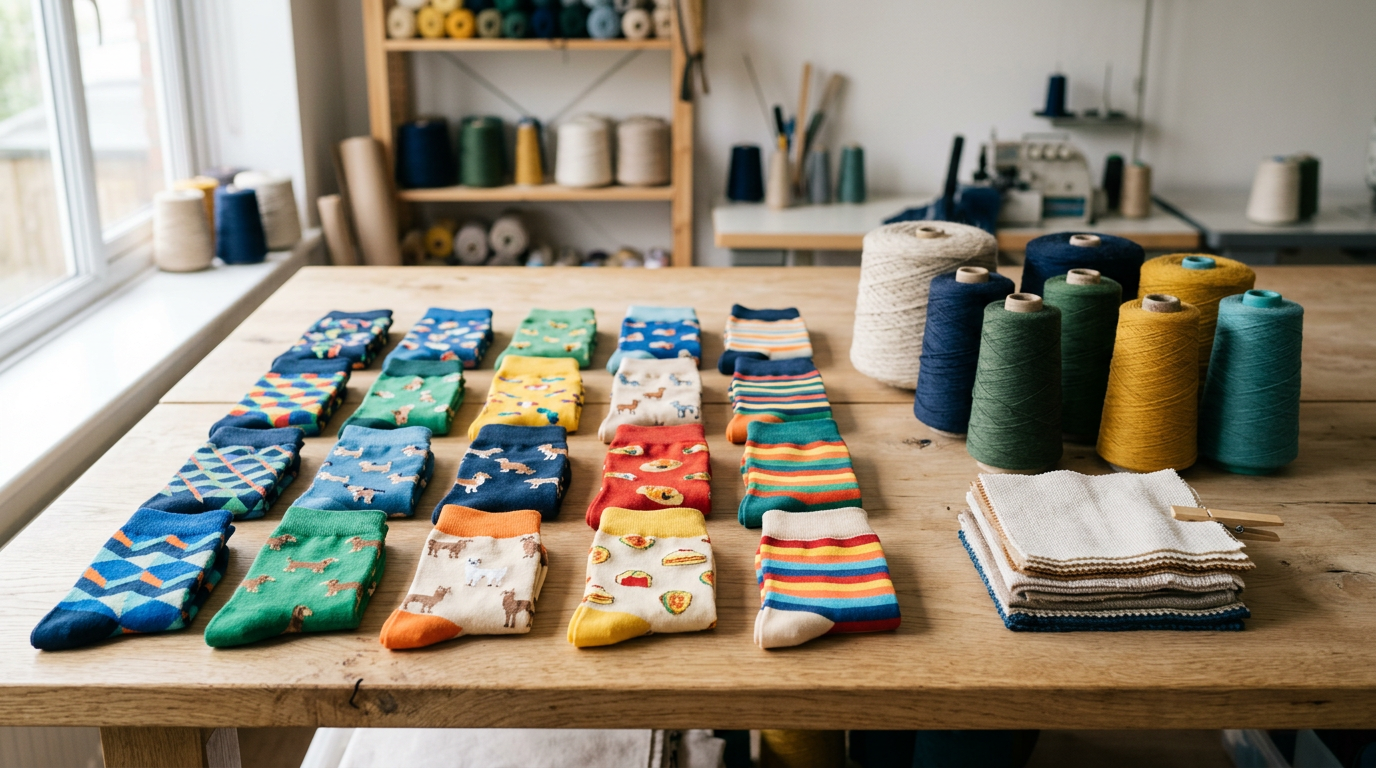
Novelty sock wholesale supplier product development capability is the practical question behind a wholesale order: can a supplier turn a buyer idea for a novelty sock into a defined product that can be sampled, checked, approved, and repeated for sale in Europe. For a European buyer, the value is not in a broad promise to develop products. It is in a clear process for artwork, materials, construction, sizing, packaging, sampling, approval, and repeat ordering, with each point agreed in writing before production begins.
This guide explains how to assess that capability as a procurement process. It focuses on the decisions a buyer and supplier must agree, the questions that reveal whether development work is organised, and the records that help both sides avoid rework. It does not describe a particular factory, a particular product range, or a particular outcome. A buyer should use it to compare suppliers on the same points, ask for documentation where a claim needs support, and record every agreed specification before placing a wholesale order.
What Product Development Capability Means for Novelty Sock Wholesale Supply in Europe
Product development capability, in this wholesale supply context, means the supplier can work from a buyer brief and produce a clear product definition. That definition should cover the novelty design, the sock construction, the yarn and colour choices, the size range, the intended wear and care, the packaging, and any labelling the buyer requires for the destination market. When those points remain vague, sampling becomes slower, approvals become harder to compare, and repeat orders become harder to reproduce.
A useful first check is how the supplier handles a brief. Ask how artwork is received, how colours are matched, how a design is placed on the sock, and how changes are recorded after a sample is reviewed. A supplier with an organised development process should be able to explain the sequence from brief to sample, who confirms each change, and what the buyer must approve before production. The buyer should also ask how the supplier handles artwork that cannot be reproduced as supplied, and how an alternative is proposed and approved.
Novelty design adds a further layer to that work. A pattern, character, motif, slogan, or seasonal theme may look clear on screen and behave differently when knitted, printed, or finished on a sock. The buyer should ask how the supplier checks legibility, placement, repeat, and colour balance across sizes, and how the supplier records the approved version. The buyer should also ask who owns the artwork supplied for the order, how the supplier stores it, and how it is used only for the agreed order. Those points are procurement controls, not design opinions, and they protect both sides when an order is repeated or changed.
For Europe, the buyer should keep destination requirements separate from product development. Rules can differ between the European Union, the European Economic Area, the United Kingdom, and individual countries, and a requirement that applies in one destination may not apply in another. The buyer should ask the supplier to confirm which destination the product is intended for, which documents the supplier can provide for that destination, and which labelling or packaging fields the buyer must supply. The buyer should not assume that one set of rules covers all of Europe, and should record the destination and the agreed documents with the order.
How to Compare Novelty Sock Wholesale Supply Development Processes
Comparing suppliers on product development capability works best when every supplier is asked the same questions and judged on the same evidence. A buyer should start with a written brief that describes the novelty design, the sock type, the intended wearer, the size range, the colour direction, the packaging, and the quantities under consideration. The brief should also state what the buyer will approve, and when approval is required, so the supplier can respond with a process rather than a general description.
The following process gives the buyer a consistent way to compare development work without relying on unsupported claims about experience or performance.
- Ask the supplier to describe the development sequence from brief to approved sample, including artwork handling, colour agreement, construction choices, and the points where buyer approval is required.
- Ask the supplier to explain how a sample is checked against the brief, how differences are recorded, and how a revised sample is identified so the buyer can tell one version from another.
- Ask the supplier to confirm which materials, yarns, colours, sizes, and packaging options are available for the requested novelty sock, and which choices must be agreed before sampling begins.
- Ask the supplier to explain how artwork changes, size changes, and colour changes are handled after a sample has been approved, and how the approved version is protected from later change.
- Ask the supplier to confirm what documents, photographs, or written records the buyer will receive with a sample, and how those records relate to the order that follows.
A supplier response should be judged on clarity and completeness. A clear response names the information the supplier needs, the decisions the buyer must make, and the records that will be kept. A vague response leaves artwork, colour, sizing, or approval open. The buyer should also check whether the supplier asks useful questions in return. A supplier that asks about the intended wearer, the size range, the colour direction, and the packaging is gathering the information needed to define the product. A supplier that asks for no detail may be working from an undefined product.
Sampling deserves particular attention. A sample is useful only when it can be compared with the brief and with the order that follows. The buyer should ask how the sample is labelled, how it is linked to the approved artwork and colour choices, and how the buyer should record approval. The buyer should also ask what happens when a sample does not match the brief, who pays for a revised sample under the agreed terms, and how many revisions the agreed process allows before the buyer and supplier must revisit the brief. Those points should be agreed before sampling, not after a dispute.
Repeatability is the other test of development capability. A novelty sock that can be made once but cannot be repeated with the same design placement, colour direction, and construction is difficult to use in wholesale supply. The buyer should ask how the supplier records the approved product definition, how a repeat order refers to that definition, and how a change in material, colour, or construction is proposed and approved. The buyer should also ask how the supplier handles a repeat order when the original artwork or colour reference is no longer available, and what the buyer must supply to restart the order.
Buyer Decision Table for Novelty Sock Wholesale Supply and Product Development Capability
Use the table below to compare suppliers on the same development points. Record the supplier answer for each row, and use the record as the basis for the order. A missing answer is itself a decision point, because it shows where the product definition is still open.
| Decision area | What the buyer and supplier must agree | Why it matters for the buyer |
|---|---|---|
| Brief and artwork | Artwork format, design placement, repeat, legibility, and ownership for the order | Keeps the novelty design defined and prevents later confusion about the approved version |
| Colour and material | Colour direction, yarn and material choices, and how colour agreement is recorded | Gives the buyer a clear basis for checking a sample and a repeat order |
| Construction and sizing | Sock construction, size range, fit direction, and how sizes are checked | Helps the buyer define the product for the intended wearer and compare samples fairly |
| Sampling and approval | Sample labelling, checking method, revision handling, and written approval | Makes approval traceable and links the sample to the order that follows |
| Packaging and labelling | Packaging format, labelling fields, and destination information supplied by the buyer | Keeps the delivered product aligned with the destination and the buyer order |
| Repeat ordering | Reference to the approved definition, change control, and records for a later order | Supports consistent repeat supply without redefining the product each time |
| Documents and records | Documents supplied with the sample and order, and how they are stored | Gives the buyer a written record to check delivery and acceptance against |
The table is not a substitute for the order itself. It is a working record that helps the buyer see where agreement is complete and where a question remains. When a row is left open, the buyer should ask for the missing information before approving a sample or placing a wholesale order. When a supplier cannot answer a row, the buyer should consider whether that supplier can support the development work the order requires.
Agreeing Artwork, Sampling, and Specifications for Novelty Sock Wholesale Supply in Europe
Agreement should happen in stages. The first stage is the brief, where the buyer describes the novelty design and the product requirements. The second stage is the sample, where the buyer checks the physical product against the brief. The third stage is written approval, where the buyer confirms the sample and the product definition that will be used for production. Each stage should be recorded, because a later question about colour, placement, or construction can usually be answered from the record.
Artwork agreement should cover more than the image itself. The buyer should agree how the design is placed on the sock, how it appears across sizes, how colours are described, and how a change is recorded. The buyer should also agree how the supplier will handle artwork that is supplied in a form that cannot be used directly, and what the buyer must provide to correct it. When artwork includes text, the buyer should check spelling, spacing, and legibility on the sample, and record the approved text in writing.
Sampling agreement should cover the purpose of the sample, the checks the buyer will carry out, and the decision that follows. The buyer should agree whether the sample is for design approval, construction approval, colour approval, packaging approval, or a combination of those points. The buyer should also agree how the sample will be labelled, how the buyer will record approval or rejection, and how a revised sample will be identified. A clear sampling agreement reduces the risk that a sample is approved for one purpose and then used for another.
Specification agreement should cover the fields that define the product for production and acceptance. Those fields can include the novelty design reference, the colour reference, the yarn and material description, the construction, the size range, the packaging, and the labelling fields. The buyer should ask the supplier to confirm each field in writing and to explain how a change to any field is proposed, approved, and recorded. The buyer should also ask how delivery will be checked against those fields, and what the buyer should do when a delivery does not match the agreed definition.
For a European destination, the buyer should keep the destination separate in the agreement. The buyer should state the destination country, ask the supplier to confirm which documents and labelling fields apply to that destination, and record the answer. The buyer should not treat a document supplied for one destination as proof for another destination, and should not assume that a packaging or labelling choice is suitable for every market in Europe. When the buyer is unsure about a destination requirement, the buyer should ask the supplier for the relevant documentation and seek independent advice before ordering, rather than relying on a general statement about Europe.
RFQ Checklist
Use this checklist when preparing a request for quotation. It keeps the request focused on the product development capability that the order depends on, and it gives the supplier the information needed to respond on the same points as other suppliers.
- Ask the supplier to confirm the development sequence from brief to approved sample, including artwork handling, colour agreement, construction choices, and buyer approval points.
- Require the supplier to explain how samples are labelled, checked against the brief, revised when needed, and linked to the order that follows.
- Specify the novelty design reference, colour direction, sock construction, size range, packaging format, and labelling fields that the supplier must confirm in writing.
- Ask the supplier to confirm which documents can be provided for the stated European destination, and to identify any field the buyer must supply.
- Require the supplier to explain how artwork changes, colour changes, and construction changes are handled after approval, and how the approved version is recorded.
- Specify the repeat-order reference, including how a later order will refer to the approved product definition and how changes will be proposed and approved.
- Ask the supplier to confirm the delivery and acceptance checks that will be used, including how the buyer should record a delivery that does not match the agreed definition.
Keep the completed checklist with the quotation, the sample record, and the order. When a supplier answer is unclear, ask for clarification in writing before approval. When a field is agreed, record it in the same place so the sample, the order, and the delivery can all be checked against one product definition. That record is the practical outcome of product development capability: a novelty sock that is defined, sampled, approved, and repeatable on terms the buyer and supplier have both agreed.
Discuss Your Requirements
Review our manufacturing capabilities, then share your specifications for a supplier-fit review.