Pet Sock OEM Customization Options for Europe: RFQ Brief
By Vincent Xi, Editorial Author
European B2B procurement teams can use this manufacturing RFQ brief to compare pet sock OEM customization options on a consistent basis. The core task is to define a buyer-owned specification, then require bidders to return availability, development needs, minimum order quantity, setup cost, unit-price effect, sample route, and schedule effect for every requested option.
The evidence boundary matters. The supplied Attirify pet-clothing page includes pet socks in a broader product range and describes grip, stretch, comfort, breathable and flexible materials, sizing consistency, solid or patterned styling, logo detailing, and seam-strength checks. These are statements from that supplier page, not independently verified specifications or performance results. The supplied GSSocks novelty pet-pattern crew-sock page concerns human crew socks with pet-themed motifs. Its references to artwork-derived motifs, jacquard or embroidered logos, header cards, and gift boxes are useful RFQ prompts, but they do not establish suitability or availability for socks worn by pets.
Pet sock OEM customization options for Europe
Use the following option matrix to turn broad customization language into measurable quote returns and approval gates. Where the sources provide no specification, the supplier should propose a value, method, and evidence rather than mark the item as generally compliant.
| Customization area | Source-supported boundary | Required supplier return | Approval gate |
|---|---|---|---|
| Product definition and fit | The Attirify page refers to sizing consistency but does not publish a pet-sock size chart, measurement method, or tolerance. | Intended pet and use; finished sales-unit definition; relaxed dimensions in millimetres; named measurement points; stretch-measurement method; grading method; tolerances in millimetres; and size-specific restrictions. | Measure a physical sample against the buyer-approved chart. A rendering or generic size name is not fit evidence. |
| Yarn and knitted body | The Attirify page uses breathable and flexible material descriptions but does not publish fibre percentages, yarn details, or a pet-sock knit specification. | Fibre composition in percent; yarn identifier or count; knit structure; gauge reporting method; colour reference; care conditions; substitution rules; and evidence supporting any performance statement. | Approve the specified yarn or knit swatch and a production-representative sock. Record sampling substitutions before bulk approval. |
| Grip customization | The Attirify page identifies grip as a product consideration but gives no chemistry, dimensions, coverage, thickness, adhesion result, wear method, or acceptance limit. | Gripper material family; application method and site; subcontracting status; pattern and placement dimensions in millimetres; coverage in percent; thickness in millimetres; colour; process tolerance; proposed validation method; conditioning; and result format. | Approve a physical grip sample and a documented buyer-approved test method. A supplier's visual check is an internal practice, not certification or proof of a performance threshold. |
| Ground colour and motif | The Attirify page mentions solid and patterned styling. The GSSocks page describes motifs derived from photos or artwork for a human crew sock. | Feasibility on the proposed pet-sock construction; accepted file formats; colour references; motif dimensions in millimetres; orientation; repeat; knit-resolution limits; simplification rules; conversion and setup charges; and revision allowance. | Approve converted technical artwork and a physical knitted sample. Human-sock motif capability is not evidence of pet-sock capability. |
| Logo method and placement | The Attirify page refers to logo detailing. The GSSocks page describes jacquard and embroidered logos at the cuff or footbed of its human sock. | Proposed method; logo width and height in millimetres; colour references; placement distances in millimetres; inner-face construction; effect on stretch; setup charge; MOQ treatment; and production location. | Inspect the physical sample on both faces. Do not transfer a human-sock method to a pet sock without construction-specific evidence. |
| Packaging customization | The GSSocks page names header cards and gift boxes for its human product. It does not establish packaging capability for a pet-sock sales unit or a named European destination. | Pack type; socks per sales unit; packaging material specification; flat and packed dimensions in millimetres; packed mass in grams; print method; dieline ownership; print and destination-version MOQs; setup and assembly charges; barcode responsibility; carton quantity and dimensions; carton mass in kilograms; and mixed-carton rules. | Approve the dieline, print proof, assembled pack, and destination version. Keep packaging charges and MOQs separate from the base pet-sock quote. |
| Quality and traceability | The Attirify page states that seam strength is checked but does not disclose the method, frequency, sampling plan, threshold, result, or record format. | Measurement and inspection methods; sample selection; check frequency; defect categories; acceptance rules; seam, grip, placement, and pack checks; record format; retain-sample period; failed-lot process; material traceability; and subcontracted operations. | Put buyer-defined acceptance rules in the purchase documents. Do not present the source page's seam check as a standard requirement, test result, or certification. |
The cited pages do not establish that their referenced yarn, grip, motif, logo, and packaging choices can be combined on the same pet sock. Require combination-specific confirmation, a physical sample using the proposed construction, and disclosure of outsourced operations before approval.
For every option, ask the bidder to classify its status as available, available with development, or unavailable. The quote should then show the effect on MOQ, setup charges, unit price, sampling, and schedule without combining those effects into an unexplained total.
Example RFQ data for quote normalization
All figures below are editorial example assumptions for a hypothetical European pet-sock sourcing exercise as of 1 March 2025. They are not facts from the cited pages, market benchmarks, or supplier promises. Every figure must be confirmed or replaced in a dated supplier quote before it is used for purchasing.
| Example data point | Scope and derivation | Procurement purpose | Source status and verification |
|---|---|---|---|
| 4 pet socks per finished sales unit | Unit: pet socks per retail sales unit. Scope: the hypothetical pet-worn style. Loose-sock quantities are divided by 4 pet socks to normalize the quote to finished sales units. | Prevents comparison of a per-sock price with a per-set price. | Editorial example assumption as of 1 March 2025; not stated by either manufacturing source. Verify count, assembly method, and price basis in the supplier's dated quote. |
| 4 sizes x 2 colourways x 1 motif = 8 SKU combinations | Units: size variants, colourway variants, motif variants, and resulting SKU combinations. Scope: the hypothetical program using a common knit, grip specification, motif, and base pack. The variant counts are multiplied to derive 8 SKU combinations. | Reveals whether setup charges and MOQs apply by size, colourway, motif, packaging version, or aggregated order. | Editorial example calculation as of 1 March 2025; not stated by either manufacturing source. Verify the bidder's SKU definition, aggregation rules, and MOQ triggers in the quote. |
| Quote breaks at 250, 500, and 1,000 finished sales units per SKU | Unit: finished sales units per SKU. Scope: every SKU in the hypothetical 8-SKU program, with currency, Incoterm, delivery point, and inclusions returned separately. | Produces comparable price breaks without presenting the quantities as normal market MOQs. | Editorial example assumption as of 1 March 2025; not stated by either manufacturing source. Verify offered quantities, capacity, price validity, and exclusions in the supplier's dated quote. |
| Dimensional review of 10 finished sales units per size | Unit: finished sales units inspected per size. Scope: every size in the hypothetical 4-size program, measured against the buyer-approved chart using the agreed method. | Gives bidders a defined inspection request from which to propose a sampling plan; it is not an acceptance standard. | Editorial example assumption as of 1 March 2025; not stated by either manufacturing source. Verify selection method, tolerances, responsibility, and acceptance rule before order placement. |
| 3 physical approval stages | Unit: approval stages. Scope: fit and construction sample, production-representative sample, and assembled destination-pack sample for the hypothetical style. | Separates early development approval from approval of the proposed bulk construction and destination packaging. | Editorial example assumption as of 1 March 2025; not stated by either manufacturing source. Verify fees, timing, materials, processes, production site, and release authority for every stage in the supplier's dated quote. |
For price comparison, require separate lines for the base pet-sock cost, yarn, grip, motif, logo, packaging, artwork, setup, samples, and inspection. The quote should identify whether each charge is recurring, version-specific, refundable, or conditional on order quantity.
Europe destination packaging customization options
This section defines manufacturing file controls, not legal requirements. Neither supplied manufacturing source establishes what applies in any European destination. The buyer's qualified compliance owner should determine the applicable product information, operator details, language, material declaration, warning, care information, packaging mark, recycling information, test, and document requirements for the named destination.
EU destination file: Name the intended EU destinations in the RFQ and provide buyer-approved copy, artwork, document requirements, and version identifiers. Ask the manufacturer to quote the print MOQ, setup charge, packing charge, schedule effect, and carton segregation for every approved version. A generic claim of Europe-wide compliance is not destination evidence.
EEA destination file: Where the buyer's review uses an EEA designation, record the named destination, approved artwork, and required evidence. Do not use EEA as a shortcut for a region-wide packaging or language version, and do not assume that a generic EU file resolves every destination decision.
UK destination file: Maintain a distinct UK-bound artwork, document, quotation, and approval record. Require the supplier to identify the documents covering the quoted product, material, manufacturing site, and process. Do not carry an EU or EEA approval into the UK file without destination-specific confirmation from the buyer's compliance owner.
Country-specific European file: Create a destination version wherever the buyer's review identifies different copy, artwork, documentation, or packaging treatment. The supplier should return the version-specific print MOQ, setup cost, packing cost, sample route, carton split, and schedule effect.
When a regulation, standard, or test method is included in the RFQ, state its exact title, edition or date, product scope, test conditions, acceptance criterion, required report issuer, and document-validity requirement. Distinguish requirements from a regulation or standard from a manufacturer's own inspection practice. Do not imply supplier or product certification without a current document whose product, material, manufacturing-site, process, date, and destination scope have been checked.
Samples, QC, and change control
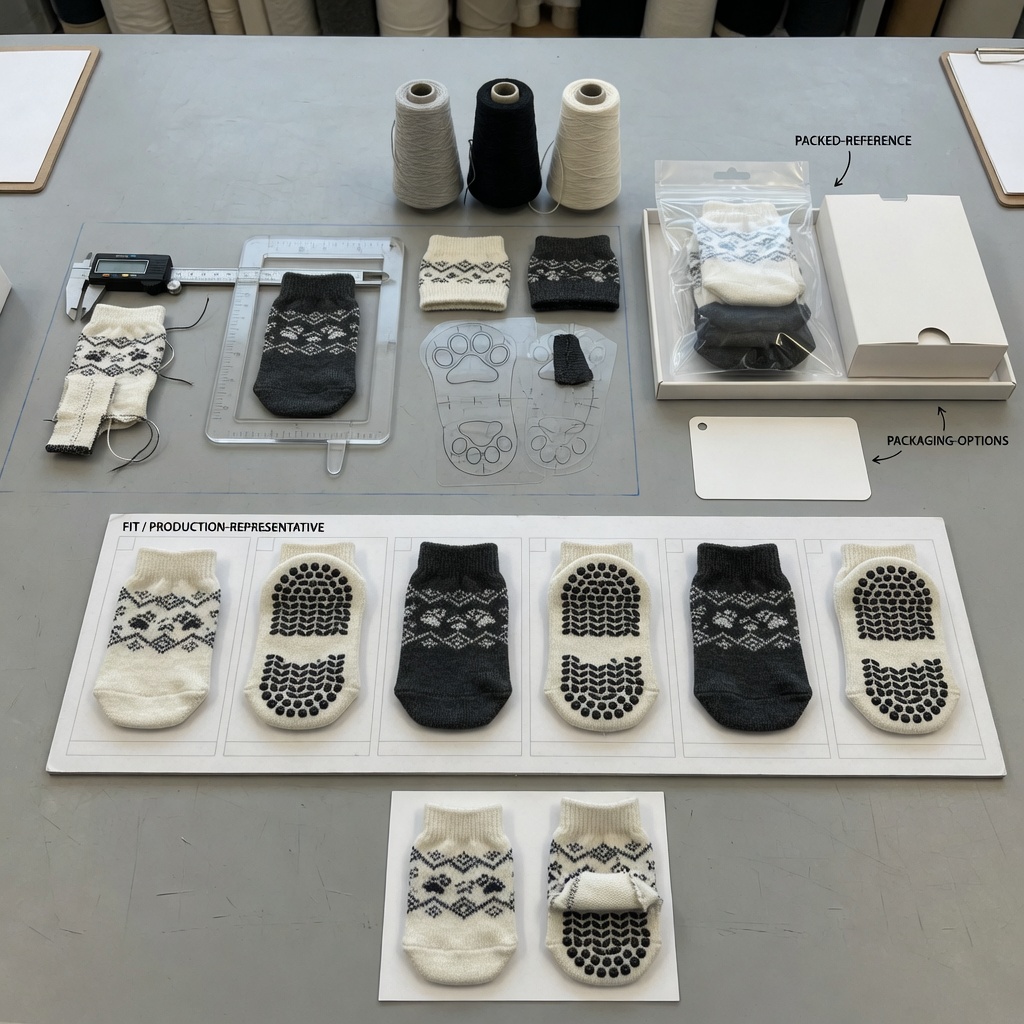
Digital artwork approval confirms only the submitted artwork revision. It does not establish finished pet-sock dimensions, stretch behaviour, grip construction, seam condition, inner-face logo construction, or assembled-pack presentation. Define the evidence required for every physical sample and state which activity the approval releases.
Fit and construction sample: Require the proposed yarn, knit construction, finished-measurement method, size chart, seam construction, and grip layout. Any sampling material or process that differs from the quote should be recorded with an explanation of the intended bulk version.
Production-representative sample: Require the quoted yarn, construction, grip process, motif conversion, logo method, manufacturing route, and subcontracting route. Inspect dimensions, grip placement, motif orientation, outer and inner surfaces, and any buyer-defined functional result obtained through the agreed method.
Assembled destination-pack sample: Require the approved sales-unit count, packaging material, dieline, artwork revision, barcode treatment, packed dimensions, packed mass, and carton-segregation identifier for the named European destination.
The Attirify seam-strength statement remains a description of that page's stated practice. Ask every bidder for its method, equipment, sample selection, check frequency, acceptance threshold, result format, record retention, and failed-result procedure. Define separate controls for finished measurements, grip placement, motif and logo placement, pack count, destination artwork, and unapproved substitutions.
Identify each approved physical reference by style, size, colourway, yarn revision, artwork revision, grip revision, logo revision, and packaging revision. Require written change control before altering yarn, gripper material, knit construction, artwork conversion, logo process, packaging stock, production site, or subcontracted operation.
Practical RFQ checklist for European pet sock customization options
Complete this checklist before issuing the RFQ, comparing bids, or approving the manufacturing order:
- [ ] Define the quoted product as a sock worn by a pet, including intended use and finished sales-unit contents.
- [ ] Attach the buyer-owned size chart with measurement points, units, stretch method, grading method, and tolerances.
- [ ] Identify required yarn, knit, colour, grip, motif, logo, and packaging options, while marking any field the supplier must propose.
- [ ] Provide controlled artwork files, colour references, placement dimensions, revision identifiers, and permitted conversion rules.
- [ ] Separate EU, EEA, UK, and country-specific destination files wherever the buyer's compliance review requires different artwork or evidence.
- [ ] Require an available, available with development, or unavailable response for every customization combination.
- [ ] Request separate MOQ, setup charge, unit-price effect, sample cost, and schedule effect for each option and destination version.
- [ ] Define the required fit, production-representative, and assembled destination-pack sample approvals.
- [ ] Require inspection methods, sample-selection rules, acceptance criteria, records, traceability, and failed-lot procedures.
- [ ] Ask for current destination evidence with its product, material, manufacturing-site, process, date, and destination scope.
- [ ] Require disclosure of subcontracted operations, sample-to-bulk differences, substitutions, and manufacturing-location changes.
- [ ] Record all deviations and make bulk release conditional on written approval and controlled physical references.
The following return schedule provides the detailed fields behind the checklist.
| Return section | Required bidder response |
|---|---|
| Quote identity | Supplier legal name, quoted manufacturing location, quote date, validity period, currency, Incoterm, named delivery point, and technical contact. |
| Product definition | Confirmation that the quoted item is a pet-worn sock rather than a human sock with pet artwork; intended pet and use; construction description; and finished sales-unit count. |
| Option matrix | Available, available with development, or unavailable for every requested size, yarn, grip, motif, logo, packaging, and destination-version combination. |
| Measurements and materials | Measurement points, relaxed dimensions, stretch method, tolerances, grading method, fibre percentages, yarn specification, knit construction, colour route, and substitution controls. |
| Grip, motif, and logo | Manufacturing method, dimensions, placement, tolerances, artwork constraints, subcontracting, setup charges, MOQ treatment, price adders, and sample evidence for every option. |
| Packaging | Pack format, sales-unit assembly, material specification, dieline owner, print method, proof route, MOQ, barcode responsibility, packed dimensions and mass, carton data, and destination-version controls. |
| MOQ and pricing | MOQ triggers by construction, size, colourway, motif, logo method, packaging type, and destination version; permitted aggregation; base price; customization adders; setup, sample, inspection, and packaging charges; and exclusions. |
| Samples and schedule | Sample type, fee, refund status, materials and processes used, sample-to-bulk differences, approval trigger, revision charge, production location, development periods, and proposed dispatch basis. |
| Quality and change control | Inspection methods, sample selection, check frequency, defect categories, acceptance rules, records, retain samples, failed-lot process, approved references, and notification requirements for changes. |
| Destination evidence | Buyer-requested documents; document owner; issue and expiry status where applicable; product, material, manufacturing-site, process, and destination scope; and unavailable evidence. |
| Subcontracting and traceability | Operations completed outside the quoted facility, controls applied to those operations, lot identification, material traceability, and notice requirements for site or process changes. |
| Commercial controls | Payment triggers, inspection rights, artwork ownership and permitted use, confidentiality, remedies for nonconforming goods, cancellation treatment, and cost responsibility after approved changes. |
A quote is not comparison-ready if it omits the sales-unit definition, hides variant-specific MOQ triggers, combines base and customization costs, supplies only a digital mock-up, substitutes a human novelty sock for a pet-sock sample, relies on an unsupported Europe-wide compliance statement, or fails to identify sample-to-bulk differences.
Shortlist bidders that complete the option matrix, provide construction-specific evidence, identify MOQ and setup triggers, disclose subcontracting, bind bulk production to approved references, separate destination versions, and accept written change control. Keep the award conditional on the approved production-representative pet sock, approved destination-pack sample, and current evidence identified by the buyer's compliance owner for the named European destination.
Evidence methodology and limitations
Pet-clothing source context: The Attirify pet-clothing page includes pet socks and describes grip, stretch, comfort, breathable and flexible materials, sizing consistency, styling, logo detailing, and seam-strength checks. This article attributes those descriptions to the page. It does not treat them as independently verified results, quantified specifications, or capabilities shared by other manufacturers.
Human novelty-sock source context: The GSSocks crew-sock page concerns a human sock with pet-themed decoration. It supports only the statement that the page describes photo- or artwork-derived motifs, jacquard or embroidered logo placements, and named packaging formats for that human product. Those details are converted into pet-sock RFQ questions, not claims of transferability or availability.
Author basis: The byline and editorial role follow Vincent Xi's author profile. The profile is used for authorship attribution only.
Methodology: Source statements were separated from buyer-defined manufacturing controls. Each supported customization reference was mapped to its source and product scope, then converted into a measurable quote field, physical approval request, or risk control. Quantitative values appear only as explicitly labelled editorial assumptions with units, scope, derivation, scenario date, source status, and supplier-verification action.
Limitations and items to verify: The supplied manufacturing sources do not establish current pet-sock fibre percentages, yarn specification, dimensions, tolerances, grip composition, coverage, thickness, test methods, results, motif constraints, logo suitability, packaging suitability, MOQ, prices, setup charges, sample timing, production lead time, capacity, destination-specific requirements, or current certification. No source publication or update date was supplied in this package. Verify capability through a dated quotation, construction-specific samples, buyer-approved test methods, current destination evidence, approved packaging, production-site scope, subcontractor disclosure, and contractual change control before bulk approval.
Discuss Your Requirements
Review our manufacturing capabilities, then share your specifications for a supplier-fit review.