Pet Sock OEM Packing Requirements for European Buyer RFQs
By Vincent Xi, Editorial Author
Pet sock OEM packing requirements for Europe belong in a controlled RFQ annex, not under a loose instruction such as standard export packing. A comparable quotation identifies the named destination, saleable-unit contents, packaging bill of materials, finished dimensions and tolerances, artwork responsibilities, barcode data, carton configuration, approval samples, inspection evidence, commercial terms, and change controls.
Classify the destination as an EU member state, a non-EU EEA country, the UK, or another named European country. This classification routes the pack through the correct buyer review; it does not establish which legal requirements apply. The buyer, importer, retailer, marketplace, or appointed compliance adviser should confirm destination- and channel-specific content before artwork release.
Keep packaging materials, printing, packing labor, setup, tooling, inspection, and unused-material treatment separate from pet sock manufacturing costs. The quotation should also identify the event that starts each lead-time stage.
The commercial sources cited here provide source-scoped RFQ prompts. They do not establish another supplier's current capability, quotation, certification, or destination compliance.
Europe RFQ Release Gate for Pet Sock OEM Packing Requirements
Use this release gate before comparing final quotations. Leave missing supplier information open rather than converting it into an assumed capability.
| Decision | Buyer RFQ input | Required supplier return | Hold approval when |
|---|---|---|---|
| Destination and channel | Named European country, EU/non-EU EEA/UK classification, sales channel, market-version matrix, and approval owner | Artwork register linking every SKU to its destination version | The destination is listed only as Europe or an artwork version is reused without buyer approval |
| Saleable unit | Pet sock SKU, size and color assortment, pack quantity, matching rule, orientation, and presentation requirements | Pack-out drawing and assembled sample using production-representative socks | The quotation does not define a complete saleable unit |
| Packaging BOM | Components, materials, dimensions, tolerances, finishes, closures, and permitted substitutions | Component specification, part references, prices, MOQs, and supporting evidence | A format name is returned without construction details |
| Artwork and data | Buyer-owned artwork, revision, language version, barcode payload, traceability fields, warnings, and approved claims | Proof, data checklist, version record, and agreed verification evidence | The supplier is expected to create, translate, or approve buyer-controlled compliance content |
| Physical approval | Structural sample requirement, representative socks, and acceptance criteria | Blank structural sample where needed, printed pre-production pack, and signed reference sample | Approval relies only on a screen proof while fit, closure, retention, or finish remains untested |
| Packing inspection | Defect definitions, sampling method, acceptance criteria, carton rules, and required records | Inspection plan, measured sample report, lot linkage, and final pack-out record | Acceptance is described only as standard QC or good quality |
| Commercial approval | Component MOQ matrix, currency, delivery term and named place, quote validity, tooling ownership, schedule basis, and leftover-material treatment | Itemized quotation and stage schedule with dependencies | Packaging cost or timing is hidden within the sock-production line item |
State the approval sequence in the purchase documents: buyer data matrix, structural proposal, artwork proof, physical sample, bulk-material release, packing inspection, and shipment release. Assign an approval owner to each stage and define which document controls if the purchase order, artwork, specification, and physical reference sample conflict.
Define the Saleable Unit and Packaging BOM
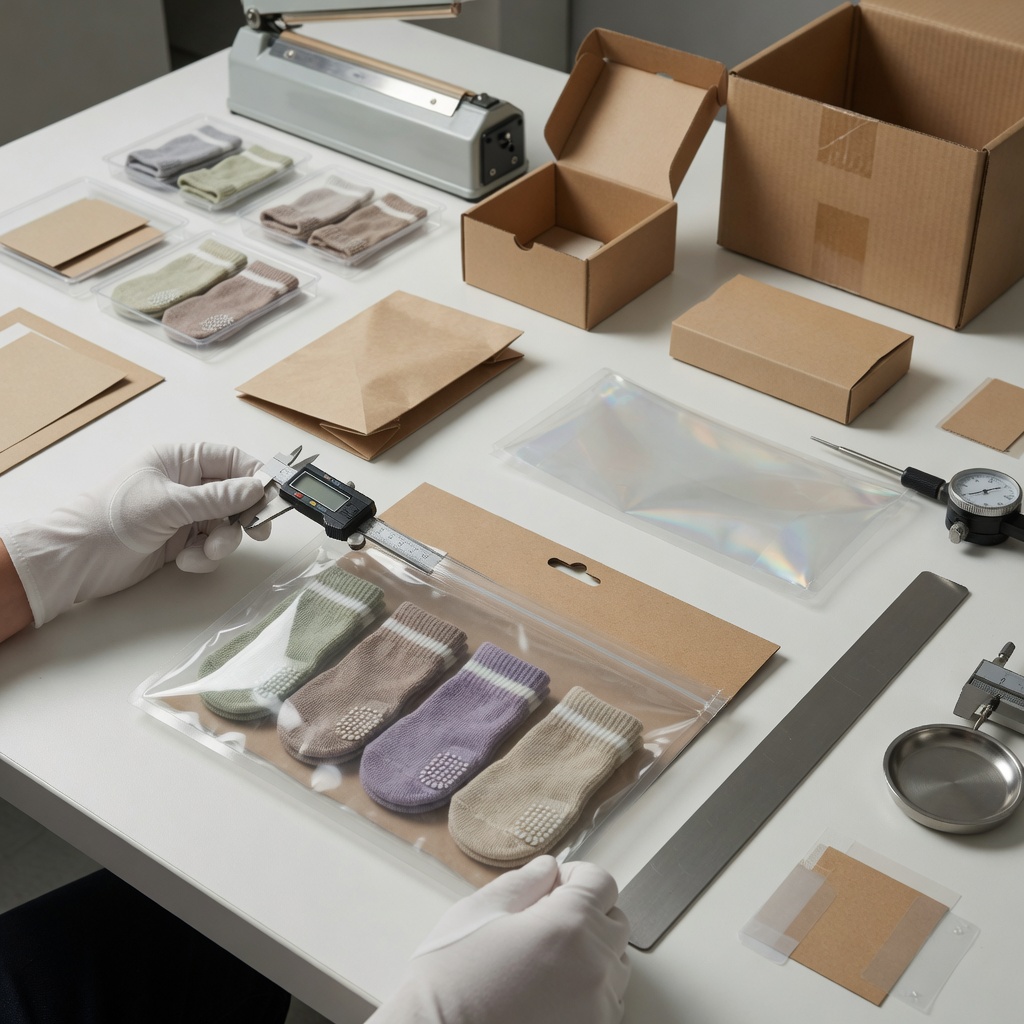
Start with the exact pet sock configuration intended for sale. Specify the SKU, size and color mix, design variant, pack quantity, matching rule, permitted substitutions, and whether the variant must be identifiable without opening the pack. If grip print, raised decoration, or another construction feature affects folding, require the proposed fold and orientation to be demonstrated with representative socks.
| RFQ field | Required specification | Supplier evidence |
|---|---|---|
| Product presentation | Fold direction, cuff position, visible face, grip orientation where applicable, insert position, and permitted movement | Assembled reference sample and pack-out images linked to the approved SKU |
| Containing components | Pouch, sleeve, card, insert, tie, sticker, seal, retail carton, liner, or other quoted component | Component list with part reference and intended function |
| Material | Material identity, grade, color, finish, thickness or basis weight, coating, adhesive, and buyer-selected tolerance | Current specification or declaration for the exact quoted component |
| Finished dimensions | Width, height, depth, hang-hole position where used, seal location, and measurement method | Dimensional report for the assembled pack rather than only an empty mock-up |
| Printing | Process, color references, finish, artwork filename, revision, language version, and buyer-defined rub criterion | Approved proof and production-sample comparison |
| Variable data | Buyer-supplied barcode symbology and payload, SKU identifier, lot fields, traceability fields, warnings, and disposal content | Data-verification record and scan evidence where a barcode is used |
| Inner and master cartons | Pack quantity, arrangement, dimensions, net mass, gross mass, closure, liner requirement, and shipping marks | Carton specification and completed pack-out report |
| Shipment handling | Stacking and palletization where in scope, mixed-SKU rules, carton identification, and receiving-unit configuration | Shipment plan matched to the destination purchase order |
Require written buyer approval before changing a material, thickness, basis weight, dimension, adhesive, print process, artwork version, subcontractor, pack count, carton arrangement, or assembly method. The change request should identify the affected SKU and market version, existing and proposed specifications, reason, price effect, schedule effect, and supporting sample or document.
Quote Each Pet Sock Pack Format Separately
Goren Socks lists branded polybags, hang tags, sleeve cards, retail boxes, gift sets, and environmentally positioned packaging among the options discussed on its OEM socks page (source). These are option prompts from that source, not proof that the quoting supplier offers the same formats or terms for pet socks.
| Pack format | RFQ controls | Approval evidence |
|---|---|---|
| Flexible pouch with card or hang tag | Film identity and thickness, dimensions, closure, seal, ventilation if proposed, card material, hang-hole construction, and artwork position | Material declaration, sealed sample containing representative socks, dimensional report, and agreed seal check |
| Paper sleeve or wrap card | Paper grade, basis weight, fold, lock, adhesive if used, finish, hang-hole construction, and retention criterion | Assembled sample, retention result, rub result, and approved artwork |
| Printed retail carton | Board grade, internal and external dimensions, closure, insert, finish, movement allowance, and carton-performance criterion | Approved dieline, assembled sample, dimensional report, and closure result |
| Presentation set | Assortment map, insert layout, component BOM, orientation rule, variant check, and substitution prohibition | Fully assembled reference sample and documented assortment inspection |
| Bulk configuration for packing in Europe | Bundle method, quantity control, product protection, carton arrangement, receiving inspection, and responsibility split | Open-carton sample, count evidence, condition criteria, and approved receiving plan |
Compare each format on the same boundary: finished dimensions, material identity and mass by component, component MOQ, setup or tooling, printing, assembly, inspection, carton utilization, packaging-related freight input, and schedule dependency. A format name alone establishes none of those values.
Separate EU, Non-EU EEA, UK, and Country-Specific Packing Requirements
Market classification is an RFQ version-control tool, not a conclusion about legal applicability.
| Market scope | Buyer-controlled input | Supplier-controlled return | Approval boundary |
|---|---|---|---|
| EU member-state destination | Named country, channel, approved languages, buyer-confirmed commercial-party data, traceability fields, warnings, and disposal content | Artwork proof and SKU register tied to the buyer's destination matrix | Approval applies only to the named destination and recorded version |
| Non-EU EEA destination | Named country, importer information, approved languages, and buyer decision on whether fields from an EU version may be reused | Separate artwork version or documented field comparison | Do not infer equivalence from EEA participation |
| UK destination | UK channel, buyer-supplied commercial-party data, approved language and consumer-facing content, and a separate version identifier | UK artwork proof, completed data checklist, and traceability record | Confirm the UK version independently from an EU version |
| Other named European destination | Country, channel, importer or distributor data, approved languages, and locally reviewed artwork fields | Country-specific proof and completed buyer checklist | Do not release artwork from a generic European template |
| Retailer or marketplace overlay | Current retailer manual, listing data, barcode owner, fulfillment rules, approved pack dimensions, and buyer-confirmed content fields | Completed retailer checklist, scan evidence, measured pack data, and carton configuration | The sample, artwork, listing data, and retailer requirements must agree |
The Pecpets page uses the word mandatory for suffocation warnings on polybags within its own OEM pet-apparel offer (source). The supplied source context identifies neither a jurisdiction nor a legal basis for that wording. Treat it as the source's disclosed practice, not evidence of a requirement across the EU, non-EU EEA, UK, or another European destination. The buyer's designated reviewer should confirm applicability, wording, language, placement, and presentation before printing.
Make Packing Requirements Measurable
A quotable requirement states the nominal value, tolerance, unit, measurement or observation method, sample scope, production stage, evidence record, and approval owner. Use consistent units in the drawing, component specification, quotation, sample report, inspection report, and purchase order.
For flexible material, request material identity, nominal thickness, tolerance, finish, closure, seal construction, measurement method, and relevant storage conditions. For paper or board, request grade, basis weight, caliper where relevant, coating, adhesive, finish, and the evidence scope for any material claim. For the assembled pack, specify finished dimensions, total mass, fold position, component alignment, permitted movement, closure condition, and cosmetic boundaries.
Every value below is an illustrative buyer assumption created only to demonstrate RFQ syntax. These values are not sourced product specifications, legal thresholds, ZheSock capabilities, or supplier offers. Verify each assumption in the supplier quotation, drawing, and physical approval sample before use.
| Example assumption to verify in the supplier quote | Unit and scope | Example verification method |
|---|---|---|
4 individual pet socks per saleable unit | Unit is individual socks; scope is a hypothetical matching set for a specified SKU and destination version | Count during pack-out and compare the assortment with the buyer-approved SKU record |
140 mm wide x 180 mm high, each dimension +/- 2 mm | Unit is millimetres; scope is the finished sealed pouch containing the illustrative saleable unit | Measure the outermost finished edges on a flat surface without compressing the contents |
50 micrometres nominal film thickness, +/- 5 micrometres | Unit is micrometres; scope is the flexible film in the illustrative pouch option | Measure agreed film locations with a calibrated thickness instrument and record the method |
100 saleable units per master carton, 12 kg maximum gross mass | Units are saleable units and kilograms; scope is the illustrative master-carton pack-out | Count sealed units, weigh the closed carton, and record the result against the carton identifier |
Do not transfer an example assumption between sizes, constructions, or pack formats without a new fit and handling review. The supplier return should replace each example with an order-specific proposal or explicit exception.
Goren Socks places branded packaging after quality control in the workflow described on its page (source). A buyer can convert that reported sequence into an order-specific control by requesting records for the packed product lot, release authority, packaging-material lots, artwork revision, and pack-out date. This is a proposed buyer control, not evidence that another supplier follows the same workflow.
Defect classes should reflect purchasing consequences:
- Critical: buyer-designated conditions such as an incorrect SKU, unauthorized destination version, unapproved warning or traceability field, safety-relevant foreign matter, or unauthorized material substitution.
- Major: buyer-designated conditions such as an open seal, wrong assortment, missing component, unreadable or incorrect barcode, material outside the approved tolerance, or artwork assigned to the wrong destination.
- Minor: buyer-designated cosmetic conditions such as scuffing, positioning variation, or folding inconsistency within stated acceptance boundaries.
These are proposed purchasing classes, not sourced legal classifications. Define the sampling method, acceptance and rejection criteria, reinspection rule, and disposition authority for each class. If an inspection standard is selected, record its applicable edition and inspection parameters. Using a standard as an inspection method does not establish product, packaging, or supplier certification.
For barcodes, identify the buyer-selected symbology, data owner, encoded payload, placement, quiet-area requirement, print-quality criterion, and verification method. A printed barcode does not prove that its identifier, payload, or ownership is correct. Require verification against buyer-supplied data and the agreed scan or grade record.
Keep Source-Reported Figures Within Their Evidence Boundaries
The cited commercial pages contain the following concrete figures. Their supplied citation records do not include publication or update dates, so each figure needs confirmation in a current supplier quotation or document.
| Source-reported figure | Unit, scope, date context, and source | Permitted RFQ use and limitation |
|---|---|---|
20-30 days | Unit: days. Scope: the bulk-production stage in the OEM sock workflow described by Goren Socks, with packaging shown after quality control. Date context: undated in the supplied citation record. The source does not state whether the range uses working days or calendar days (source). | Use only as a question prompt. Request the quoting supplier's duration, clock-start event, day basis, packaging-material lead time, capacity assumptions, and approval dependencies. It is not a ZheSock commitment. |
100 percent biodegradable PLA | Unit: percent. Scope: the Pecpets wording for PLA polybags associated with its own OEM pet-apparel offer. Date context: undated in the supplied citation record (source). | Treat it only as an attributed source claim. Request composition, test or declaration scope, applicable end-of-life conditions, document date, and confirmation for the exact quoted film before approving material or artwork claims. |
350 grams per square metre | Unit: grams per square metre. Scope: the kraft hang-tag example on the Pecpets OEM pet-apparel page. Date context: undated in the supplied citation record (source). | Use basis weight as a supplier-return field. Confirm the paper grade, caliper, stiffness, finish, dieline performance, and production sample. Basis weight alone is not physical approval. |
These attributed figures do not establish ZheSock capabilities, universal manufacturing performance, legal compliance, or current certification.
Compare MOQ, Schedule, and Packing Cost
Request a component-level MOQ matrix. Separate the pet sock manufacturing MOQ from the MOQ for every printed pouch, card, sleeve, carton, label, destination version, language version, artwork revision, size, color, and packaging subcontractor. Require a written disposition for unused printed components, including ownership, storage, transfer, return, disposal, and related charges.
GreenTime associates OEM control over labeling and packaging with higher MOQs than less-customized ODM arrangements on its comparison page (source). The supplied source context gives no component-level quantity for a pet sock quotation. It supports an RFQ question about MOQ structure, not a numerical assumption.
Separate the schedule into artwork freeze, material procurement, print proof, structural or pre-production sample approval, bulk product release, packing, outbound inspection, and shipment handover. For each stage, record the clock-start event, working-day or calendar-day basis, buyer dependency, and effect of a delayed approval or change request. Packaging-material timing should remain separate from sock-production timing.
Use the following only as an example calculation structure to verify in the supplier quote:
Comparable packing cost per saleable unit = packaging components + allocated setup and tooling + printing + assembly + packing inspection + carton allocation + packaging-related freight input + agreed rework allowance
The formula contains no quoted price. Verify every input and record the currency, quote-validity date, order quantity, SKU mix, destination-version mix, delivery term and named place, tax treatment, tooling ownership, storage charge, and rework basis.
Control Packaging Material and Environmental Claims
Treat eco-friendly, biodegradable, compostable, recyclable, and recycled content as evidence-controlled claims. Before approval, request the exact component covered, material composition, applicable conditions, test method, document issuer, tested sample, issue date, validity, and relationship between the evidence and the proposed production material.
For film, verify composition, thickness, closure or seal behavior, storage limits, and the buyer-confirmed disposal route for the named destination. For paper and board, verify grade, basis weight, coatings, adhesives, inks, and support for any sourcing or recycled-content statement. Do not print a certification mark unless current authorization covers the relevant organization, material, scope, and proposed artwork. A material declaration, test report, or use of a standard does not by itself establish certification.
Environmental evidence does not replace physical pack approval. Inspect the finished design with production-representative pet socks and define acceptance for closure, retention, contamination protection, pack condition, and product deformation relevant to the approved presentation.
Evidence Method, Author Basis, and Limitations
Methodology: Source statements were confined to the product and commercial context of the page on which they appear. Goren Socks was used only for its reported OEM workflow, packaging-option examples, and stated bulk-production range (source). Pecpets was used only for attributed packaging, warning, PLA-polybag, and kraft hang-tag statements within its own pet-apparel offer (source). GreenTime was used only for its OEM-versus-ODM comparison concerning labeling, packaging control, and MOQ direction (source). Those source statements were converted into RFQ questions, document requests, and approval controls; they were not treated as legal authority, universal supplier capabilities, or proof about ZheSock.
Author basis: Vincent Xi is identified by ZheSock as an Editorial Author. The approved profile supports that name and role only. It does not document factory visits, product tests, certifications, customer outcomes, or other personal experience claims, so none are asserted here.
Limitations and items to verify: The supplied commercial evidence is undated and does not include a current supplier quotation, order-specific material declaration, complete test report, destination-specific legal analysis, or certificate covering an exact pet sock pack. No regulatory source was supplied to establish that a warning, language, disposal field, commercial-party statement, or material claim applies across the EU, non-EU EEA, UK, or another European country. Before approval, verify every specification and commercial value with the quoting supplier, inspect production-representative samples, obtain current documents for the exact packaging components, and have the buyer's importer, retailer, marketplace, or qualified compliance adviser confirm requirements for the named destination and channel.
Discuss Your Requirements
Review our manufacturing capabilities, then share your specifications for a supplier-fit review.