Pet Sock Sourcing Customization Options for United States RFQs
By Vincent Xi | Editorial Author
For United States B2B buyers, pet sock sourcing customization options become comparable only after each choice is converted into a measurable RFQ field. The request should define the human wearer, sock silhouette, decoration route, artwork revision, finished measurements, material declaration, color references, labeling review, packaging, order allocation, sample gates, pricing scope, and delivery milestones. Each bidder should complete the same response schedule and mark every exception.
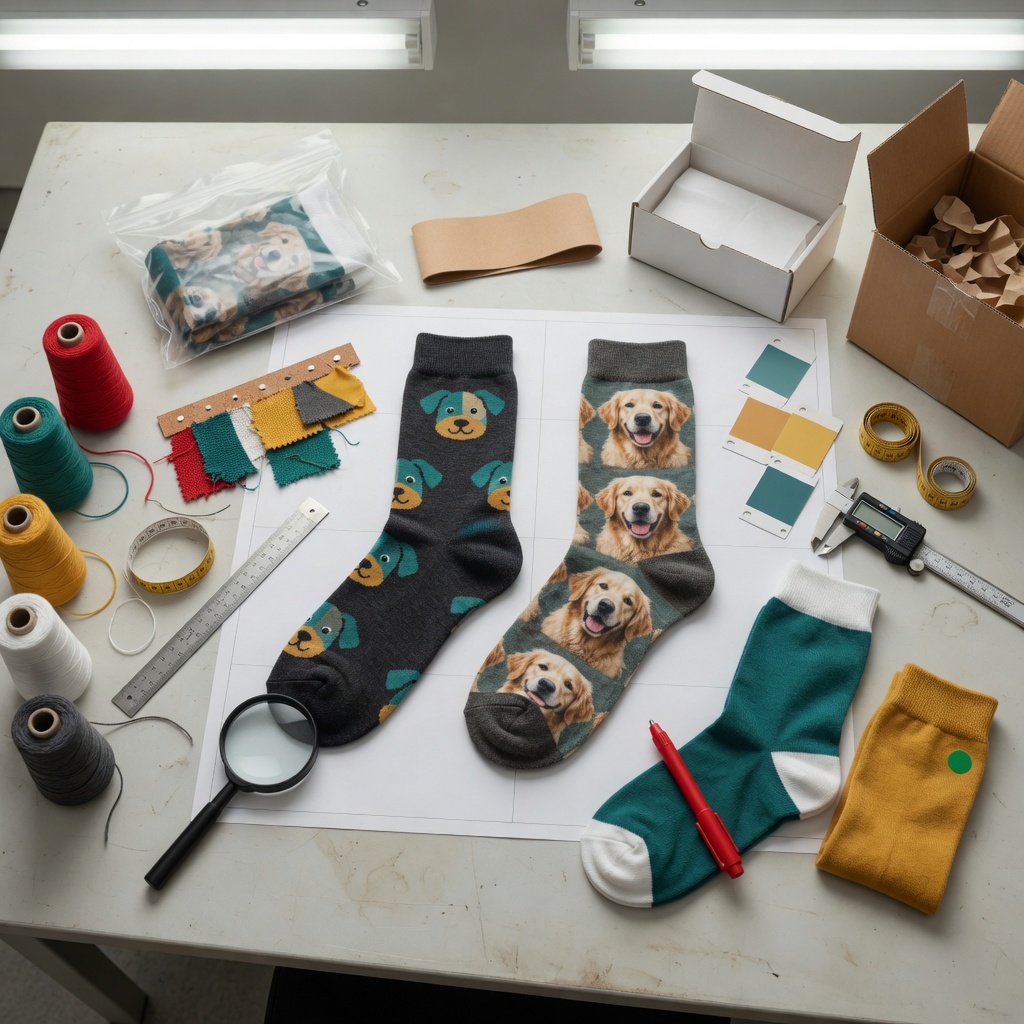
Here, pet sock means a human-wear sock decorated with pet artwork, not a sock worn by a pet. A sock-focused customization article identifies crew and no-show silhouettes, pet-photo input, jacquard knit, dye-sublimated decoration, and full-wrap printing as candidate customization concepts. It does not establish that a particular supplier offers those options or can meet a specific material, minimum order quantity, price, quality level, or delivery date.
The practical release rule is simple: every selected customization option should lead to a supplier disclosure, measurable specification, approval record, and documented effect on price, sampling, minimum order quantity, or delivery. A product image or general capability statement is not enough to award an order.
Evidence Boundaries for Pet Sock Procurement
The sources have different product scopes. Those boundaries matter when a buyer turns editorial research into an RFQ.
| Source context | Supported use | Boundary |
|---|---|---|
| Sock-focused customization article | Candidate silhouettes, pet-photo input, jacquard knit, dye-sublimated decoration, and full-wrap printing | Does not verify a bidder's process limits, materials, quality, minimums, pricing, or schedule |
| Broader pet-apparel sourcing article | Discovery context for embroidered logos, printed patterns, and environmental material requests | Does not establish compatibility with human-wear pet socks or verify any supplier claim |
| Broader custom-pet-product wholesale article | General context for minimum-order discussions and delivery planning | Does not provide a pet-sock quote, production schedule, or United States compliance determination |
| Vincent Xi author profile | Confirms the named author and Editorial Author role | Supports editorial authorship only, not sourcing experience, factory activity, product testing, or customer outcomes |
The specification templates and approval controls below are buyer-authored procurement tools. They are not presented as universal industry requirements or as capabilities of ZheSock or any prospective supplier.
Pet Sock Customization Options to Lock Before Quoting
Require bidders to answer each decision against the same RFQ revision. Treat a blank response as an exception rather than implied acceptance.
| Customization decision | Buyer-controlled RFQ field | Required supplier response | Release evidence |
|---|---|---|---|
| Product boundary | Human-wear pet-image sock, intended wearer segment, intended channel, and exclusions | Confirm the product interpretation and identify conflicts | Signed specification cover page |
| Silhouette | Named profile with dimensioned cuff, leg, heel, foot, and toe construction | Proposed construction, standard-component constraints, and substitutions | Dimensioned construction sheet |
| Decoration route | Jacquard knit, dye-sublimated decoration, full-wrap printing, or a clearly named alternative | Process name, proposed material compatibility, artwork limits, setup charges, minimums, and substitutions | Physical sample made through the proposed route |
| Pet artwork | Source-file identifier, crop, orientation, repeat, background treatment, placement zones, and color intent | Accepted input requirements, supplier edits, output limits, and returned production artwork | Buyer-approved artwork revision |
| Material | Generic fiber names, composition percentages, yarn details, finishes, coatings, and prohibited substitutions | Proposed declaration and current support for each material or environmental claim | Material record linked to the approved sample |
| Size and color | Measurement points, units, conditioning state, targets, proposed tolerances, grading logic, and authorized color references | Finished dimensions, measuring method, approval medium, lot-control proposal, and exceptions | Approved size set and signed color reference |
| Branding and packaging | Label, belly band, insert, unit pack, assortment, and carton requirements | Methods, templates, materials, dimensions, mass, setup charges, unit charges, minimums, and substitutions | Approved packed sample |
| Commercial scope | SKU allocation, currency, trade term, named place, quote validity, payment terms, and exclusions | Completed pricing schedule and exception register | Normalized quote tied to the RFQ revision |
| Approval route | Artwork, material, color, process sample, size set, preproduction sample, packed sample, and bulk inspection | Charges, timing, resubmission rules, hold points, and responsible contacts | Dated approval and milestone schedule |
Terms such as "custom pet photo" or "premium material" are not specifications. The RFQ should state the intended result, how it will be measured, which record controls production, and what happens when the supplier proposes a change.
Compare decoration routes through physical evidence
The cited sources support option discovery, not process performance. Keep route selection provisional until the supplier returns measurable limits and a representative sample.
| Candidate option | Source basis | Bidder disclosures | Buyer release control |
|---|---|---|---|
| Jacquard knit | Listed by the sock-focused source | Proposed yarn-palette limit, minimum reproducible feature, motif dimensions, placement tolerance, reverse-side construction, and appearance limits | Approve a sample made through the proposed knitting route and linked to the production artwork |
| Dye-sublimated decoration | Listed by the sock-focused source | Proposed compatible composition and construction, printable zones, heel and toe treatment, transition locations, color-reference method, and artwork preparation | Approve the complete pair, including transitions and all decorated zones |
| Full-wrap printing | Listed by the sock-focused source | Wrap boundary, repeat logic, transition location, unprinted zones, pair alignment, and placement-control method | Review both sides of the complete pair against the signed artwork |
| Embroidery or applied branding | Mentioned in the broader pet-apparel source, not verified for human-wear pet socks | Proposed location, finished dimensions, backing, skin-side finish, flexibility, construction effect, minimums, and verification method | Hold as an investigated option until a pet-sock sample is accepted |
| Supplier-proposed alternative | No capability is assumed | Process name, reason for substitution, changed material, visible differences, minimums, price effect, timing effect, and replacement sample | Release only after written deviation approval |
Use a digital proof to approve crop, orientation, repeat, and placement intent. Use a production-method sample to approve the physical result. The purchase order should identify which revision controls artwork, dimensions, material, color, labeling, packaging, and accepted deviations.
Turn Customization Options into Measurable Specifications
Artwork control. Assign separate identifiers to the original pet image, edited source file, and returned production artwork. Record file format, actual pixel dimensions, color space, crop, background treatment, orientation, repeat, mirroring permission, color intent, and placement by product zone. Require the bidder to disclose input requirements, edits, production-file format, measurable output limits, and proof timing. Resizing, moving, mirroring, recoloring, or replacing the image should trigger a new revision.
Size control. Replace labels such as "adult size" with a measurement table. For each point, identify the garment position, unit, conditioning state, measuring tool, target, tolerance, designated sample size, and whether the sock is measured laid flat or on a specified form. Ask whether the proposed construction or decoration route changes the finished dimensions.
Material and claim control. Request generic fiber names and composition percentages rather than relying on an unsupported marketing term. Record yarn or fabric identifiers, finishes, coatings, and prohibited substitutions. For every material, environmental, testing, or certification claim, request a current document showing the exact claim, issuer, product or material scope, facility scope where relevant, and validity period. A buyer request or supplier declaration does not by itself establish certification.
Color control. Identify the buyer-authorized reference for each artwork field, cuff, heel, toe, and other visible zone. Require the bidder to state the approval medium, matching method, lot-control proposal, and exception procedure. A descriptive color name should not release production.
Packaging control. Quote the pet sock, branding components, unit packaging, and shipping carton as separate cost blocks. Request templates, materials, dimensions, packed mass, pack method, assortment, packaging minimums, setup charges, unit charges, carton configuration, and substitutions. Approve the fully packed configuration before bulk packing.
The following values are hypothetical buyer assumptions for a United States RFQ dated January 15, 2025. They are examples of measurable fields, not standards, production recommendations, supplier capabilities, or current offers. Every value must be confirmed or replaced in the current supplier quote, sample record, and purchase order.
| Example specification field | Buyer assumption as of January 15, 2025 | Verification required |
|---|---|---|
| Finished foot length | 240 mm laid flat for one designated adult sample size, with a buyer-proposed tolerance of +/- 5 mm | Bidder returns its measuring method and accepts or marks up the target and tolerance |
| Pet-artwork bounding box | 58 mm wide by 68 mm high on the designated sample, with a buyer-proposed placement tolerance of +/- 3 mm | Bidder confirms producibility through the selected route and submits a measured production-method sample |
| Pack configuration | 1 pair per unit pack and 50 pairs per carton for the hypothetical order | Bidder returns actual package dimensions, packed mass, assortment method, carton use, and cost |
United States Controls for Labeling, Landed Cost, and Delivery
Build a labeling decision record
The supplied research pages are not United States regulatory authorities and do not support a universal pet-sock label template. Applicability can depend on the final composition, claims, production location, importer arrangement, destination, and sales channel. A qualified United States reviewer should determine current requirements for the actual SKU and transaction using authoritative sources.
The RFQ can collect the underlying facts without treating an undocumented supplier statement as a compliance conclusion.
| Candidate review field | Supplier evidence to request | United States buyer control |
|---|---|---|
| Product identity | Proposed product description and every label or package location | Reviewer records the approved wording and applicability basis |
| Fiber information | Generic fiber names, composition percentages, material records, and proposed layout | Reviewer checks the final composition against current applicable requirements |
| Country-of-origin information | Declared production location, supporting transaction records, and proposed marking | Reviewer approves the wording, placement, permanence, and supporting basis |
| Responsible-business information | Proposed company identity and contact fields | Buyer confirms the correct responsible entity and presentation |
| Care information | Proposed instructions and the material or test basis used to develop them | Buyer approves only wording supported for the final construction |
| Claims or certification references | Exact claim wording plus a current document, issuer, scope, and validity | Buyer removes unsupported wording and verifies any required qualification |
| State or channel fields | Proposed warning, tracking, barcode, assortment, or retailer data | Qualified reviewer and channel owner determine whether each field applies |
The supplier should reproduce only the approved content, material, placement, and revision. A change to composition, production location, label material, claim wording, or packaging should reopen the affected review.
Normalize landed cost before comparing quotes
Unit prices are comparable only when they cover the same specification revision, SKU allocation, decoration, labeling, packaging, quantity, trade term, named place, and approval scope.
| Cost block | Mandatory bidder response | Buyer verification |
|---|---|---|
| Product | Unit price by SKU and included construction, decoration, label, and pack | Match every inclusion to the approved specification revision |
| Development | Artwork, setup, tooling, samples, resubmissions, and credit conditions | Separate one-time, recurring, refundable, and nonrefundable charges |
| Minimum-order exposure | Minimum by order, artwork, base construction, material, color, size, packaging item, and reorder | Calculate total cash and excess inventory by constraint |
| Origin scope | Handover point, origin transport, documentation, handling, and exclusions | Reconcile the response with the stated trade term |
| International movement | Mode, charge basis, insurance treatment, route assumptions, and quote validity | Obtain a dated logistics quote using the same shipment assumptions |
| Border cost | Product description, origin data, proposed classification information, and separately identified estimates | Ask the buyer's customs broker to verify current classification and treatment |
| United States delivery | Destination, appointment assumptions, handling, and final transport | Confirm warehouse and receiving requirements |
| Quality and loss reserve | Inspection, testing, rework, rejected quantity, replacement, and unusable overproduction assumptions | Keep buyer reserves separate from supplier prices and identify the calculation basis |
All values below are hypothetical buyer assumptions for a sample United States RFQ dated January 15, 2025. They are not supplier offers, market benchmarks, tariff determinations, freight forecasts, or customs conclusions. Each quantity, price, allocation, reserve, and result must be confirmed or replaced in current supplier, logistics, broker, inspection, and purchase-order records.
| Example decision input | Assumption as of January 15, 2025 | Calculation or procurement effect |
|---|---|---|
| Program allocation | 1,200 pairs across 3 colorways and 4 adult sizes | 12 pet-sock SKUs at 100 pairs per SKU |
| Hypothetical quote A | USD 2.20 per pair for 1,200 pairs | USD 2,640 hypothetical product spend |
| Hypothetical quote B | USD 2.05 per pair with an order minimum of 1,800 pairs | USD 3,690 hypothetical product spend |
| Quote comparison | Quote B compared with quote A under the same example product-price scope | USD 1,050 more product spend and 600 additional pairs before other cost differences |
| Quote A freight reserve | USD 0.35 per accepted pair for the hypothetical 1,200-pair shipment | Replace with a dated logistics quote |
| Quote A border-cost reserve | USD 0.18 per accepted pair for the hypothetical 1,200-pair shipment | Replace after broker review; this is not a classification or duty statement |
| Quote A inspection reserve | USD 144 for the hypothetical order | USD 0.12 per accepted pair when allocated across 1,200 accepted pairs |
| Quote A illustrative subtotal | Product plus only the listed freight, border-cost, and inspection reserves | USD 2.85 per accepted pair under the stated hypothetical assumptions |
The lower example unit price produces higher example product spend because it carries a larger order minimum. The USD 2.85-per-pair result is only an illustrative subtotal. A live landed-cost model should separately identify applicable setup, sampling, packaging changes, origin charges, insurance, brokerage, United States delivery, storage, financing, rejected quantity, rework, and excess inventory. When accepted quantity differs from ordered quantity, use the appropriate denominator and state it.
Control delivery by milestone
The broader custom-pet-product source provides general discussion of minimum-order negotiation and delivery planning for a broader product category. It does not establish a current pet-sock lead time or a supplier commitment. Require a dated, stage-based schedule for the selected customization route.
| Delivery milestone | Mandatory bidder response | Buyer control |
|---|---|---|
| Artwork return | Start condition, return date, revision allowance, and owner | Production does not begin from unapproved artwork |
| Material readiness | Material identifier, availability basis, ready date, and substitution risk | Substitution requires documentation, sample review, cost disclosure, and written approval |
| Process and size samples | Sample type, production route, completion date, freight treatment, and resubmission timing | Each sample answers a defined approval question and carries revision identifiers |
| Preproduction approval | Complete configuration, buyer review period, and production hold point | Bulk work starts only after the named approver releases the record |
| Bulk production | Start condition, production window, capacity assumption, and recovery action | Changes to quantity, material, artwork, or process trigger schedule review |
| Inspection and handover | Inspection date, remedy allowance, handover point, and required documents | Failed or incomplete inspection does not silently consume the delivery buffer |
| Transit and clearance | Mode, route assumption, calendar or working-day basis, document owner, and contingency | Replace assumptions with a dated logistics plan and broker review |
| United States receipt | Named destination and definition of arrival | State whether arrival means carrier handover, warehouse receipt, receiving acceptance, or inventory availability |
A single lead-time statement should not replace the milestone schedule. The purchase order should name owners, dependencies, notification deadlines, approval hold points, and recovery actions.
Sampling and RFQ Award Controls
Every sample should identify the specification revision, artwork revision, material, size, color, decoration route, and packaging configuration it represents. Mixed-revision or unidentified samples should not release bulk production.
| Gate | Decision question | Required record |
|---|---|---|
| Material and color reference | Are the proposed composition, yarn or base material, finish, and color reference acceptable? | Material declaration and signed physical references |
| Decoration-process sample | Can the proposed route produce the approved artwork, zones, and transitions under the bidder's stated controls? | Measured sample linked to the production-artwork revision |
| Size set | Do finished measurements and grading match the approved table? | Size-set samples and measurement report |
| Preproduction sample | Does the complete pair combine the approved construction, artwork, material, color, labeling, and branding? | Buyer-signed preproduction record |
| Packed sample | Do unit pack, label placement, assortment, and carton method match the approved configuration? | Sealed reference sample and packing record |
| Bulk inspection | Does the production lot conform to the purchase order and approved references? | Inspection report using agreed defect definitions, sampling method, and acceptance rules |
Define product-specific inspection fields before production. Candidate fields include paired size and color, artwork revision, motif location, print or knit discontinuity, holes, seam condition, loose yarns, cuff condition, contamination, odor, label content, packaging configuration, and carton assortment. The buyer should assign severity and acceptance treatment; the list itself does not establish a universal defect classification.
When testing is required, specify the method, specimen conditioning, equipment, procedure, acceptance limit, responsible party, report timing, and effect of a material or process change. Potential RFQ topics may include wash behavior, abrasion, colorfastness, stretch recovery, and restricted substances. Listing a topic does not mean that a test is legally required, that the product has passed, or that a supplier is certified.
Practical RFQ Checklist for United States Buyers
Apply this checklist to every bidder and quoted SKU. Record the controlling revision, supplier response, supporting evidence, exception, owner, and resolution status. Do not award the order while a required item is blank or supported only by a general capability statement.
- [ ] Confirm that the product is a human-wear pet sock and state the wearer segment, silhouette, sales channel, and exclusions.
- [ ] Freeze the RFQ identifier, issue date, specification revision, artwork revision, response deadline, quote currency, and quote-validity period.
- [ ] List every SKU by artwork, color, size, packaging configuration, requested quantity, accepted quantity, and minimum-order exception.
- [ ] Lock the customization options, including decoration route, material, finished measurements, tolerances, color references, motif dimensions, placement zones, and prohibited substitutions.
- [ ] Require the supplier to return all artwork edits, production limits, setup charges, proof timing, and the production-artwork revision for approval.
- [ ] Obtain generic fiber names, composition percentages, yarn or base-material identifiers, finishes, coatings, and current support for every claim.
- [ ] Define each sample gate, including purpose, quantity, charge, production route, completion date, freight treatment, resubmission rule, and approval hold point.
- [ ] Complete the United States labeling review for the actual composition, production location, claims, importer arrangement, destination, and sales channel.
- [ ] Approve the label, belly band, unit pack, assortment, carton configuration, packaging dimensions, packed mass, and any barcode or channel data.
- [ ] Normalize each quote to the same SKU allocation, included decoration, labeling, packaging, trade term, named place, payment terms, development charges, and exclusions.
- [ ] Calculate landed cost from current product, setup, sample, packaging, logistics, broker, border-cost, inspection, United States delivery, and inventory assumptions.
- [ ] Require a milestone schedule covering artwork return, material readiness, samples, preproduction approval, bulk production, inspection, handover, transit, clearance, and United States receipt.
- [ ] Define inspection fields, defect treatment, measurement checks, test methods where applicable, acceptance rules, remedies, and the records required before release.
- [ ] Obtain a signed exception register showing every deviation, affected SKU, evidence, price effect, delivery effect, replacement-sample requirement, and authorized disposition.
- [ ] Issue the purchase order only after it identifies the approved revisions, sample records, packed reference, pricing scope, delivery milestones, change-control route, and responsible approvers.
Hold the bid when it omits a constraint-level minimum, substitutes a material without evidence, quotes a different decoration route, leaves packaging scope unclear, relies on an unsupported claim, or gives a delivery promise without stage assumptions.
Method, Limitations, and Author Basis
Method. The article separates sourced option discovery from buyer-authored controls, supplier-dependent facts, and example calculations. The sock-focused customization source is used only to identify candidate pet-sock silhouettes and decoration concepts. The broader pet-apparel source and broader custom-pet-product source are used only as qualified discovery context where their product scope differs from human-wear pet socks.
The RFQ tables and practical checklist were derived by translating each customization decision into a buyer field, bidder response, release record, exception rule, and change-control trigger. Numerical examples use arithmetic based on explicitly hypothetical buyer assumptions dated January 15, 2025. They demonstrate comparison structure and do not represent keyword data, market demand, supplier performance, or current commercial terms.
Limitations and verification. The supplied sources do not include a live supplier quote, current capability record, independent laboratory report, facility audit, production record, United States legal opinion, customs determination, logistics quote, inspection report, or current certificate. Before award, verify construction, decoration compatibility, artwork limits, measurements, tolerances, composition, color control, packaging, minimums, pricing, production location, labeling applicability, customs treatment, testing, supporting documents, sample identity, inspection criteria, and delivery through current supplier responses, qualified review, approved samples, logistics and broker records, the purchase order, and the inspection plan.
Author note. The Vincent Xi profile identifies Vincent Xi as Editorial Author. That source supports editorial authorship only; it does not document factory visits, product tests, customer outcomes, or personal procurement experience, and no such claim is made here.
Discuss Your Requirements
Review our manufacturing capabilities, then share your specifications for a supplier-fit review.