Pet Sock Sourcing Material Options for Australian Procurement
By Vincent Xi, Editorial Author
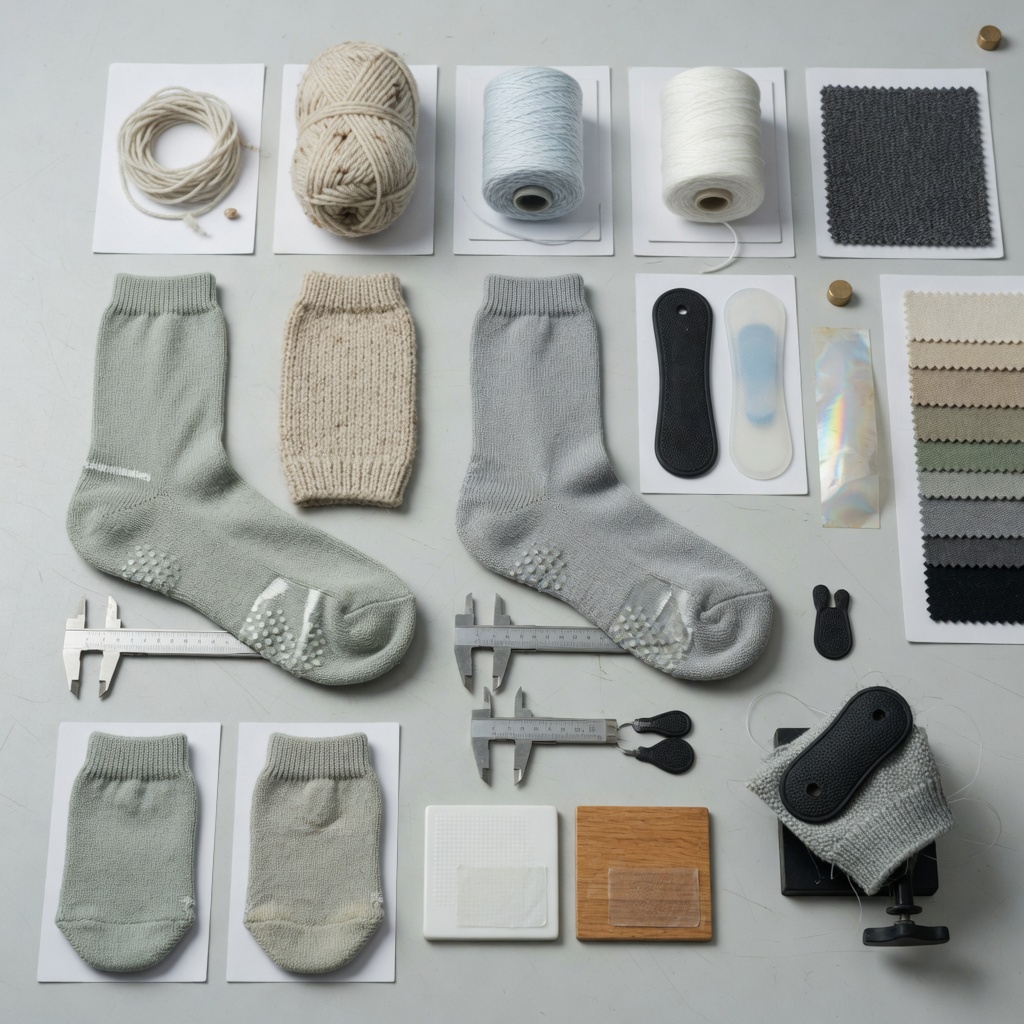
For Australian buyers, pet sock sourcing material options should be compared as complete, quote-specific constructions rather than as fibre names alone. The supplied evidence supports a shortlist of materials to sample, but it does not prove finished pet sock performance, prescribe universal blend ratios, establish supplier capability, or confirm Australian compliance.
The consumer-focused Pets for Life article recommends cotton for breathability, wool for warmth and moisture-wicking, and rubber or silicone grips for traction. It also cautions that synthetic fibres may cause overheating or irritation. The commercial Custom Sock Shop material guide describes cotton as soft and breathable and polyester as durable.
These statements identify candidates for an RFQ; they do not approve a finished construction. The procurement decision is therefore which candidates to quote, what each quotation must disclose, and what sample evidence must be accepted before order release.
Australian pet sock material options to quote
| RFQ candidate | Source-supported reason to sample | Unresolved before approval | Required quotation and sample evidence |
|---|---|---|---|
| Cotton-based knit | Pets for Life recommends cotton for breathability; Custom Sock Shop describes it as soft and breathable. | Neither source supplies measured breathability, thermal, abrasion, care, fit, or finished pet sock results. | Full composition and declaration scope, knit construction, care instructions, sample dimensions, surface inspection, and evidence for any finished-product claim. |
| Wool-containing knit | Pets for Life recommends wool for warmth and moisture-wicking. | The source does not specify wool content, blend construction, shrinkage, drying behaviour, a moisture test method, or comparative results. | Wool proportion, all other fibres, construction details, care response, dimensional records, surface inspection, and substantiation for any warmth or moisture claim. |
| Polyester-containing comparison | Custom Sock Shop describes polyester as durable, while Pets for Life cautions that synthetic fibres may cause overheating or irritation. | The sources do not resolve those statements with pet sock test data or define a suitable polyester proportion or component location. | Disclosure of polyester content and location, followed by a finished-sample comparison against the selected control under the same use, care, dimensional, and surface checks. |
| Rubber or silicone sole grip | Pets for Life recommends rubber or silicone grips for traction. | The source does not identify compound chemistry, grip geometry, adhesion, floor-specific performance, or performance after care. | Generic compound declaration, coverage drawing, application method, nominated floor surface, agreed evaluation conditions, acceptance criterion, and post-care inspection record. |
Treat these as quotation candidates, not approved formulas. Keep the nominated size, foot dimensions, cuff dimensions, grip layout, colour basis, packaging basis, intended use, and sample method consistent enough to make material the meaningful comparison.
The supplied evidence does not support selecting a construction for outdoor, water-resistant, waterproof, or wet-grip use. Any such proposal requires a separately defined claim and finished-product evidence for the supplier's actual construction.
Define each material-bearing component
A quoted fibre description may cover only the main knit. The RFQ should identify every component that can alter composition, comfort, care response, grip attachment, or the scope of a product claim.
| Component | RFQ definition | Evidence to obtain |
|---|---|---|
| Main knit body | Candidate fibre or blend, declaration basis, declaration scope, yarn and knit construction | Signed composition declaration, substantiation basis, permitted tolerance, and matching sample identifier |
| Cuff or stretch component, where present | Fibre identity, proportion, location, contact area, and construction | Component description, location drawing, flat measurements, recovery record, and supporting material information |
| Heel or toe reinforcement, where present | Material, location, coverage, and construction method | Component declaration, sample map, and evidence matching any abrasion or durability claim |
| Sole grip and bonding system, where present | Generic grip compound, pattern, coverage zone, colour, application process, and bonding material | Material declarations, measured sample layout, attachment record, care-screen result, and nominated-surface evaluation |
| Dye, coating, print, or finish, where present | Treatment identity, application location, process, and associated product claim | Treatment declaration and claim evidence tied to the proposed material, colour, process, and finished sample |
The two cited material pages contain no comparative laboratory values for breathability, warmth, moisture handling, durability, or traction. Do not convert a source's general material description into a measured claim for the finished pet sock.
Put measurable material options in the supplier quote
The values below are buyer-created examples for RFQ drafting. They are not findings from the cited sources, legal requirements, industry benchmarks, or recommended pass criteria. Each example applies only to its stated scope as of the buyer's RFQ issue date and must be confirmed, revised, or rejected in the dated supplier quotation.
| Illustrative RFQ entry | Unit, scope, date context, and source status | Verification before use |
|---|---|---|
60% cotton + 35% polyester + 5% elastane = 100% | Buyer-created example calculation in percentage by textile-fibre mass, covering the declared textile fibres in the nominated finished sample and excluding separately declared grip and bonding materials. It is current only as of the buyer's RFQ issue date and is absent from both cited material sources. | The supplier must verify or replace every percentage in the quotation, state the composition method and declaration scope, and provide evidence matching the approved sample. |
3 mm nominal grip-dot diameter and 5 mm nominal centre-to-centre spacing | Buyer-created dimensional assumptions in millimetres for the buyer-marked sole zone on the nominated sample size. They are current only as of the buyer's RFQ issue date and are absent from both cited material sources. | The supplier must confirm manufacturability or propose alternatives in the quotation. Measurement locations, equipment, and tolerances must be agreed before sample assessment. |
10 wash cycles at 30 degrees C with +/- 3 mm maximum flat-foot-length change | Buyer-created care-screen assumption covering the nominated finished sample, with cycles as the care count, degrees C as the wash temperature, and millimetres as the dimensional-change limit at buyer-defined measurement points. It is current only as of the buyer's RFQ issue date and is absent from both cited material sources. | The supplier must accept or replace the method and limit in the quotation. The agreed record must identify the wash program, detergent basis, drying method, conditioning, baseline measurement, equipment, and result. |
Use final values that match the actual size system, knit structure, component materials, grip layout, care instructions, intended conditions, and supplier evidence. An example becomes a purchase requirement only after it is incorporated into the accepted quotation or specification.
Material comparison and release gates
| Procurement risk | Evidence required | Release decision |
|---|---|---|
| The quoted blend covers the knit body but is presented as a whole-product composition | Component bill of materials showing the scope of the knit, stretch element, reinforcement, grip, bonding material, dyes, coatings, prints, and finishes | Hold approval until the declaration scope and treatment of non-fibre components are explicit. |
| A source description is used as proof of finished-product performance | Evaluation or test record tied to the claim, construction, colour, size, care method, conditions, result date, and sample identifier | Do not release the claim or order from editorial material guidance alone. |
| Polyester is selected from durability language without addressing the consumer-source caution | Complete polyester disclosure and a side-by-side finished-sample comparison conducted under the same documented conditions | Select the construction from the resulting evidence, not from either general source statement in isolation. |
| Grip is approved by the generic name rubber or silicone | Finished-sample record covering layout, application, attachment, nominated floor surface, test state, care response, and observed cracking, peeling, migration, or detachment | Do not use a traction or non-slip claim unless the evidence matches the proposed construction and intended condition. |
| A material or process changes after sample approval | Written change notice identifying the affected component, process, claim evidence, quotation, and sample | Block production or shipment release until the buyer approves the change and any replacement evidence. |
| A supplier proposes a water-related claim | Defined claim, complete construction, agreed method, test conditions, result record, and care limitations | Exclude water-resistant, waterproof, wet-grip, or equivalent language until matching finished-product evidence is accepted. |
Retain the approved reference sample and its identifier with the purchase record. The supplier's substitution control should cover fibres, yarn sources, stretch components, reinforcements, grip compounds, bonding materials, dyes, coatings, print materials, finishes, and related processes.
Australia-specific procurement boundaries
Australia is the sole destination market for this article package. The cited material sources do not establish Australian legal, labelling, import, product-safety, freight, or climate requirements, so no local compliance result or country-wide wear condition is claimed here.
For quotation comparability, identify the actual Australian delivery location and ask each supplier to state currency, delivery basis, freight assumptions, carton dimensions and weight, sample timing, production timing, order minimum, tooling charges, material or colour surcharges, and quotation validity. These are supplier-specific commercial inputs, not values supported by the cited pages.
Do not infer a use environment from the destination alone. State the intended animal, size system, indoor or outdoor use, nominated floor surface, expected dry or wet condition, seasonal use, care method, sales channel, and proposed claims. Have a qualified Australian adviser determine the legal, labelling, import, and product-safety requirements that apply to the actual product, transaction, channel, and claims.
Pet sock material options RFQ checklist
- [ ] Name Australia as the destination and state the delivery location and quotation basis.
- [ ] Define the intended animal, size system, use environment, floor surface, expected condition, seasonal use, care method, sales channel, and proposed claims.
- [ ] Request separately priced material candidates only where they match the source-supported shortlist and intended use.
- [ ] Keep dimensions, grip layout, colour basis, packaging basis, and sample conditions aligned across candidates.
- [ ] Require a component bill of materials with composition basis, declaration scope, substantiation method, and permitted tolerance.
- [ ] Define the grip compound, geometry, application, nominated floor surface, evaluation state, and acceptance criterion.
- [ ] Require each test or evaluation record to identify the sample, method, conditions, testing party, result date, and result.
- [ ] Obtain supplier confirmation or replacement of every buyer-created numerical assumption in the dated quotation.
- [ ] Request evidence matching every proposed breathability, warmth, moisture, durability, traction, fibre-origin, environmental, or water-related claim.
- [ ] Record commercial terms, material availability risks, custom-material charges, and the effect of substitutions.
- [ ] Tie order release to the accepted quotation, approved sample identifier, bill of materials, agreed methods, result records, claim evidence, packaging version, defect criteria, and remedy for non-conforming material.
Evidence method and limitations
Consumer source context: The Pets for Life dog-sock article provides consumer-oriented guidance. It recommends cotton for breathability, wool for warmth and moisture-wicking, and rubber or silicone grips for traction. It also cautions that synthetic fibres may cause overheating or irritation. In the supplied evidence, it provides no comparative method, measured finished-product result, universal formula, supplier evidence, or Australia-specific conclusion.
Commercial source context: The Custom Sock Shop material guide is commercial guidance about custom socks. It describes cotton as soft and breathable and polyester as durable. Those descriptions are not finished pet sock test results and do not establish a supplier's formula, capability, consistency, or product performance.
Methodology: Each retained source statement was treated as a material-selection input. It was mapped to an RFQ candidate, its unresolved questions, and the evidence needed before approval. The differing polyester statements were retained as a comparison issue rather than resolved without data. Numerical entries were separated from source findings and labelled as buyer-created assumptions requiring supplier verification.
Limitations and verification: The cited pages are editorial material guidance, not comparative finished-product reports. They do not determine suitability for a particular animal, size, floor, care method, claim, or Australian transaction. Before order release, verify the complete bill of materials, declaration scope, sample identity, finished-product results, current supporting documents, commercial terms, applicable Australian requirements, and substitution controls against the same dated quotation and approved reference sample.
No standard is named because the supplied evidence does not establish which standard, edition, method, or clause is relevant to the proposed construction or claim. A buyer-defined method or tolerance is an RFQ condition, not a standard requirement, evidence of a supplier's normal practice, or proof of certification. If a supplier cites a standard or certification, require a current document identifying the issuer, holder, scope, covered product or material, and validity before making any conformity or certification statement.
Author note: The Vincent Xi author profile identifies Vincent Xi as an Editorial Author. The profile does not document first-hand sourcing, factory inspection, product testing, certification, or procurement outcomes, so none is claimed in this article.
Discuss Your Requirements
Review our manufacturing capabilities, then share your specifications for a supplier-fit review.