Photo Sock Sourcing Cost Breakdown for United States Buyers
By Vincent Xi, Editorial Author (https://www.zhesock.com/authors/vincent-xi/). This editorial attributes published supplier and roundup pages plus United States textile-import checkpoints. It does not report factory visits, unpublished invoices, laboratory tests performed for this brief, or customer outcomes.
United States B2B buyers should not award a photo sock order from a headline pair price. The figure that belongs in the file is landed cost per accepted pair. A photo sock sourcing cost breakdown itemizes artwork, blank construction, photographic print, sampling, packaging, freight, United States entry, labeling, and inspection, then divides those costs by pairs that pass receiving—not by pairs ordered.
Public list and guide prices are not that figure, and they are not a ZheSock quotation. A no-minimum custom photo sock product page lists $24.99 per pair and a BOGO $12.50 per pair effective checkout price, with 5–7 business days production. A manufacturer roundup cites $10–26 per pair with no MOQ and 2–4 weeks turnaround, and $6–10 per pair at a 24-pair MOQ. A 2026-titled B2B printed-socks guide lists sublimation photo-real bands of $8–15 per pair at 50–150 units, $5–10 per pair at 150–500 units, and $3–7 per pair at 500+ units, with a bulk MOQ of 180 pairs. Use those bands only to catch missing lines on a worksheet, then issue an itemized RFQ that merchandising, finance, and compliance can score on the same scope.
Award gates before you send the RFQ
Close three gates, in order, or pair prices are not comparable:
- Specification lock. Name a photo sock, not a logo sock: United States size run, target pair weight in grams (blank and printed), all-over versus panel coverage, unique left/right photos if required, fiber blank, and a documented photographic process.
- Same-scope cost. Every supplier quotes the same pair count, size mix, pack, sample path, currency (USD), quote validity window in calendar days, and Incoterm to the same United States ship-to.
- Entry and label clearance. Proposed HTS, broker review as of the planned entry date, and a label packet that can enter and be offered for sale in the United States.
Reject a response that collapses those gates into “from $X per pair,” copies a consumer checkout price, omits a validity date, or leaves samples, packing, freight, duty ownership, or seconds unpriced.
Photo sock sourcing cost breakdown: line items to quote
Put every fee on a per-pair or per-order line so two suppliers quoting the same headline pair price can be compared on the same scope. Landed cost is merchandise plus development, packing, logistics, United States entry, and inspection, divided by accepted pairs.
Product and process lines:
- Blank construction: fiber blend, gauge, size run, cuff/leg/foot length, heel and toe type, and pair weight in grams before and after print.
- Image process: cited third-party pages associate photo-real results with dye-sublimation on polyester-rich socks; the same manufacturer roundup states knit-in patterning lasts longer but cannot reproduce photographs.
- Coverage: an all-over photographic wrap versus a calf panel changes ink, press time, and seconds; the quote must state which coverage was priced.
- Pairing: unique left and right photos increase art handling versus one repeated image; price unique SKUs as separate art lines.
Commercial lines that incomplete quotes hide:
- Artwork: file prep, mockups, revision rounds, and color management, with included revisions stated as a count.
- Sampling: prototype, size-set, pre-production (PP), and top-of-production strike-offs, plus sample freight and any sample-entry charges if samples clear in the United States.
- Packaging: pair presentation, polybag, barcode if required, inner pack, export carton, carton gross weight in kilograms, and carton marks a United States DC can receive.
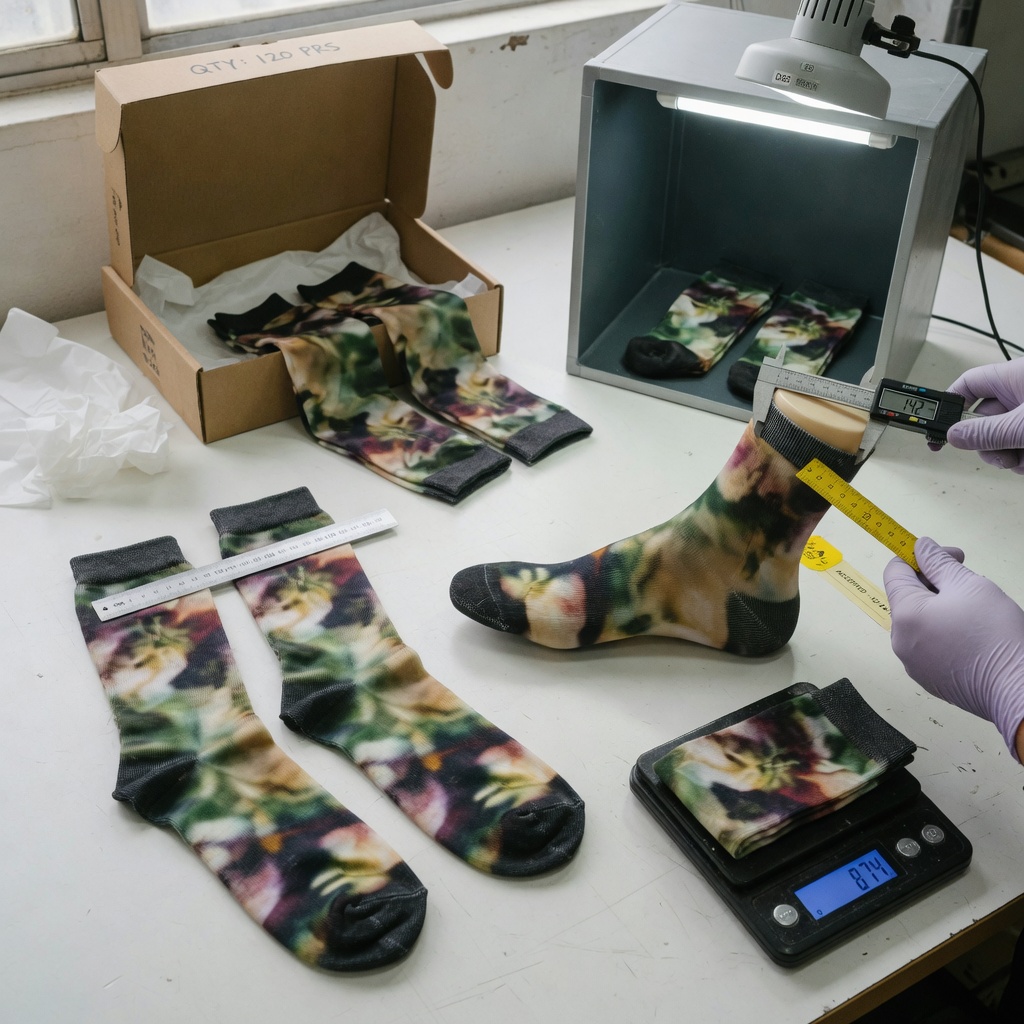
- Quality: print-registration tolerance in millimeters, shade band, pairing accuracy, AQL inspection, and needle detection if the DC requires it.
- Logistics and United States entry: origin pickup, international freight and insurance, destination charges, broker, duty, merchandise processing and related fees when they apply, ISF if the lot moves by ocean, drayage, and inventory hold until labels clear.
The custom-manufacturer roundup reports that pricing varies 20–40% with volume and complexity (percent swing as published on that roundup; the excerpt does not define the base price or the SKU mix) and that sublimation offers photo detail but fades after 10–15 washes, while knit-in cannot do photos (custom sock manufacturers roundup). Treat 10–15 washes as a published qualitative claim (laundry-cycle count for sublimation photo socks as stated on that roundup; the excerpt does not name a test date or AATCC method). Do not write that count into a purchase order until a lab report is attached.
Published unit-price bands versus landed cost
Log unit, scope, and source next to every number. Consumer checkout math and B2B volume brackets are not interchangeable and are not United States landed cost. Do not paste these bands into an RFQ as a target price.
On a custom photo sock product page, the published composition is 80% polyester, 15% nylon, 5% spandex (fiber percent by weight, as stated on that page). The published list price is $24.99 per pair (USD, no-minimum custom photo socks). A BOGO offer is described as $12.50 effective cost per pair. Production is 5–7 business days. 300 DPI high-resolution photos are recommended. Bulk over 100 pairs is described as the point where designer support and discounts are offered (Custom Photo Socks product page). As-of context: these values are as published on the cited product page; the excerpt does not include a last-updated date. BOGO is promotional math, not a wholesale contract price and not a United States duty-paid cost.
In a 2026-titled B2B buyer’s guide, custom printed socks using sublimation for photo-real designs are listed at $8–15 per pair for 50–150 units, $5–10 per pair for 150–500 units, and $3–7 per pair for 500+ units (USD bands as published). Bulk MOQ is stated as 180 pairs, with a dropship option at no minimum (B2B custom printed socks guide). As-of context: the page title identifies a 2026 guide; confirm the live page before copying bands into a bid model. Those unit brackets do not disclose freight, United States duty, labeling, or seconds.
The manufacturer roundup cites one sublimation example at no MOQ, $10–26 per pair, 2–4 weeks turnaround, and another program at a 24-pair MOQ, $6–10 per pair (custom sock manufacturers roundup). Those are named third-party examples in that review, not equivalent landed costs and not a specification match to your photo file, size run, or pack.
Example calculation (assumption to verify in the supplier quote and with a United States customs broker, not a published offer): 500 pairs × $5.00 quoted ex-works = $2,500 merchandise. Add $120 for PP samples (for example three pairs plus express), $60 art setup, $0.18 per pair packing ($90), $480 international small-lot air freight, $85 broker/disbursement, and a duty line calculated from the actual HTS ad valorem rate on the fiber content—do not insert a guessed percentage as if it were the tariff. If domestic trucking is $140 and 3% of pairs fail registration, divide all landed costs by accepted pairs, not by 500. Every assumed dollar in this paragraph must be replaced by a dated quote.
Printing method, fabric, and resolution as cost controls
Keep process choices inside the RFQ: they move pair price, seconds, and replacement risk. This is not a substitute for a photo sock specification.
Cited product and guide pages specify photo-real custom socks on polyester-rich sublimation programs. Nylon and spandex are stretch/recovery fibers on the published 80/15/5 blank; do not assume they take the same photographic transfer as the polyester share. Specify whether the photograph must wrap instep, sole, and toe, and whether an unprinted or paler cuff is acceptable. Those choices move ink, seconds, and pair price.
Trade-offs to price explicitly:
- Resolution: treat 300 DPI as the cited page’s source-file recommendation, then require 300 DPI at the actual print size of the sock panel, not 300 DPI on a small crop. Ask for a 1:1 print on the production blank.
- Ground shade: require the supplier to state whether the process can print white or whether highlights come from the blank. Specify optical white versus off-white and whether both sides of the sock are imaged.
- Wash life versus photo fidelity: the roundup’s 10–15 wash fade note is a cost risk if the sock is a repeat-wear uniform or retail program. Require a named method (AATCC 61, AATCC 135, or the lab’s documented equivalent) and a numeric pass/fail (gray scale or delta-E). Distinguish that test requirement from any mill’s unstated house practice. AATCC methods are test protocols; they are not a factory certification.
- Process lock: if the brief is a customer photograph, do not accept a knit-in or spot-color substitute that cannot render the photo. If the brief is a one-color logo, a different process may cut cost and raise durability—keep that out of a photo sock RFQ unless you issue a written change.
- Seconds: all-over photos raise mis-registration and crease marks. Cap seconds as a percent of the lot and state whether they ship, scrap, or credit. Pay against accepted pairs only.
Volume, MOQ, sampling, and lead time
MOQ and calendar are cost drivers, not just operations notes. The published no-minimum 5–7 business day program, the 2–4 week no-MOQ sublimation example, the 24-pair bracket, and the 180-pair bulk MOQ with stepped 50–150 / 150–500 / 500+ unit prices are comparison scaffolds only.
A United States first buy should be quoted as three commercial steps, even with one supplier: paid development samples, a signed PP sample against the photo file and size spec, then production with a frozen shade band. Sample cost is a line item, not a favor. State whether sample freight and any United States sample-entry fees are credited against bulk.
Lead time versus freight: a $2–4 per pair unit-price reduction (example spread to verify, not a market index) can disappear if the lot must fly to hit a United States in-DC date. Require two Incoterms on the same specification—for example FCA/FOB origin and DAP or DDP a named United States warehouse—so freight and duty ownership are visible. Incoterms allocate commercial risk; they do not satisfy FTC or CBP labeling rules.
SKU complexity: the published 20–40% swing with volume and complexity is a reason to freeze unique photos, sizes, and left/right variants before asking for a best-and-final price. Require the quote to list the SKU count that was priced.
United States customs, labeling, and delivery costs
The United States receiving market changes the cost breakdown. This section is an RFQ control list for photo sock procurement, not a generic country guide.
Classification and duty. Knitted socks are commonly classified in heading 6115 of the Harmonized Tariff Schedule of the United States; the 10-digit line depends on fiber, knit construction, and other features. Duty is generally an ad valorem rate on customs value (typically transaction value). A blend such as 80/15/5 polyester/nylon/spandex can change the line if that is the blank you actually import. The RFQ should require the supplier’s proposed HTS and a licensed United States broker’s confirmation as of the planned entry date. This editorial does not state a duty percentage. Any rate in an internal spreadsheet is an assumption until the broker replaces it.
Also budget broker fees (per entry), merchandise processing and other CBP fees when they apply, ISF for ocean shipments, possible cargo exam, and domestic drayage. Informal-entry and de minimis treatments change; confirm them for the actual value and mode on the ship date. Do not plan a photo sock program on a duty-free assumption.
Labeling and identity. United States textile apparel generally must disclose fiber content, the identity of the manufacturer or importer (often an RN number when the importer is a United States company), and country of origin, under the Textile Fiber Products Identification Act and FTC rules, with origin marking also required by CBP (including 19 CFR Part 134). Care instructions are required for most textile apparel under the FTC Care Labeling Rule. Those are legal duties of the importer of record and brand owner. They are not mill certifications, and this brief does not imply that any factory holds a current certificate. If the socks are children’s products (age 12 and under), state that in the RFQ so CPSIA tracking labels and children’s product rules are priced and documented.
Delivery. Name the United States ship-to, carton size and weight limits, pallet versus floor-load, and how unique photo pairs are clipped and labeled. Warehouse re-pairing is a receiving cost; price it as a chargeback risk rather than assuming the polybag is the last handling step. Price barcode or carton-mark errors as a chargeback risk at the receiving DC, not as a free correction.
Buyer decision table: compare photo sock RFQs
Every row is a specify, compare, verify, approve, or order action.
| Decision line | Specify in the RFQ | Compare across suppliers | Verify before award | Approve / order control |
|---|---|---|---|---|
| Quote completeness | USD itemized cost breakdown, validity window in calendar days, same pair count and United States ship-to | Incomplete “from $X” quotes vs full landed-cost worksheets | Dated quote; missing lines treated as not quoted | Reject incomplete quotes; do not fill gaps with published bands |
| Unit price basis | Pair count, size mix, all-over vs panel, unique left/right photos, blank and printed pair weight in grams | Whether the quote is ex-works or DDP United States; whether published bands ($3–7, $5–10, $8–15, $10–26, $24.99 list) were copied without scope | Dated USD quote and validity window | Freeze the spec; reject from-$X pricing |
| MOQ and brackets | First buy, reorder, and size-run MOQ | No-MOQ vs 24-pair vs 180-pair published styles vs the mill’s actual MOQ | Bracket matches the construction you specified | Separate sample PO from production PO |
| Artwork and DPI | Native file, 300 DPI at print size, color space, bleed at cuff/heel/toe | Setup fee, included revision count, mockup format | 1:1 print on the production blank | Sign digital mockup and fabric strike-off |
| Fabric and stretch | Fiber % (approve 80/15/5 only if that is the intended blank), gauge, cuff recovery, pair weight | Polyester share vs photo gamut; nylon/spandex vs wear | Composition test or mill certificate of analysis; stretch/recovery measurement | Approve the blank SKU before print |
| Fastness | Named AATCC or equivalent method, cycles, numeric pass/fail | Blog-style 10–15 wash claims vs a lab report | Report run on the production blank and ink | Hold bulk until PP and report match |
| Sampling path | Proto, size set, PP, top-of-production quantities; who pays sample freight and United States sample entry | Sample price, credit against bulk, sample freight | Signed PP under D65 lighting, photographed | No bulk start without written PP approval |
| Packaging | Pair clip, bag, UPC if needed, carton marks, carton kg, DC limits | Pack cost per pair | Carton spec and packed-pair photo | Packing list must match the PO |
| Seconds and AQL | AQL, registration tolerance in mm, shade delta-E, pairing | Who owns seconds and how credits are calculated | Inspection protocol at origin and/or United States incoming | Pay against accepted pairs |
| United States entry | Importer of record, Incoterm, proposed HTS, broker | Who pays duty and fees | Broker HTS/value review; label packet (fiber, origin, identity/RN, care) | Do not release for sale until labels pass |
| Lead time | Art freeze, PP, ex-factory, United States DC window | 5–7 day vs 2–4 week published examples vs reserved capacity | Written capacity and material availability | Split ship only if the PO allows it |
| Complexity | SKU count, unique photos, sizes | 20–40% published complexity swing as a stress test | Line-item art and pairing labor | Cap SKUs before the production PO |
RFQ checklist for photo sock procurement
- Name the product as a photo sock (not a generic logo sock): height, United States size run, target blank and printed pair weight in grams, all-over versus panel print.
- Attach print-ready art: one file per unique photo, 300 DPI at actual print size, left/right named if paired, with crop guidance for cuff, heel, and toe.
- Lock fiber and blank: request composition; do not assume 80% polyester, 15% nylon, 5% spandex unless that blank is approved. Require blank approval before printing.
- Name the process: photographic sublimation or another documented photo method. Forbid a knit-in substitute without a change order.
- Require an itemized USD cost breakdown with a validity date in calendar days: pair price, art/setup, each sample type, packing, origin freight, international freight, insurance, United States duty with rate source, broker, inbound, inspection, and consumables.
- Quote two volumes that bracket the first order (for example 120 and 500 pairs) plus reorder MOQ, so step-downs like 50–150 / 150–500 / 500+ can be tested against the actual spec.
- Quote two Incoterms to a named United States address on the same date (origin FCA/FOB and DAP/DDP warehouse).
- Require a proposed HTS line in heading 6115 with fiber justification, for broker confirmation as of entry date. Leave the duty percent blank until the broker fills it.
- Attach a label packet: fiber, country of origin, importer or manufacturer identity (RN if applicable), care, and CPSIA tracking if the end user is 12 or under.
- Specify tests: registration tolerance in mm; crocking; wash fastness under a named AATCC method (do not accept 10–15 washes as the spec); stretch/recovery; needle detection if the DC requires it.
- Define sampling: quantities, who pays, whether sample freight and United States sample-entry fees are credited, and a rule that bulk cannot start before written PP approval.
- Set AQL and seconds: inspection site, photo-misalignment defect list, seconds cap as a percent of the lot, and credit math on accepted pairs.
- Issue a calendar: art freeze, PP, ex-factory, United States DC arrival; state the cost of late artwork.
- Request current documents only: composition, colorfastness, and any restricted-substance report your policy requires. Do not treat a marketing claim as a certification.
- State payment and image rights: deposit versus PP versus copy-documents versus United States delivery; the mill may not reuse the photograph.
- Name carton and pallet limits for the United States DC, carton gross weight in kilograms, how unique photo pairs are clipped, and who pays rework if marks or pairing fail receiving.
Method, source context, and what to verify
Source context A: a custom-manufacturer roundup publishing example MOQs, pair-price bands, a 20–40% volume-and-complexity swing, and a sublimation versus knit-in contrast, including a 10–15 wash fade note (custom sock manufacturers roundup). Source context B: a custom photo sock product page publishing 80/15/5 composition, $24.99 / $12.50 pair prices, 5–7 business days, 300 DPI, and a 100-pair bulk mention (Custom Photo Socks product page). Source context C: a 2026-titled B2B printed-socks guide publishing sublimation photo-real volume bands and a 180-pair bulk MOQ (B2B custom printed socks guide).
How the data were derived: published pair prices, fiber claims, lead times, and process notes from those pages were copied with their stated units and scopes, then mapped onto a United States landed-cost and RFQ worksheet (product, development, packing, logistics, customs, labeling, inspection). Third-party pages are used as commercial and process evidence only.
Limitations: public pages may mix consumer promotions with B2B brackets; they may omit freight, duty, art, packing, and seconds; two of the three excerpts are undated; wash-life language is not a lab certificate; HTS duty depends on fiber and entry date; true MOQ, capacity, and seconds are mill-specific. Replace every example calculation with a dated supplier quote, a broker duty worksheet, and signed PP samples before approving production.
Discuss Your Requirements
Review our manufacturing capabilities, then share your specifications for a supplier-fit review.