Photo Sock Sourcing Production Scalability Planning for Malaysia
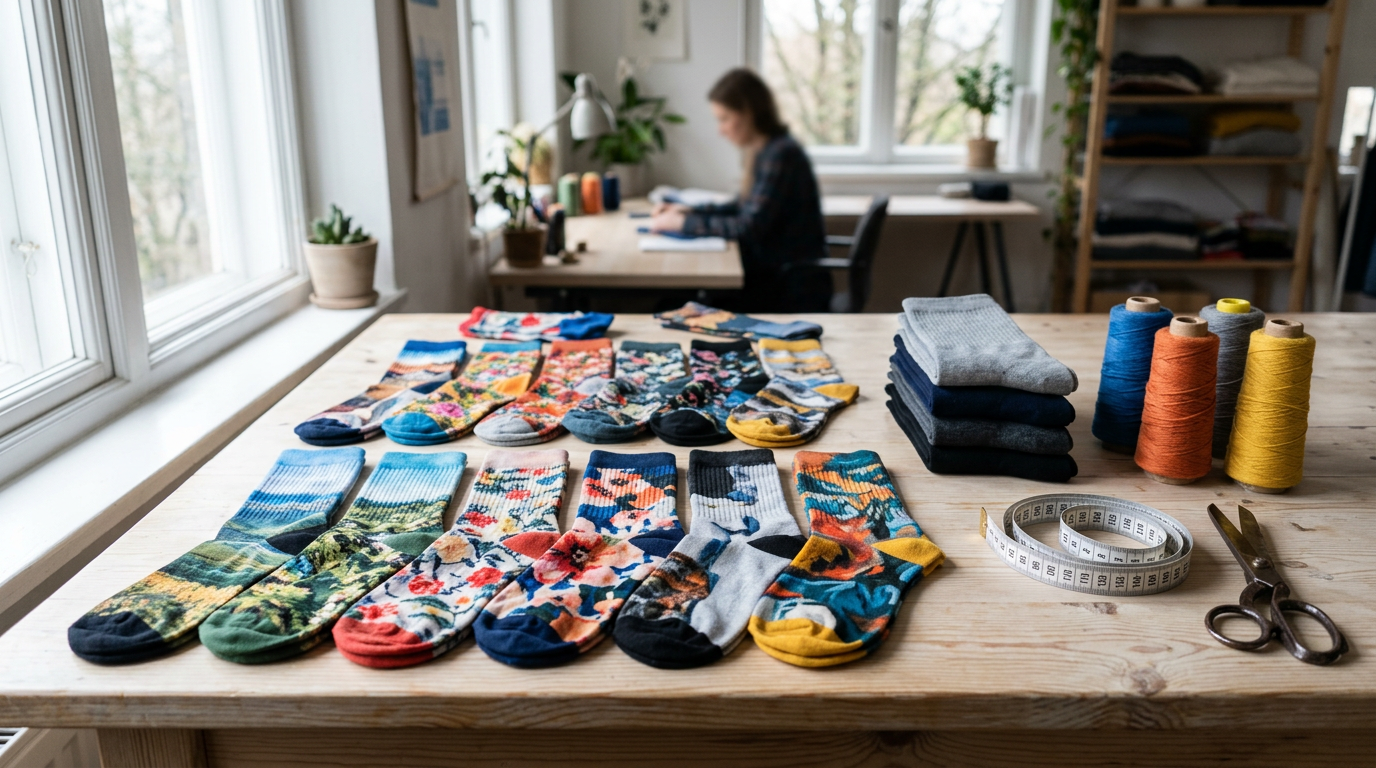
Photo sock sourcing production scalability planning helps a Malaysian buyer move from a first order to larger repeat orders without losing control of design, sizing, colour, packaging, and delivery. The task is not only to find a supplier who can make a sample. The task is to agree how volume will grow, how changes will be handled, and how each larger order will be checked before it leaves the factory. When those points are agreed early, the buyer can compare suppliers on the same basis and avoid decisions that have to be remade at every reorder.
For a buyer in Malaysia, scalability planning also means thinking about ordering rhythm, storage, and communication across distance and time zones. A supplier may be able to make a small trial quantity, yet still need a different arrangement for larger quantities, for a wider size range, or for a wider set of designs. The buyer should therefore treat the first order as a test of the whole process, from artwork handling and sampling through production, inspection, packing, and delivery, rather than as a test of one pair of socks alone.
What Production Scalability Planning Means for Photo Sock Procurement
Production scalability planning in photo sock procurement means defining how an order can grow while the product stays consistent. A photo sock carries a printed image, so the buyer and supplier need a shared understanding of artwork, placement, colour appearance, and the area covered by the print. As quantities grow, the same artwork may be used across more sizes, more colourways, and more repeat orders. The buyer should ask how artwork files will be stored, how a repeat will be matched to an earlier approved sample, and what will happen if an artwork file needs to be changed.
Scalability also covers materials and construction. The buyer should agree the sock construction, the yarn and fabric feel, the cuff and heel construction, and the way the printed area relates to stretch and wear. These points matter because a design that looks clear on a flat sample may look different when the sock is worn, washed, or made in another size. The buyer should therefore agree a sampling process that covers the sizes and designs that will be ordered at scale, not only one representative size.
A further part of scalability planning is production scheduling. The buyer should ask how orders are scheduled, how a larger order is divided into production runs, and how the supplier will confirm that each run follows the same agreed specification. The buyer should also agree how the supplier will report progress, how delays will be communicated, and what information the buyer needs before approving shipment. Clear scheduling and reporting reduce the risk that a larger order is treated as a series of separate small orders with different results.
Scaling Photo Sock Orders in Malaysia: Capacity and Communication
Scaling photo sock orders in Malaysia starts with a clear picture of demand. The buyer should define the expected order pattern before asking a supplier to scale, including whether orders will be regular, seasonal, or linked to a specific campaign or event. The buyer should also define whether all designs will grow at the same rate, or whether some designs will remain small while others become the main volume. That distinction helps the supplier plan materials, printing, and packing, and helps the buyer avoid overcommitting to designs that may not repeat.
Communication should be agreed as part of the plan. The buyer should name a single point of contact for artwork, a single point of contact for production questions, and a single point of contact for delivery and documentation. The buyer should also agree the format for order confirmations, production updates, and inspection results, so that information is easy to compare across orders. When the same fields are used for every order, the buyer can see whether a change is a one-off adjustment or a pattern that needs a new agreement.
Delivery planning for Malaysia should be treated as a procurement decision, not as an afterthought. The buyer should agree the delivery address, the packing method, the labelling of cartons, and the documents that must travel with the goods. The buyer should also agree how the goods will be checked on arrival, who will be responsible for that check, and what will happen if the delivered quantity, sizes, or designs do not match the order. Agreeing those points before scaling makes it easier to accept a larger delivery with confidence.
Comparing Suppliers for Production Scalability Planning
When comparing suppliers for production scalability planning, the buyer should use the same questions for each supplier. Start with capacity and flexibility. Ask how the supplier handles a change in quantity, a change in the mix of sizes, and a change in the number of designs. Ask how the supplier handles a repeat of an earlier design and how the supplier keeps the result consistent with the earlier approved sample. The answers should be practical and specific to the photo sock product, not general statements about manufacturing.
Next, compare sampling and approval. Ask what sample the supplier will provide before production, what the sample is intended to prove, and how the buyer should record approval. Ask whether the sample will cover print placement, colour, sizing, and construction, and whether a new sample is needed when artwork, size, or material changes. A supplier who can explain the purpose of each sample helps the buyer avoid approving a sample that does not represent the larger order.
Finally, compare quality control and problem handling. Ask how the supplier checks the product during production and before packing, what will be checked, and how the results will be shared. Ask how the supplier handles a defect found during inspection, how a replacement or correction will be arranged, and how the supplier will prevent the same issue in the next order. The buyer should also ask for supplier documentation that supports the agreed specification, and should keep that documentation with the order record for future comparison.
Buyer Decision Table for Scalable Photo Sock Sourcing
| Decision area | What to agree before scaling | Buyer check |
|---|---|---|
| Artwork and print | Artwork format, print area, placement, colour reference, and repeat matching | Confirm the approved sample matches the artwork record for each design |
| Sizing and fit | Size range, size labelling, and how print placement changes by size | Check the sample set covers the sizes that will be ordered at scale |
| Materials and construction | Fabric, cuff, heel, toe, and stretch characteristics to be used for every run | Ask the supplier to confirm the agreed construction in writing before production |
| Sampling and approval | Sample type, approval record, and when a new sample is required | Keep the approval record with the order and refer to it at reorder |
| Production capacity | How quantity, size mix, and design count can change without a new agreement | Ask how a larger order will be scheduled and reported |
| Quality inspection | Inspection points, sample selection for inspection, and acceptance criteria agreed by the buyer | Require inspection results before shipment approval |
| Packing and labelling | Pair packing, carton packing, carton labelling, and design separation | Check that packing matches the order by design, size, and quantity |
| Delivery and acceptance | Delivery address, documents, arrival check, and handling of a mismatch | Agree who checks the delivery and how a mismatch will be recorded |
From a Trial Order to Repeat Photo Sock Orders
A structured move from a trial order to repeat orders helps the buyer learn from the first production run before committing to larger volume. The following process keeps each stage separate, so that a problem found at one stage can be corrected before the next stage begins.
- Agree the specification, artwork, sizes, materials, packing, and acceptance checks in writing before the trial order is placed.
- Ask the supplier to provide a sample that represents the trial order, and record the approval with the design, size, and artwork details that were approved.
- Place the trial order using the same fields that will be used for larger orders, so that the trial tests the ordering process as well as the product.
- Check the trial delivery against the order by design, size, quantity, packing, and labelling, and record any difference in the order file.
- Review the trial result with the supplier, agree any change to the specification or process, and update the written agreement before the next order.
- Scale in stages, changing only one major variable at a time where possible, such as quantity, size range, or design count, so that the cause of any change in result can be identified.
This staged approach also helps the buyer decide when a supplier is ready for larger volume. Readiness is shown by consistent samples, clear production updates, complete inspection information, and deliveries that match the order. If those points are not consistent at a small quantity, the buyer should resolve them before increasing the order, rather than expecting a larger order to resolve them.
RFQ Checklist
Use this checklist when preparing a request for quotation for scalable photo sock sourcing. Each point should be answered in the quotation or in the written agreement that follows it.
- Ask the supplier to describe how production capacity changes when quantity, size mix, and design count increase.
- Require the supplier to confirm the artwork, print area, placement, and colour reference that will be used for each design.
- Specify the size range, size labelling, materials, and construction that must apply to every production run.
- Ask the supplier to explain the sampling process, the approval record, and when a new sample is required.
- Require the supplier to state the inspection points, acceptance checks, and inspection information that will be shared before shipment.
- Specify the packing method, carton labelling, and separation of designs and sizes for delivery to Malaysia.
- Ask the supplier to confirm the delivery address, required documents, arrival check, and process for recording a mismatch.
- Require written agreement on how order changes, repeat designs, and production problems will be communicated and resolved.
Agreeing the Next Step Before You Scale
Before scaling a photo sock order, the buyer should be able to answer three questions from the written record. First, what specification was approved, and does the approved sample cover the designs and sizes that will be scaled. Second, how will the supplier schedule, inspect, and report the larger order, and what information will the buyer receive before shipment. Third, how will delivery be checked on arrival, and what will happen if the delivery does not match the order. If any answer is missing, the buyer should ask for it and record the answer before placing the larger order.
That discipline keeps photo sock sourcing production scalability planning focused on decisions the buyer can control. A clear specification, a consistent sampling and approval process, a shared inspection approach, and a written delivery and acceptance agreement give the buyer a practical basis for comparing suppliers and for growing volume in Malaysia with fewer surprises at each reorder.
Discuss Your Requirements
Review our manufacturing capabilities, then share your specifications for a supplier-fit review.