Private Label Socks Manufacturer Guide: MOQ, Pricing Structure, and Landed-Cost Controls
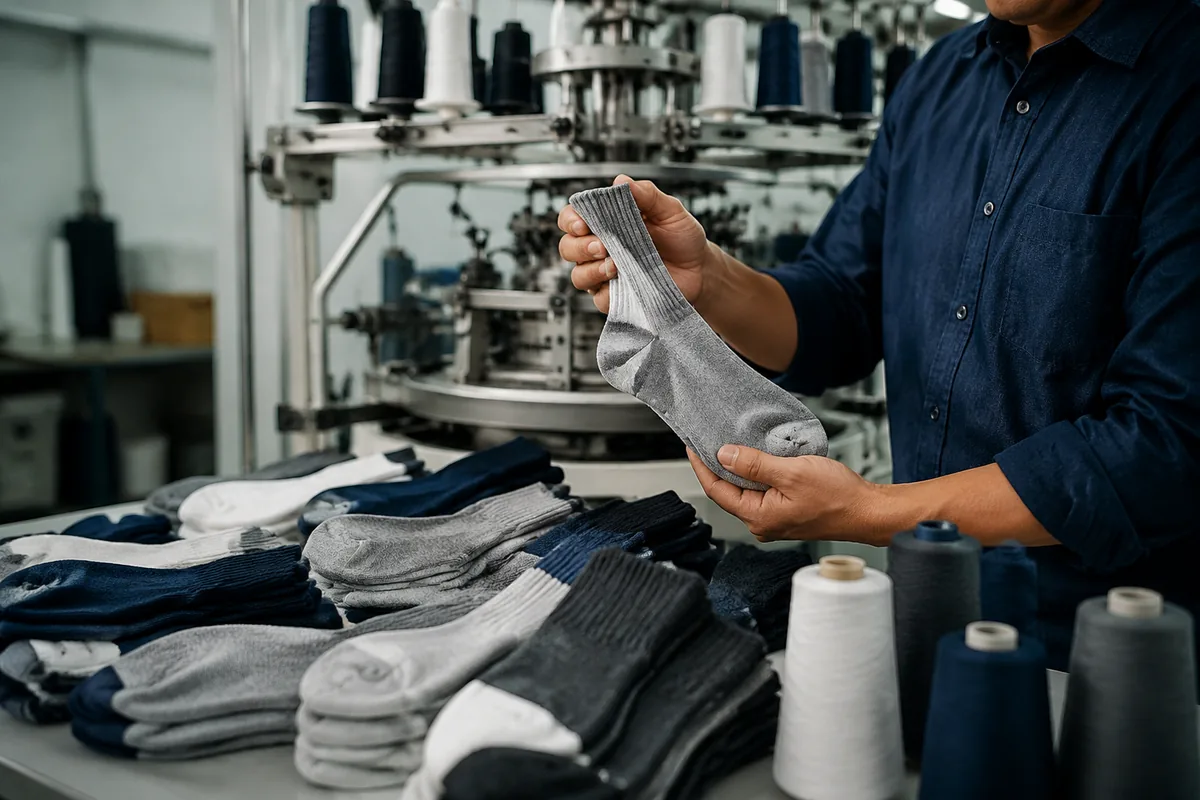
Private Label Socks Manufacturer Guide: MOQ, Pricing Structure, and Landed-Cost Controls
**By Vincent Xi, Editorial Author**
Private label sock programs usually fail on commercial structure, not design taste. Minimum order quantity (MOQ), how a factory builds unit price, and what remains after freight, duty, packaging, and quality cost decide whether a quote is usable. This guide is for brand, retail, and sourcing teams evaluating a **private label socks manufacturer**. It separates OEM and private-label models from wholesale, maps common price blocks, and shows how to control landed cost before sampling locks in a weak quote.
No first-hand factory visit, lab test, customer outcome, or ZheSock production capability is claimed. Numeric ranges below are retained only where the cited public pages state them, with source context, or are labeled as example calculations to re-verify in a live supplier quote.
What “private label socks manufacturer” means in B2B practice
Buyers often treat “private label,” “OEM,” “ODM,” and “white label” as interchangeable. They are not. The model changes MOQ, development cost, IP control, and how much of the construction is fixed before bulk knitting starts.
A Turkey-focused B2B manufacturing guide distinguishes the models as follows:
- **OEM** — buyer supplies design, colors, logo, and yarn specifications; factory produces to those specs under the buyer’s brand
- **ODM** — factory designs a sock the buyer brands
- **Private label** — described as a subset of OEM in which socks are made to a standard specification and branded with the buyer’s labels, hang tags, and packaging
- **White label** — pre-manufactured stock sold without branding for later labeling
Source: Goren Socks B2B Guide.
A separate commercial comparison frames private label as custom manufacturing sold exclusively under the buyer’s brand, versus wholesale as bulk purchase of pre-made products for resale with less differentiation (DeadSoxy private label vs wholesale overview).
**RFQ wording tip:** name the model explicitly. “Private label athletic crew, semi-custom from existing construction, own-brand packaging” is a different MOQ and development path than “full OEM jacquard with custom yarn dye, multi-zone cushion map, and retail carton set.”
MOQ: how minimums are set in sock production economics
MOQ is not a single industry constant. It is a production-economics constraint driven by circular-knitting setup, yarn dye lots, needle-cylinder or yarn-carrier changeovers, linking and finishing labor, packaging print runs, and whether the factory will absorb small-lot inefficiency.
Published MOQ ranges buyers commonly see
Published manufacturer and brand education pages give *ranges and supplier offers*, not universal rules:
1. **Private label MOQ often cited at 200–600 pairs** per style/colorway, with **lead times commonly described as 6–12+ weeks** after approvals. Unit: pairs and weeks. Scope: private-label vs wholesale comparison content on the cited page. As-of context: as stated on the DeadSoxy page (page published-time stamp recorded as 2026-02-18T03:57:22Z). Source: DeadSoxy. 2. **Wholesale entry quantities are described as low as 12–48 pairs** in the same comparison, reflecting pre-made inventory rather than custom knitting. Unit: pairs. Scope: wholesale/stock path in that comparison. As-of/source: same DeadSoxy page as above. 3. One factory-facing wholesale/OEM page advertises **MOQ from 100 pairs** and **samples ready in 15 days** as *that supplier’s* stated commercial offer. Unit: pairs and calendar days. Scope: that company’s published terms only. As-of context: as stated on the cited VelonSocks page at retrieval. Source: VelonSocks wholesale buying guide. Do not treat these figures as a market floor.
A private-label/OEM sourcing hub for brands emphasizes checking MOQ, sampling, yarns, fit, packaging, quality, and export readiness before a first order (EGE Socks Sourcing Guide). That checklist framing is more useful than hunting for one “standard MOQ.”
What raises or lowers MOQ in socks
These are production-constraint patterns used in RFQ scoping. They are not measured outcomes from a named factory audit.
**Higher minimums are common when the order requires:**
- Custom yarn dye or non-stock fiber blends (cotton/poly/nylon/spandex ratios that force new dye lots)
- Complex jacquard, intarsia, or multi-carrier patterns with frequent yarn changes
- Special constructions (compression zones, silicone grip prints, multi-density cushion maps)
- Branded packaging with short print runs or unique carton marks
- Multiple sizes with uneven size curves that leave machines on short efficient runs
**More flexible minimums are common when the order uses:**
- Stock yarn colors already on cones
- Existing constructions with logo, label, and packaging changes only
- Balanced size runs that keep cylinder utilization high
- Shared polybag, hangtag, and carton formats across SKUs
**Buyer control tip:** request MOQ by *style + colorway + size ratio*, not only “pairs total.” A 300-pair MOQ split across five colorways and four sizes is a different commercial problem than 300 pairs of one colorway in a known size curve.
Pricing structure: unit price is only the first line
Factories usually quote a unit or per-dozen price at a stated MOQ, Incoterm, yarn assumption, and packaging assumption. The useful B2B skill is decomposing that price into comparable blocks.
Common cost blocks inside a private label sock quote
| Cost block | What drives it | What to lock in writing | |---|---|---| | Yarn / fiber | Cotton, polyester, nylon, spandex %, recycled content, dye method, yarn count/ply if specified | Fiber %, approved shade method, any restricted-substance rule | | Knitting | Machine gauge/needle setup, pattern complexity, cuff/heel/toe construction | Construction sketch or tech pack, accepted measurement tolerance | | Linking / sewing / boarding | Toe-close method, board shape, finishing steps | Process list and inspection point | | Branding | Woven labels, jacquard logos, silicone grip, heat transfer | Artwork files, placement map, wash-durability expectation | | Packaging | Polybag, hangtag, barcode sticker, header card, carton marks | Packaging BOM and barcode ownership | | Overhead / yield | Seconds allowance, sampling amortization, small-lot inefficiency | Seconds policy and who pays for approved overruns | | Logistics term | EXW / FOB / CIF / DDP | Incoterm, port/airport, insurance scope |
Published margin commentary is directionally useful for commercial planning but is **not** a factory cost model. One comparison states private label retail/business margins in a **60–75%** range versus wholesale margins in a **30–50%** range. Unit: percent margin as presented by that page. Scope: buyer-side product economics in a private-label-vs-wholesale education article, not manufacturer gross margin and not a guaranteed retail outcome. As-of/source: DeadSoxy. Re-model those bands against your sell price, returns, discounts, and channel fees.
How to compare quotes without being misled
Normalize every quote to the same base:
1. Same style, yarn, weight target (if specified), and size curve 2. Same branding and packaging BOM 3. Same Incoterm and destination 4. Same QC standard and AQL (or equivalent inspection rule) 5. Same payment terms and sample-approval path
A lower FOB pair price with expensive packaging upgrades, weak size-curve flexibility, or unpaid sampling revisions can lose to a higher but complete quote.
Landed-cost controls that matter more than headline pair price
Landed cost is the full cost to place sellable pairs in your warehouse or 3PL: product + export packing + international freight + insurance + duty/tax + brokerage + domestic inbound + quality-failure cost.
Origin and transit as commercial variables
One Turkey manufacturing guide argues that proximity to Europe can improve total landed economics versus longer East Asia lanes because shipments from Istanbul can reach Germany, the Netherlands, the UK, and Scandinavia with shorter transit and often lower freight, and because reorder response can be faster (Goren Socks B2B Guide). An export-oriented sourcing page similarly highlights short transit, the EU customs-union context for European buyers, and documented standards as reasons Turkey is evaluated by EU sock buyers (EGE Socks Sourcing Guide).
These are **source-attributed origin arguments**, not proof that one country always wins. Duty rates, preference-program eligibility, fuel surcharges, anti-dumping exposure, and your actual destination can reverse the ranking. Re-run the math for the ship-to country and the HS classification your broker assigns.
Example landed-cost calculation (illustrative only — verify in quote)
The following is an **example calculation / assumption set**, not a market-price survey and not a ZheSock offer. Every figure is an assumption for method teaching and must be replaced with supplier, forwarder, and broker inputs.
| Line item | Assumed value | Scope | |---|---|---| | FOB unit price | **USD 1.80 / pair** | One style/colorway; example assumption | | Order size | **3,000 pairs** | Single production lot; example assumption | | International freight + insurance allocation | **USD 0.22 / pair** | Allocated from total freight; example assumption | | Duty/tax/brokerage allocation | **USD 0.18 / pair** | Destination-dependent; example assumption | | Packaging extras not in FOB | **USD 0.10 / pair** | Buyer-defined BOM; example assumption | | QC failure / replacement reserve | **USD 0.05 / pair** | Planning reserve; example assumption |
**Example landed cost = 1.80 + 0.22 + 0.18 + 0.10 + 0.05 = USD 2.35 / pair** for that 3,000-pair scenario.
If a competing quote is **USD 1.65 FOB** but freight/duty/packaging/QC reserve totals **USD 0.90**, landed cost becomes **USD 2.55 / pair**. The cheaper FOB loses. Re-run with your broker’s duty estimate, actual cartonization, and current freight rates before awarding production.
Practical landed-cost control levers
- **Consolidate SKUs** that share yarn and packaging to raise knitting efficiency without inflating dead inventory.
- **Freeze packaging early** so print plates, barcode ownership, and carton marks are not revised after bulk yarn is dyed.
- **Define size ratios from sell-through data**, not equal splits, to reduce stranded extreme sizes.
- **Separate sampling cost from bulk price** so “free sample” programs are not silently amortized into opaque unit pricing.
- **Specify Incoterm and inspection location** so responsibility for defects found after arrival is unambiguous.
- **Budget a quality reserve** instead of assuming zero seconds outside the factory’s allowance.
Buyer decision table: private label vs adjacent models
| Decision factor | Private label / OEM path | ODM / catalog customization | Wholesale / white-label stock | |---|---|---|---| | Brand exclusivity | High if construction and design are controlled by buyer | Medium; base design may be shared | Low; others can sell similar goods | | Design control | High (OEM) to medium (standard private label) | Medium; choose from factory designs | Low to light branding only | | Typical MOQ pressure | Higher; custom work needs efficient lots | Medium; depends on change depth | Lower if stocked | | Speed to first sellable inventory | Slower; sampling and approvals | Faster than full OEM | Fastest | | Unit-price transparency need | High; many custom cost blocks | Medium | Medium-low | | Landed-cost sensitivity | High; development mistakes multiply across reorder cycles | Medium | Driven more by freight and inventory turns | | Best fit | Differentiated brand assortment, retail programs, controlled quality story | Launch speed with moderate differentiation | Test market, fill-in, low design investment |
This table is a decision aid synthesized from the model definitions and commercial contrasts published in the cited B2B guides (Goren Socks; DeadSoxy; EGE Socks). It is not a performance guarantee for any named factory.
Quality, sampling, and documentation without over-claiming compliance
A serious private label program needs a sample path that freezes commercial risk before bulk yarn is committed:
1. **Tech pack or construction brief** — fiber, weight target if known, cuff/heel/toe, logo method, packaging. 2. **Development sample** — validates look and construction. 3. **Fit / size-set sample** — validates graded sizes, not only one size. 4. **Pre-production sample** — made with bulk-intended yarn and trims. 5. **Bulk inspection rule** — measurement chart, visual defects, packaging audit, and shipment-release criteria.
Name standards only when they are relevant to a product claim you will make (for example, a test method referenced in a buyer QC manual). A standard’s laboratory method is not the same thing as a factory’s everyday practice, and publication of a standard name is not proof of current certification. Request current documents from the supplier when a certificate is commercially required; do not treat marketing language as certification.
Published manufacturer pages may list capacity, sampling speed, or export positioning for *their own* operations. For example, one Turkey manufacturer site states capacity of **1M+ pairs / month** on its public sourcing/contact content. Unit: pairs per month. Scope: that company’s self-published capacity claim only. As-of context: as stated on the cited EGE Socks page at retrieval. Source: EGE Socks. That figure is not a market benchmark, not a requirement for every private label socks manufacturer, and not a claim about ZheSock production.
Practical RFQ checklist for a private label socks manufacturer
Use this checklist as the body of your request for quotation. Incomplete RFQs produce non-comparable prices.
Commercial scope
- [ ] Program type: private label / OEM / ODM / white label
- [ ] Target market and ship-to country
- [ ] Forecast for first order and 12-month reorder intent (even if approximate)
- [ ] Requested Incoterm and destination port/airport or door
- [ ] Currency and payment terms requested
Product definition
- [ ] Style names and reference photos or tech packs
- [ ] Fiber content targets and any restricted-substances requirements
- [ ] Construction notes: cuff, heel, toe close, cushioning, grip, compression
- [ ] Colorways with Pantone or physical standards if available
- [ ] Size run and ratio
- [ ] Branding: woven label, jacquard, print, hangtag, barcode ownership
- [ ] Packaging BOM and retail vs bulk pack
MOQ and sampling
- [ ] Ask MOQ per style, per colorway, and per size-curve constraint
- [ ] Sample types, sample fees, and sample lead time in calendar days
- [ ] Number of free revision rounds included
- [ ] Whether bulk yarn/dye lots must match approved lab dips
Pricing and landed-cost fields to force into the quote
- [ ] Unit price at two MOQ tiers (example: threshold A and threshold B — values to be proposed by supplier)
- [ ] Price validity date
- [ ] Packaging included vs excluded line items
- [ ] Carton packing details (pairs per polybag, bags per carton, carton dimensions/weight if available)
- [ ] Estimated production lead time after PP sample approval
- [ ] Seconds allowance and defective replacement policy
- [ ] Freight estimate responsibility (supplier, forwarder, or buyer)
- [ ] Any duty-preference documents the supplier can support for your route
Quality and release
- [ ] Measurement chart tolerances
- [ ] Visual defect list
- [ ] Third-party inspection rights and who pays
- [ ] Required documents: packing list, invoice, packing photos, test reports if specified
Methodology and source context
**How this article’s data was derived:** Editorial synthesis of publicly available B2B sock-sourcing pages focused on manufacturing models, MOQ language, wholesale vs private label economics, and export-oriented buyer checks. Numeric ranges were retained only where the cited pages publish them (private label MOQ and lead-time ranges; wholesale entry quantities; one supplier’s stated 100-pair MOQ and 15-day sample claim; one manufacturer’s published monthly capacity figure; margin ranges presented in a private-label-vs-wholesale comparison). The landed-cost worksheet is an explicit example calculation for method teaching, not a survey average and not a quotation.
**Source contexts used:**
1. Manufacturer B2B guides explaining OEM/ODM/private label/white label and Turkey-to-Europe logistics arguments (Goren Socks; EGE Socks). 2. Commercial model comparison of private label versus wholesale minimums, timelines, and margin bands (DeadSoxy). 3. Factory-facing wholesale/OEM buying-guide claims on MOQ and sampling speed (VelonSocks).
Limitations and what to verify before you buy
- Published MOQ, sample-day, margin, and capacity figures are **as stated on third-party pages at retrieval** and may change without notice.
- Country-of-origin advantages depend on your destination, freight market, HS code, and preference-program eligibility; re-validate with a customs broker.
- Margin ranges describe commercial outcomes claimed in educational content, not guaranteed retail performance.
- No factory audit, lab test, customer outcome, certification status, or ZheSock production capability is asserted in this article.
- Before award, verify current pricing, lead time, yarn availability, packaging tooling cost, inspection rights, and document set in a formal quote and purchase contract.
Closing decision path for sourcing teams
If brand control and assortment differentiation are the goal, structure the project as private label/OEM with a complete tech pack, staged sampling, and landed-cost fields in the RFQ. If speed and low inventory risk dominate, wholesale or white-label stock may be the correct first step, with a later migration to private label once size curves and sell-through are known—an approach also described in private-label-versus-wholesale education content (DeadSoxy).
The commercially durable habit is simple: compare manufacturers on **comparable specs, comparable Incoterms, and comparable quality release rules**, then choose the quote with the best controlled landed cost—not the lowest pair price on the first line.
---
*Editorial author: Vincent Xi, Editorial Author — author profile. This article is informational B2B sourcing guidance compiled from cited public pages and example calculations. It does not constitute a factory quotation, certification claim, or product performance warranty.*