Logo Sock Wholesale Supplier Minimum Order Quantity for United States Buyers
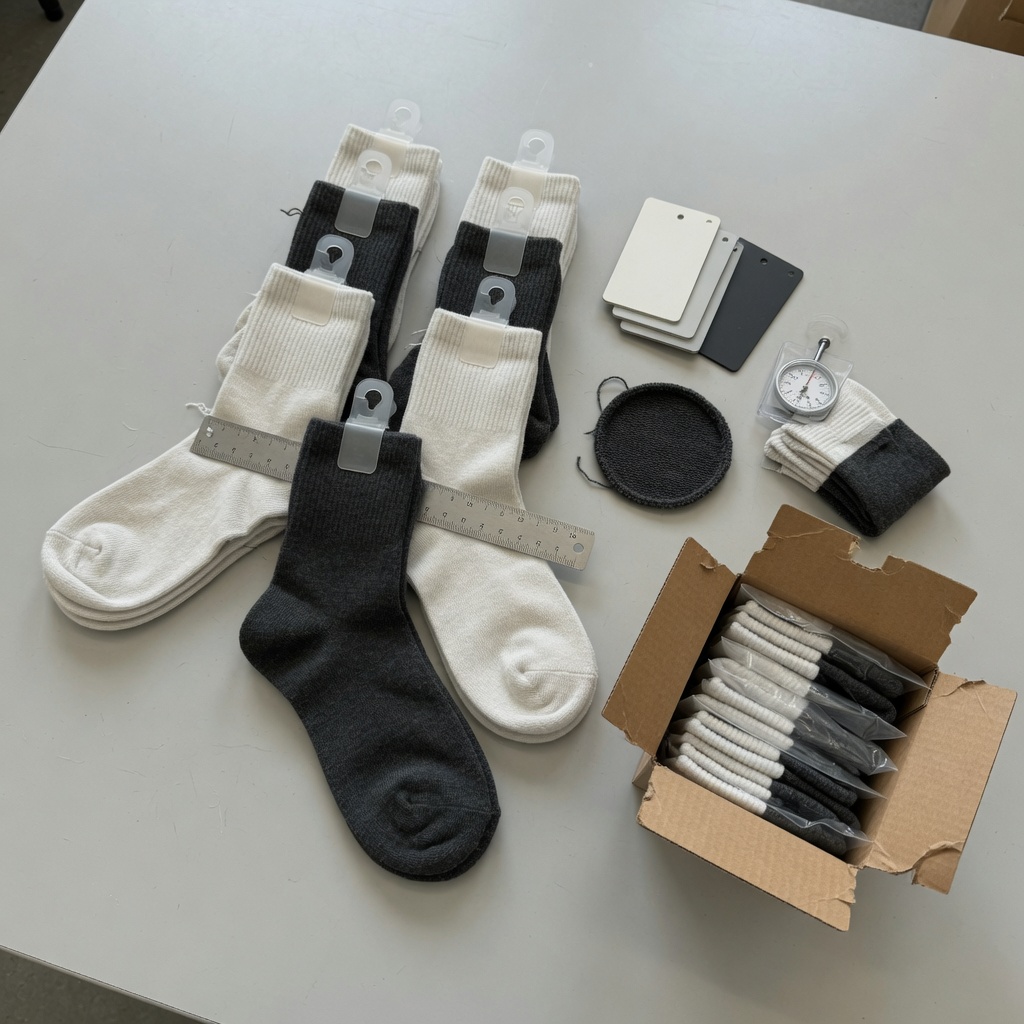
United States buyers comparing a logo sock wholesale supplier minimum order quantity should lock three items before they compare a unit price: logo method (knit-in, other knitted custom, or print), the pair floor that applies to that method, and whether that floor is per design, per color, per size, or per shipment. Public pages do not publish one shared pair count, so a promotional sock wholesale supply RFQ is comparable only after those three items are written down.
Sourced pair floors — unit: pairs; scope: the construction each page names; as-of: as stated on the cited pages (reconfirm on the live quote):
- DeadSoxy’s bulk-ordering guide states that ordering logo socks in bulk starts at 100 pairs, that its knit-in custom program starts at a 100-pair minimum, and that most custom sock manufacturers require 100 to 200 pairs per design for knit-in logo socks (DeadSoxy bulk ordering guide).
- Custom Sock Shop’s custom wholesale page states a 12-pair minimum for wholesale custom dress and athletic knit styles, that the 12-pair minimum applies across all knit styles regardless of order complexity, and no minimum order quantity for print socks (Custom Sock Shop).
- Sokke’s custom wholesale article states that most wholesale custom sock orders start at 100 pairs, with that supplier’s own minimum at 100 pairs for knitted custom logo socks (Sokke).
Those figures are pair counts and supplier-stated commercial policies, scoped to the constructions each page describes. They are not laboratory results, not a freight quote, not a United States Customs ruling, and not a ZheSock production schedule. Match logo method, size run, packaging, and labeling to a pair floor you can fund, store, and sell through, then lock that floor in a written RFQ.
This article is published on ZheSock under the Person byline Vincent Xi, job title Editorial Author (Vincent Xi author profile). It does not claim factory visits, client names, tests, awards, certifications, customer outcomes, or first-person production experience.
What a logo sock wholesale supplier minimum order quantity actually controls
Minimum order quantity is the smallest number of pairs a supplier will put on a knitting machine, a print line, or a pick ticket for a defined design. For logo socks, “design” usually means a combination of construction, colorway, and logo treatment. A 100-pair floor that applies per design is not the same as 100 pairs split across three logos or four sizes.
The pair floor is a production-economics control, not a quality certificate and not a United States import-clearance document. Knit-in logos require patterning, yarn setup, and machine time that a mill recovers across a run. Printed logos can follow a different setup path, which is why one cited wholesale page separates a 12-pair knit floor from a no-minimum print program. Record four dimensions on every supplier comparison:
- Unit: pairs. Confirm the quote is not using dozens, pieces, or cartons as the silent unit.
- Scope: per design, per color, per size, or per ship-to location.
- Construction: knit-in logo, other knitted custom, or printed.
- Commercial envelope: sample lot versus bulk production, and whether pair bags, hangtags, or inner packs change the floor.
If a quote lists “100” with no unit, stop and restate the line as “100 pairs per design, adult crew, [knit-in or print], polybagged pairs.” Example unit conversion (assumption to verify in the quote, not a sourced MOQ): 1 dozen = 12 pairs, so a mill that means 100 dozen is offering 1,200 pairs, not 100 pairs. Write the unit on the quote before you compare price.
Freeze the logo method first. Do not apply a print floor to a knit-in logo, or a 12-pair knit floor to a mill that only published a 100-pair knit-in start. Copy only the published floor that matches the method you will buy, then convert every quote to pairs and to per-design, per-color, per-size, and per ship-to scope.
Why knit-in and print programs publish different pair floors
The cited pages disagree on the numeric floor because they are not describing the same process. That disagreement is the buying decision, not noise to average away.
DeadSoxy and Sokke both publish a 100-pair start for knitted custom or knit-in logo programs. DeadSoxy also characterizes most custom sock manufacturers as requiring 100 to 200 pairs per design for knit-in logo socks; that “most manufacturers” wording is that page’s characterization, not a census of every mill. Sokke’s “most wholesale custom sock orders start at 100 pairs” wording is likewise that page’s characterization, not a market survey.
Custom Sock Shop publishes a different commercial envelope: 12 pairs across wholesale custom dress and athletic knit styles, plus no minimum order quantity for print socks. That page does not, in the cited excerpt, define those knit styles as knit-in logos. Do not treat a 12-pair knit floor as proof that every knit-in mill will pattern a new logo at 12 pairs.
For a United States promotional program, choose logo method before you negotiate the pair floor. The cited knit-in and knitted-custom programs publish 100 pairs or 100 to 200 pairs per design. The cited print program publishes no minimum order quantity. Construction and supplier policy drive the floor. Do not read “no MOQ” as “no setup cost.” Ask the supplier to line-item screens, digital print files, or plate charges, and to state whether those fees amortize only after a stated pair count.
A 12-pair knit floor and a 100-pair knit-in floor are published commercial floors, not interchangeable quality claims. Specify yarn, gauge, cuff, heel and toe, and logo placement, then approve a pre-production sample against those specs.
How the pair floor changes cash, leftover risk, and landed cost
The pair floor changes three measurable outcomes: cash tied in inventory, leftover risk if the campaign is short, and the per-pair production cost a supplier is willing to quote.
The source pages do not publish a complete delivered price list for United States destinations. This article therefore does not invent a dollar-per-pair figure, a duty rate, or a freight rate. Model the following in your own spreadsheet and label any dollar math as an example calculation to verify in the supplier quote:
- Amortized setup. If knit-in patterning is recovered across 100 to 200 pairs per design (DeadSoxy’s characterization of most manufacturers, as stated on its bulk guide), a supplier that will even accept a 12-pair knit lot is spreading the same class of setup over fewer pairs, which usually raises the quoted per-pair price. On a no-minimum print program, setup often appears as a separate line. Dividing that line by pair count is an example calculation to re-run on the live quote.
- Landed cost per pair, not origin price per pair. For United States receipt, add freight, insurance, customs brokerage, any duty, and inland cartage, then divide by sellable pairs received. A 12-pair lot and a 100-pair lot do not share freight the same way (example comparison of two sourced floors, not a carton specification). Do not use a made-up duty percentage. Ask the supplier for the HTS classification they intend to use and have your broker confirm it.
- Inventory carrying and obsolescence. A 200-pair per-design floor on three logo variants is 600 pairs before any size-run expansion (example calculation / assumption to verify in the quote, not a sourced order size). If an event needs 80 pairs (example demand assumption, not a sourced campaign size), leftover pairs are a holding-cost and write-off risk. Record expected sell-through weeks and a leftover plan before you “save” per-pair cost by jumping to the next published floor.
- Size-run inflation. If the floor is per design but you need multiple adult sizes, confirm whether 100 pairs may be mixed or whether each size has its own floor. Mixed-size 100-pair lots are commercially different from 100 pairs per size. The cited pages do not specify size-run rules; that is a verify item, not a figure to invent.
Example calculation (assumption to verify in the quote, not a market price): landed per-pair ≈ (setup + (pairs × pair price) + freight + brokerage + duty) ÷ pairs received. Re-run the same formula at 12 pairs, 100 pairs, and 200 pairs using only numbers the supplier and carrier provide. Placeholder arithmetic is not a bid.
United States labeling, delivery, and landed-cost controls next to minimum order quantity
A pair floor that ignores United States receiving rules is not an orderable spec. Keep the product and RFQ decision primary: you are buying promotional socks on wholesale supply terms. The following controls belong in the same RFQ block as minimum order quantity because they change whether the lot can enter your channel and what you actually pay per pair.
Textile identification. For United States retail and many wholesale-to-retail channels, covered textile products commonly need fiber content, country of origin, and manufacturer or RN/WPL identification on the label you will receive. Specify label language, attachment method (sewn-in versus printed-in), and who supplies the labels. Confirm the current FTC textile-labeling requirements for your channel with counsel. Do not treat a hangtag proof as a substitute for fiber-content identification unless counsel confirms that format for your channel. This is a buyer-side channel control, not a claim that the cited supplier pages already ship a compliant United States label, and not a ZheSock certification.
Intended end use. State in the RFQ whether the sock is adult corporate or event merchandise. If the end use is a children’s product, additional tracking-label and safety obligations may apply; name the age grade instead of leaving the mill to guess.
Packaging that changes both the pair floor and freight. Pair bands, individual polybags, inner packs, and master cartons change cubic volume and sometimes the pair floor. Specify pair presentation, whether a UPC/GTIN is required, inner-pack quantity, and whether mixed sizes may share a carton. Ask for carton dimensions, gross weight, packed-pair count, and whether special packaging raises the pair floor so a United States warehouse can plan inbound.
Delivery envelope. Name the United States delivery location type (warehouse, 3PL, or event site), requested Incoterm, importer of record, and whether you need one drop or a split shipment. A 100-pair production floor shipped as two 50-pair drops is a fulfillment request, not a knitting MOQ (example split, not a sourced carton rule); some suppliers will not split below a carton.
Landed-cost document set. Require a line-item quote in the currency you will pay that separates pair price, setup, packaging, origin inland freight, international freight, insurance, brokerage, and duty treatment. If the supplier will not estimate duty, your broker should. This article does not publish a duty percentage because the source set does not include a current tariff extract for a named construction.
Quality hold points that are not the pair floor. Pair floor is not a substitute for a pre-production sample, a size spec (cuff height, overall length, stretch girth), a broken-needle or needle-detection policy if you require it, and a written over/under shipment tolerance. Ask the supplier to state the allowed over/under as a percentage of ordered pairs. Do not assume a percentage this page does not source.
Decision table: matching promotional sock pair floors to the buyer task
Use this table to specify and compare options. Figures in the published-floor column are supplier-stated pair counts from the cited pages, scoped as those pages describe them, as published on those pages. They are not ZheSock production MOQs and not a promise that every mill will match them.
| Buyer task | Logo method / construction | Published pair floor (unit: pairs; as-of: as stated on the cited page) | Scope to confirm | Cost and inventory trade-off | Verify before you approve |
|---|---|---|---|---|---|
| Pilot a print-branded giveaway for one US event | Print socks | No minimum order quantity, Custom Sock Shop custom wholesale page | Whether “no minimum” still carries a setup or per-color charge; adult vs youth | Lowest inventory risk; setup may dominate per-pair cost at very small lots | Print durability against a wash method you define; placement; ink/substrate; US fiber and origin label |
| Small knit wholesale restock for a single logo | Knit dress or athletic (not specified as knit-in logo on that page) | 12 pairs across knit styles, Custom Sock Shop custom wholesale page | Per design vs per color vs per size; dress vs athletic spec | Lower cash outlay; per-pair price may be higher than a 100-pair knit-in run | Gauge; yarn; heel/toe; size spec; whether 12 pairs may mix sizes |
| Campaign knit-in logo socks with brand color in the fabric | Knit-in logo | 100 pairs on DeadSoxy’s custom program, DeadSoxy bulk ordering guide | Per design; whether extra colorways duplicate the floor | Better setup amortization; 100 pairs of leftover risk if demand is lower | Pattern approval; yarn dye lot; logo definition; carton pack-out |
| Plan against that guide’s “typical” knit-in manufacturer floors | Knit-in logo socks | 100 to 200 pairs per design, DeadSoxy guide’s statement about most custom sock manufacturers | What counts as a design change (heel color, cuff, logo) | Higher cash and storage; leftover risk falls only if sell-through is real | Written confirmation that your design count matches the mill’s definition |
| Knitted custom logo lot aligned to a 100-pair wholesale start | Knitted custom logo socks | 100 pairs on Sokke; same page states most wholesale custom sock orders start at 100 pairs | Whether the floor is per design; size assortment | Same directional trade-off as other 100-pair knit programs | Construction sheet; lead time to a US address; sample vs bulk floor |
Read the table left to right as a specification path: task → method → published floor → scope → economics → verification. Do not average 12 and 100 to invent an “industry MOQ.”
RFQ checklist for a logo sock wholesale supplier minimum order quantity
Every item below is a specify, compare, verify, approve, or order control. Copy it into the RFQ and replace brackets with program data.
- Pair floor, unit, and scope. Request [N] pairs per design. Require the supplier to reply with minimum order quantity in pairs, and whether it applies per logo, per colorway, per size, or per shipment. Ask them to cite the floor that applies to your construction.
- Construction and logo method. Specify crew, ankle, or knee; knit-in, other knitted custom, or printed; yarn blend you require; gauge; cuff, heel, and toe type. Attach artwork and a placement diagram with measurements from the cuff edge.
- Size run and grading. List pairs by United States adult or youth size. Ask whether the MOQ may be mixed across that run. Require cuff height, foot length, and stretch girth, with a tolerance in millimeters or inches.
- Color and dye-lot control. Name a physical swatch or other color standard. Ask whether a new colorway restarts the pair floor. Require dye-lot continuity inside one purchase order.
- Sample versus production MOQ. Ask for pre-production sample quantity, sample lead time, whether sample pairs are from the production machine/program, and whether sample pairs count toward the bulk minimum order quantity.
- United States labeling pack. Require fiber content, country of origin, and manufacturer or RN/WPL identification consistent with your channel. Specify sewn-in versus printed-in. State adult promotional use or children’s product age grade. Ask for a label proof before bulk knit or print.
- Packaging and identifiers. Pair band or polybag; inner-pack quantity; master-carton pair count; carton dimensions and gross weight; UPC/GTIN if needed. Ask whether special packaging raises the pair floor.
- Quality holds. Define inspection for pairing, holes, logo registration, color, and measurements. If you require needle detection, state it. Ask for a written over/under tolerance as a percentage of ordered pairs (supplier states the percentage).
- US delivery and Incoterms. Ship-to ZIP, dock or 3PL appointment rules, requested Incoterm, importer of record, and whether split shipments are allowed below a carton. Require estimated ship date and United States arrival as ranges from a named trigger (artwork approval or deposit).
- Landed-cost line items. Pair price; setup; packaging; freight; insurance; brokerage; duty treatment. Ask for the intended HTS heading. Require commercial invoice and packing list pair counts to match. Label any internal amortization math as an example to verify against this quote.
- Artwork storage and repeats. Who stores the knit program or print file, for how long, and whether a repeat PO inside [X] months keeps the same pair floor.
- Change control. Written rule for what constitutes a new design (logo resize, cuff color, yarn substitution) and therefore a new minimum order quantity.
- Payment and cancellation. Currency, deposit, balance trigger, and cancellation after patterning—as the supplier states them, not as assumed terms.
- Approval pack. Construction sheet, size spec, artwork proof, label proof, carton marks, and a quote that restates minimum order quantity in pairs.
Issue the RFQ only after logo method, pair floor, and United States receiving controls sit on one page. Approve the PO only when the quote restates those items in numbers and documents you can file.
Methodology, source context, and what to verify before you issue a PO
How these figures were derived. This article compares three publicly stated commercial policies for custom or wholesale logo socks. No laboratory test was commissioned. No ZheSock factory minimum order quantity is claimed. Exact numbers above are pair counts as written on the cited pages, with scope limited to the construction each page names, and with as-of context equal to as stated on those published pages. Unit conversions (dozen to pairs) and leftover-pair multiplications are example calculations / assumptions to verify in the supplier quote.
Source context (two or more). (1) DeadSoxy’s logo-socks bulk ordering guide is a supplier-owned commercial guide that publishes a 100-pair bulk/knit-in start and a 100 to 200 pairs per design characterization of most custom sock manufacturers for knit-in logo socks. (2) Custom Sock Shop’s custom wholesale socks page is a supplier-owned catalog policy page that publishes a 12-pair knit wholesale floor and no minimum order quantity for print socks. (3) Sokke’s custom wholesale socks article is a supplier-owned article that publishes a 100-pair minimum and states that most wholesale custom sock orders start at 100 pairs. These pages describe their own or “typical” pair floors. They are not independent laboratory reports, not United States Customs rulings, and not ZheSock capability statements. DeadSoxy and Sokke cluster around a 100-pair knit/wholesale start; Custom Sock Shop publishes a lower knit floor and a no-minimum print path. That split is evidence that construction and supplier policy drive the pair floor, which is why the RFQ must restate construction.
Limitations (what to verify). Published pair floors can change without notice. The cited pages do not include a tariff extract, a freight tariff, a dated price list, size-run rules, over/under percentages, or a United States label layout. HTS classification, duty, brokerage, and lead time to a United States warehouse must come from the live quote and your broker. A 12-pair floor on one site does not obligate another supplier to match it. A “most manufacturers require 100 to 200 pairs” statement is DeadSoxy’s characterization, not a census of every mill. A “most wholesale custom sock orders start at 100 pairs” statement is Sokke’s characterization, not a market survey. FTC textile-labeling obligations depend on channel and end use; this article is not a compliance opinion. If a claim is not supported by the sources above or by the supplier’s written quote, omit it from the purchase order.
Before you issue a PO, reconcile: pair floor and unit; per-design scope; logo method; United States labeling pack; packaging and carton yield; Incoterm and ship-to; sample approval; landed-cost lines. Approve only when the quote restates those items in numbers and documents you can file.
Discuss Your Requirements
Review our manufacturing capabilities, then share your specifications for a supplier-fit review.