Sock Wholesale Guide: MOQ, Pricing Structure, and Landed-Cost Controls
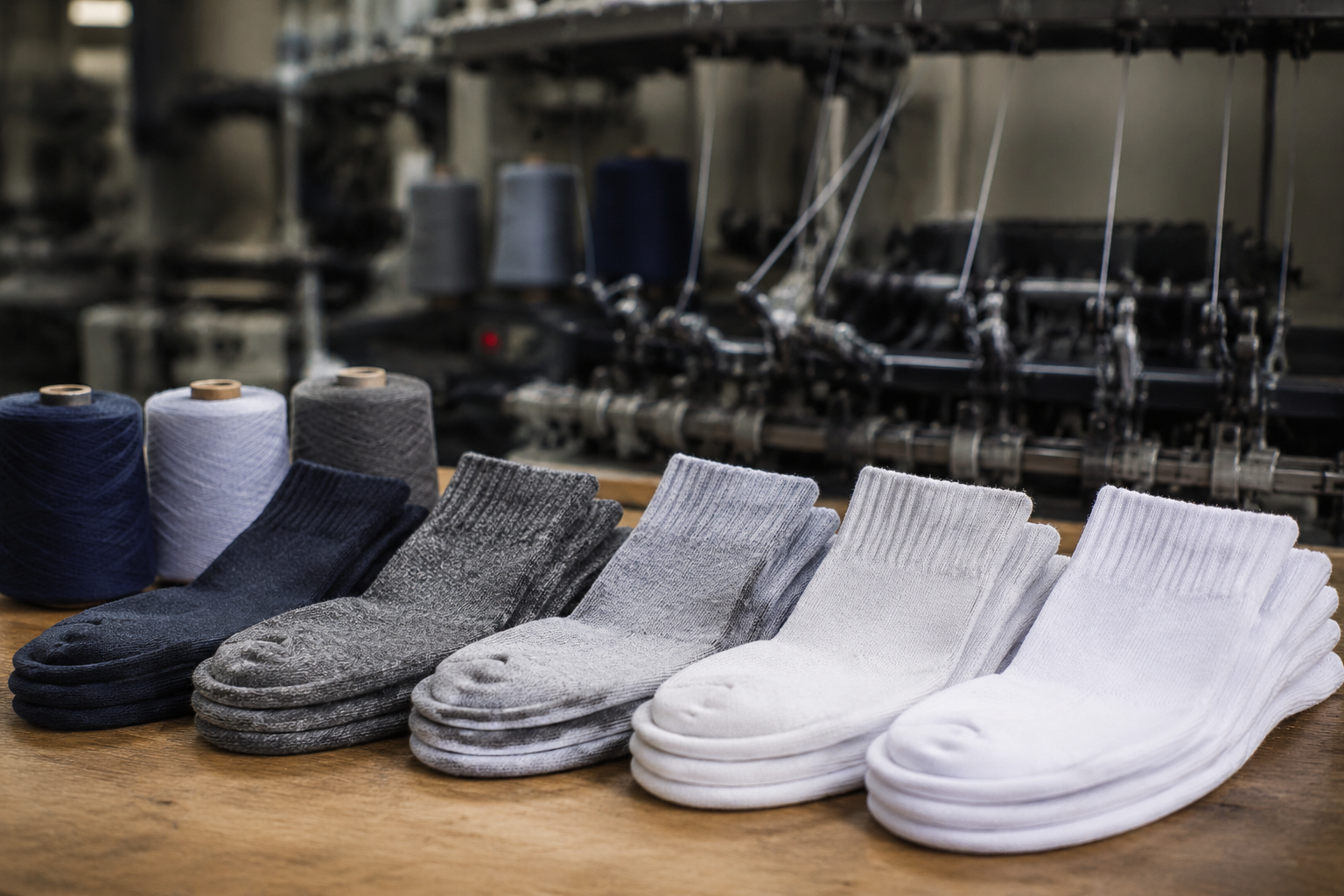
Sock Wholesale Guide: MOQ, Pricing Structure, and Landed-Cost Controls
**Byline:** Vincent Xi, Editorial Author, ZheSock
Sock wholesale is a program decision, not a single unit-price decision. Minimum order quantity (MOQ), commercial model, decoration, packaging, freight mode, duties, sampling, and reorder timing all change the true cost of a pair. This guide gives B2B buyers a practical framework for MOQ planning, pricing structure, and landed-cost control before they issue an RFQ.
What this guide helps you decide
1. Which commercial model to request (OEM, ODM, private label, white label) 2. What MOQ range fits sell-through risk versus factory efficiency 3. How to force tiered pricing and line-item transparency 4. How to compare offers on the same landed-cost basis
What Sock Wholesale Means in a B2B Context
In B2B use, sock wholesale usually means buying blank or custom socks in commercial volume for retail resale, private label, corporate gifting, team programs, promotions, or distributor inventory.
One bulk-buying guide defines typical wholesale order sizes as **100 to 10,000+ pairs** (order-size scope: bulk blank/custom sock programs as described by that publisher) and states that volume pricing can reduce per-unit cost by **30–60% versus retail** for those bulk programs (DeadSoxy bulk socks B2B guide). Treat those figures as published market ranges from that source, not as a universal factory quote or as-of date for current yarn markets.
Separate commercial models before you request prices
- **OEM:** buyer-controlled design, construction, yarn, and branding
- **ODM:** manufacturer-designed base style, buyer branding and colorway
- **Private label:** standard or near-standard construction with buyer labels and packaging
- **White label:** pre-made unbranded stock with later labeling
A Turkey-focused manufacturer guide describes these same OEM, ODM, private-label, and white-label distinctions as the practical language manufacturers expect in RFQs (Goren Socks B2B guide). Clear model selection reduces quote noise and prevents comparing incompatible offers.
MOQ Ranges and How They Shape Program Economics
MOQ is not only a production constraint. It is a cash-flow, SKU-complexity, and inventory-risk decision.
Published MOQ examples by program type
1. **Bulk custom or blank programs:** commonly discussed from **100 pairs upward**, with larger runs into **thousands or 10,000+ pairs** depending on brand, retail, or promotional needs (DeadSoxy bulk socks B2B guide). Scope: bulk sock purchasing examples as published by that guide; not a single-factory standard. 2. **Corporate gifting / branded programs:** one source places typical corporate volumes around **200 to 5,000 pairs per order** (DeadSoxy bulk socks B2B guide). Scope: corporate/branded program volumes as stated in that guide. 3. **Retail dress-sock entry points:** a retailer-focused guide cites branded wholesale MOQs as low as **12–48 pairs**, and custom/private-label MOQs around **100–500 pairs** (DeadSoxy wholesale dress socks guide). Scope: dress-sock retail wholesale entry points as published there. 4. **Factory-direct marketing examples:** some manufacturer pages advertise MOQs from **100 pairs** and sampling windows such as **15 days** as commercial offers on their sites (VelonSocks wholesale buying guide page claims). These are supplier marketing claims for that seller, not industry standards and not transferable to other factories without written confirmation.
Practical MOQ logic for buyers
- **Low MOQ** helps test colorways, sizes, and packaging, but often raises unit price and setup amortization per pair.
- **High MOQ** can improve yarn purchasing efficiency and machine utilization, but increases inventory risk if size curves or artwork are wrong.
- **Multi-SKU MOQ** matters more than total pairs. An order of 1,200 pairs across 12 colorways is operationally different from 1,200 pairs in one colorway.
- **Assortment rules** (size ratio, color mix, packaging variants) can quietly raise effective MOQ even when the headline pair count looks flexible.
For landed-cost control, model MOQ in two layers:
- **Production MOQ:** what the factory needs to run efficiently
- **Commercial MOQ:** what your sell-through, storage, and cash cycle can absorb
Buy only the commercial MOQ you can fund and clear. Do not treat production efficiency as automatic demand.
Pricing Structure: Unit Price Is Not the Whole Quote
A usable sock wholesale quote should break cost into controllable components. Headline pair price alone is rarely enough for margin planning.
Core price drivers to force into the quote
- Yarn grade and fiber mix (for example, combed cotton, merino blends, performance synthetics)
- Gauge / needle count and construction complexity
- Toe closure method and reinforcement choices
- Color count, yarn changes, and pattern complexity
- Branding method (knit-in design, embroidery, transfer, labels)
- Packaging (poly bag, band, hangtag, gift box, carton marks)
- QC level, AQL sampling intensity, and third-party testing if required
- Incoterms and payment terms
Retail-side economics can look attractive when wholesale quality is stable. One dress-sock retailer guide states wholesale dress socks can support **55–70% retail margins**, versus an apparel average range it cites at **40–50%**, and notes professionals may replace dress socks **6–10 times per year** (DeadSoxy wholesale dress socks guide). Scope: retail-margin and replenishment claims as published by that guide. They do not guarantee any buyer’s actual contribution margin after markdowns, returns, freight, and duty.
Example calculation (assumption only; verify in supplier quote)
Use this only as a worksheet method, not as market pricing and not as an as-of quote:
| Cost line | Assumed value | Scope note | |---|---|---| | FOB unit price | **USD 2.40 / pair** | Example assumption only; replace with quote | | Ocean freight + local inland + insurance allocation | **USD 0.28 / pair** | Example assumption only; lane- and date-specific | | Duty/tax allocation | **USD 0.22 / pair** | Example assumption only; destination- and HS-code-specific | | Packaging and labeling already in FOB | **USD 0.00 incremental** | Example assumption only | | QC/sample amortization | **USD 0.10 / pair** | Example assumption only; depends on sample plan and order size |
**Illustrative landed cost = 2.40 + 0.28 + 0.22 + 0.10 = USD 3.00 / pair.**
Every number above is an example assumption for method demonstration and must be replaced with quote-specific values, current freight lanes, and destination-duty rules before RFQ comparison or PO release.
Pricing structure to request in every RFQ
Ask suppliers to price in tiers, not a single flat number:
- **Tier A:** sample / pilot quantity
- **Tier B:** first production run
- **Tier C:** repeat order with locked BOM
- Optional rush premium and color-change premium
- Packaging variants as separate lines
This structure makes it easier to compare offers and isolate which lever is actually driving cost.
Landed-Cost Controls Buyers Can Actually Manage
Landed cost is the full cost to receive sellable inventory at your warehouse or 3PL: product, export handling, freight, insurance, duty/tax, brokerage, domestic delivery, and quality failure cost.
Control levers that matter
1. **Incoterms clarity** FOB, CIF, DDP, and similar terms allocate different risk and cost. A lower FOB price can lose to a cleaner DDP offer if your team underestimates import complexity.
2. **Origin and transit time** A Turkey sourcing guide notes that proximity to European markets can reduce transit time and freight relative to longer East Asia lanes, and frames this as part of total landed-cost evaluation rather than unit price alone (Goren Socks B2B guide). That is a logistics argument from that source; buyers should still compare current lane rates, not historical assumptions.
3. **Carton efficiency and pack-out** One retailer guide cites storage density around **40–60 pairs per cubic foot** for dress socks as a merchandising/storage consideration (DeadSoxy wholesale dress socks guide). Scope: dress-sock storage density as published by that guide. Better pack-out can reduce freight per pair even when unit price is unchanged.
4. **Assortment discipline** Extra sizes, seasonal colors, and special packaging raise dead-stock risk. Dead stock is a landed-cost problem because paid freight and duty sit on unsold units.
5. **Quality cost, not only defect rate** A low defect rate with late discovery is still expensive if goods are already in the destination market. Build inspection points before final packing and before shipment release.
6. **Reorder planning** Stable BOM, shade continuity, and size-curve history reduce emergency air freight. Air freight is often the fastest way to destroy a planned margin.
Landed-cost checklist for quote comparison
- Same Incoterm across compared suppliers
- Same packaging specification
- Same inspection standard and sample plan
- Same destination and delivery point
- Same payment terms, or a cash-flow adjustment applied
- Same inclusion/exclusion of labels, inserts, and barcodes
If any of those inputs differ, normalize them before ranking unit prices.
Buyer Decision Table: MOQ, Price, and Landed-Cost Fit
| Buyer scenario | Typical MOQ posture (from published market examples) | Pricing structure to prioritize | Landed-cost control focus | Main risk if mismanaged | |---|---|---|---|---| | Small retailer testing dress styles | Low branded entry points cited at **12–48 pairs**; custom often higher (dress socks guide) | Small-run unit price + reorder price | Pack size, returns, shade consistency | Overbuying colorways before sell-through proof | | Corporate gifting program | Often discussed around **200–5,000 pairs** (bulk guide) | Decoration + packaging line items | On-time delivery, presentation QC, split-ship cost | Artwork/size errors found after branding | | Private-label retail launch | Common custom/private-label discussion range **100–500+ pairs** (dress socks guide; bulk guide) | Tiered production pricing + packaging SKUs | Duty, carton marks, barcode readiness | SKU proliferation and weak size curve | | Distributor / high-volume wholesale | Often **1,000–10,000+ pairs** program scale in bulk discussions (bulk guide) | Volume tiers, annual forecast pricing | Ocean vs air mix, warehouse density, claim process | Cash locked in slow movers | | OEM performance or technical sock program | Usually higher technical MOQ by construction complexity (confirm per factory; no universal published fixed MOQ applied here) | BOM-locked pricing, test-cost allocation | Spec compliance, retest cost, rejection cost | Spec drift between sample and bulk |
Use the table as a planning matrix. Replace every published example range with the actual supplier’s current commercial terms, dated quote validity, and written assortment rules.
Practical RFQ Checklist for Sock Wholesale
Send one complete RFQ package so suppliers quote the same scope.
1) Commercial scope
- Target channel: retail, corporate, team, promo, distributor
- Commercial model: OEM / ODM / private label / white label
- Target first-order pairs and 12-month forecast range
- Required delivery windows and destination country/city
- Preferred Incoterm and payment terms
2) Product specification
- Sock type: dress, crew, ankle, athletic, compression-style, etc.
- Size run and size ratio
- Fiber content targets and acceptable substitutes
- Weight / thickness expectation
- Needle count or hand-feel reference if known
- Heel/toe reinforcement requirements
- Toe closure preference
- Elasticity and cuff performance expectations
- Color standard method (Pantone or approved yarn cards)
3) Branding and packaging
- Logo method and placement map
- Label language and legal marks for destination market
- Hangtag, header card, polybag, or gift-box requirements
- Barcode / SKU logic
- Inner pack and master carton marks
- Carton strength and humidity protection needs
4) Quality and compliance controls
- Approved sample process (fit, wash, color)
- In-line and final inspection expectations
- Defect classification examples (critical / major / minor)
- Any lab tests required by your channel (state them as buyer requirements; do not assume factory certification)
- Shade-band approval and bulk-lot continuity rules
5) Pricing and landed-cost data request
- Unit price by quantity tier
- Setup, cylinder, or artwork fees if any
- Packaging unit cost by variant
- Sample cost and sample lead time
- Production lead time after sample approval
- Carton dimensions, pairs per carton, gross/net weight
- Quoted Incoterm and what is included/excluded
- Known origin, HS code suggestion (buyer still verifies duty treatment)
- Claim process for short shipment, wrong size mix, or shade variance
6) Decision documents to require before PO
- Signed specification sheet
- Approved pre-production sample photos and retained reference pair
- BOM freeze date
- Production schedule with inspection gates
- Packaging dieline approval
How to Compare Suppliers Without Overweighting Headline Price
Score suppliers on total program fit, not pair price alone:
1. **Spec fidelity:** does bulk match the approved sample? 2. **Commercial transparency:** are tiers, fees, and exclusions explicit? 3. **Operational reliability:** can they hold size ratios and ship windows? 4. **Communication quality:** do they flag risks early (yarn availability, color limits, packaging constraints)? 5. **Landed-cost completeness:** can they provide carton data and realistic ship options?
Origin can be a strategic variable. The Goren guide positions Turkey as a major export base and states it is the world’s second-largest sock exporter, with proximity advantages for European inbound logistics (Goren Socks B2B guide). That ranking and proximity framing are claims from that source. Buyers should still validate present-day capacity, compliance documents, and lane pricing rather than treating export rank as a substitute for due diligence.
Methodology, Source Context, and Limitations
Source context
This article synthesizes publicly available B2B sock-sourcing guidance from:
- A Turkey-oriented custom sock manufacturer B2B guide discussing commercial models and export/logistics positioning (Goren Socks)
- A bulk sock purchasing guide discussing order-size ranges, volume-pricing claims, and buyer segments (DeadSoxy)
- A retailer-focused wholesale dress socks guide discussing margin ranges, replenishment frequency, storage density, and MOQ examples (DeadSoxy)
- A manufacturer wholesale buying-guide page presenting commercial claims such as MOQ from 100 pairs and sampling timing (VelonSocks)
How the data was derived
Figures used above are extracted as published statements from those pages and labeled with unit and scope. Where a publication date is not restated on the cited page excerpt used here, treat each numeric claim as “as published by the linked source,” not as a live market index. No factory audit, lab test, customer outcome, or first-hand production claim is asserted for ZheSock in this article. The landed-cost worksheet is an explicit example calculation for buyer modeling only.
Limitations / what to verify before purchase
- MOQ, pair price, sample timing, and margin claims are source-specific and bound to those publications; current quotes can differ by yarn market, machine allocation, and destination rules.
- Retail margin ranges do not equal importer or brand contribution margin after returns, promotions, freight, duty, and overhead.
- Export-rank or proximity advantages do not replace current freight quotes, customs classification, or quality evidence.
- Any certification, test report, or compliance claim should be verified with current documents for the exact factory and product, not inferred from general marketing language.
- Confirm Incoterms, packaging inclusions, size-assortment rules, and claim policy in writing before deposit or PO release.
Closing Decision Framework
For sock wholesale, control three numbers before you negotiate the fourth:
1. **Commercial MOQ** your channel can sell through 2. **Fully loaded pair cost** under a named Incoterm 3. **Failure cost** if size mix, shade, or delivery is wrong
Only after those are modeled should buyers push for a lower unit price. The strongest wholesale programs are built on locked specifications, tiered pricing, and landed-cost visibility—not on the lowest headline pair rate alone.
If you are preparing a supplier shortlist, use the RFQ checklist above as the common brief, require carton and tier data from every bidder, and compare offers on the same Incoterm and packaging basis. That process keeps MOQ, pricing structure, and landed-cost controls aligned with verifiable B2B quote inputs.