Socks Wholesale for B2B Buyers: MOQ, Pricing Structure, and Landed-Cost Controls
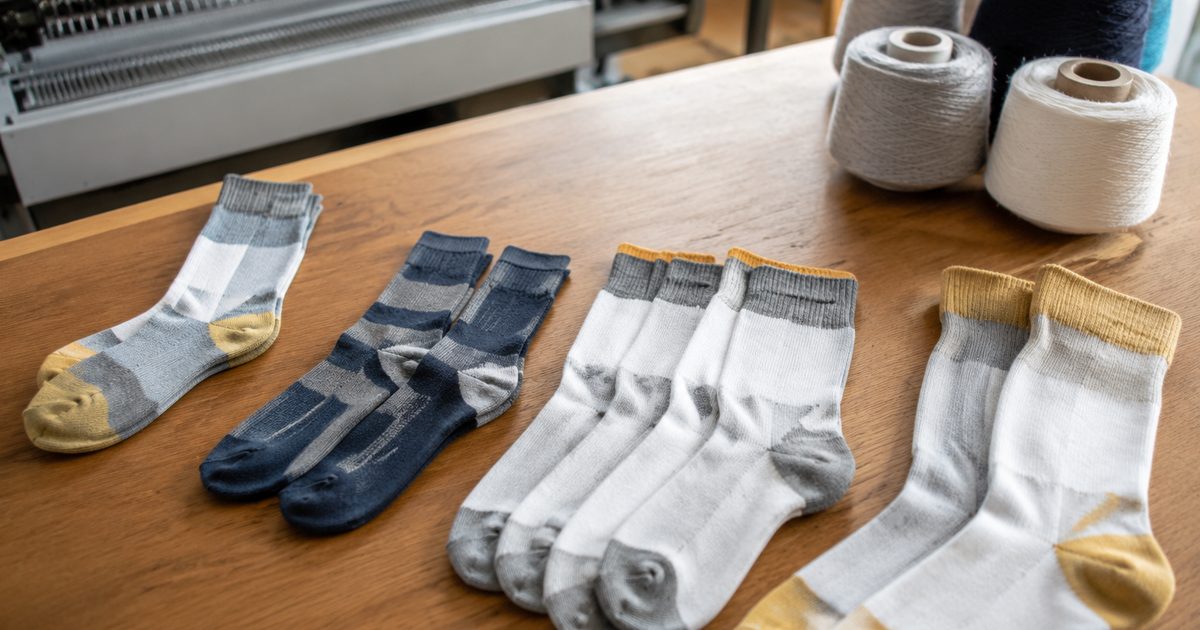
Socks Wholesale for B2B Buyers: MOQ, Pricing Structure, and Landed-Cost Controls
**By Vincent Xi, Editorial Author** Author profile
Socks wholesale is rarely decided by a single per-pair number. For retailers, corporate buyers, distributors, and private-label brands, the real decision is whether minimum order quantity (MOQ), pricing structure, and landed-cost controls stay aligned with margin targets, cash flow, and reorder risk. This brief is for procurement and merchandising teams that need a defensible way to compare supplier quotes—not consumer shopping advice.
**Buyer outcome:** choose the commercial path first, force MOQ into measurable layers, convert every quote into landed cost under one Incoterm, and freeze samples before bulk release.
What “socks wholesale” means in a B2B brief
In B2B practice, socks wholesale usually means volume purchasing of blank, branded, or fully custom socks for resale, uniforms, gifting, promotions, or inventory programs. Industry buyer guides commonly frame bulk purchasing as roughly **100 to 10,000+ pairs** (order-size scope as published; unit = pairs), with volume tiers that can reduce per-unit cost by about **30–60% versus retail pricing**, depending on construction, decoration, and order size, as published in a bulk socks B2B guide (DeadSoxy bulk buyer guide). Treat those figures as third-party planning anchors published on that page—not as universal factory rules or as a current ZheSock commercial offer. Reconfirm ranges in dated supplier quotes before RFQ decisions.
A stock dress-sock reorder can sit at the low end of MOQ; a multi-color OEM program with custom packaging and size runs usually does not. Order structure, not category labels alone, drives the commercial path.
Custom and private-label programs also differ by commercial model. A manufacturing-oriented B2B guide distinguishes common structures that buyers should name explicitly in RFQs (Goren Socks B2B guide):
- **OEM:** buyer provides design, colors, logo, and yarn/spec direction; manufacturer produces to that brief under the buyer brand.
- **ODM:** manufacturer provides a ready design library; buyer brands selected styles.
- **Private label:** production follows a standard or semi-standard specification with buyer labels, hang tags, and packaging.
- **White label:** pre-made unbranded stock that the buyer labels later, usually with less differentiation and faster turnaround.
Clear model selection reduces quote noise. An “OEM” request that is actually private-label stock will produce mismatched MOQs, sampling fees, and lead times.
MOQ structures that change unit economics
MOQ is not only a factory rule; it is a cost-allocation tool. Lower MOQs improve assortment testing and cash control. Higher MOQs usually improve machine utilization, yarn dye-lot efficiency, and packaging setup recovery—if sell-through is reliable.
Published retailer and wholesale guidance shows a wide market spread (figures below are as published on the linked pages; as-of context = publication on those pages; reconfirm before purchase):
| Order type (as framed in published guides) | Example MOQ context | Planning implication | | --- | --- | --- | | Branded / stock wholesale dress styles | As few as **12–48 pairs** in some premium wholesale programs, as published in a dress-sock retailer guide (DeadSoxy retailer guide) | Useful for assortment tests; unit price may be higher than full custom volume tiers | | Custom / private label | Often cited around **100–500 pairs** in published bulk/retailer guidance (DeadSoxy retailer guide; DeadSoxy bulk guide) | Better for brand control; requires tighter size-curve and color forecasting | | Factory-direct custom programs marketed for teams/brands | Example market messaging includes **MOQ from 100 pairs** and sample timelines such as **samples ready in 15 days**, as published on a factory-direct wholesale guide page (VelonSocks wholesale guide page) | Helpful for launch calendars; still verify whether MOQ is per color, per size, or per style | | Corporate gifting / program buys | Commonly discussed around **200 to 5,000 pairs** per order in bulk buyer framing (DeadSoxy bulk guide) | Branding and packaging can dominate cost more than basic knit construction |
How to read MOQ without accepting it at face value
Ask suppliers to separate:
1. **Style MOQ** (first production of a construction/pattern) 2. **Colorway MOQ** (each dye/color setup) 3. **Size-run MOQ** (whether sizes can be mixed inside the style MOQ) 4. **Packaging MOQ** (poly bag, band, hangtag, gift box, carton mark) 5. **Reorder MOQ** (often lower after needles, programs, and packaging are already set)
A quote that says “MOQ 300 pairs” without defining those five layers is incomplete. Also confirm whether leftover sizes from a forced size ratio become buyer inventory risk, and whether the stated unit is pairs, dozens, or cartons.
Pricing structure: what should appear on a wholesale sock quote
A usable socks wholesale quote is a cost stack, not a single line. At minimum, request:
- yarn / material grade and blend percentage (fiber content stated by weight %)
- needle count / gauge class and construction notes (heel/toe reinforcement, cuff type, seamless toe if required)
- decoration method (knit-in pattern, embroidery, silicone grip, printed logo)
- packaging configuration
- sampling cost and whether it is deductible against bulk
- production unit price by volume tier (unit = pair or dozen; quantity break; currency)
- tooling/setup if any
- named Incoterm and named place (for example EXW factory, FOB port)
- lead time for sample and bulk (calendar days; start event defined)
- payment terms and validity window of the quote (date-stamped)
Retail-side economics help explain why buyers care about these details. One wholesale dress-sock retailer guide states that wholesale dress socks can support **55–70% retail margins**, versus apparel averages often framed around **40–50%**, and notes a professional replenishment pattern of roughly **6–10 replacements per year**, as published in that guide (DeadSoxy retailer guide). Those figures are category illustrations from that guide’s published framing (scope: dress-sock retail economics as presented there); they are not a guarantee for every assortment, channel, cost base, or destination market, and they are not ZheSock performance claims.
The same guide also notes compact storage density on the order of **40–60 pairs per cubic foot** and merchandising effects such as average-order-value lifts when socks are placed near related apparel or checkout (DeadSoxy retailer guide). For B2B buyers, the operational takeaway is simpler: socks can be inventory-efficient on cube, but only if MOQ and size curves do not force slow movers.
Example landed-cost calculation (assumption set to verify in supplier quote)
The following is an **example calculation only**, not a published market price, not a supplier offer, and not a ZheSock commercial quote. Use it only as a worksheet structure and replace every input with quote-backed numbers that state unit, Incoterm, quantity break, validity date, and construction scope.
**Assumptions to verify in the supplier quote and logistics estimate:**
- Ex-works unit price: **USD 2.40 / pair** at **1,200 pairs**, crew sock, combed cotton blend, one color, standard poly bag
- Export packing and local handling: **USD 0.12 / pair**
- International freight allocation: **USD 0.35 / pair** (based on a buyer-estimated carton yield)
- Duty/tax allocation: **USD 0.28 / pair** (buyer-market estimate; HS code and destination rules must be verified)
- Inbound handling + QC reserve: **USD 0.10 / pair**
**Example landed cost:** 2.40 + 0.12 + 0.35 + 0.28 + 0.10 = **USD 3.25 / pair** If planned retail is **USD 12.00 / pair**, gross merchandise margin before overhead is **USD 8.75 / pair** (about **72.9%** of retail). If the same style only supports **USD 9.00** retail in the actual channel, margin compresses to **USD 5.75 / pair** (about **63.9%**). This shows why a lower factory price can still lose if freight, duty, packaging, or forced overbuy move the landed number.
Any exact commercial number in an RFQ response should state unit, Incoterm, quantity break, date/validity, and material/construction scope.
Landed-cost controls that protect margin
Landed cost is where socks wholesale programs succeed or quietly fail. Controls that matter most:
1) Separate product cost from logistics cost
Ask for unit price under a named Incoterm (for example EXW, FOB, or DDP) and force logistics into a second line. Comparing a DDP quote to an EXW quote without conversion is not analysis. Convert all options to one Incoterm and one destination before ranking suppliers.
2) Optimize carton yield and size curve before production
Socks are light but volume-sensitive. Poor size ratios create both freight waste and markdown risk. Require a proposed size breakdown, pairs-per-carton target, and carton packing standard before approving bulk.
3) Treat sampling as a cost gate, not a formality
Published factory-direct messaging in the market includes free mockups and sample readiness windows such as **15 days** in one supplier’s wholesale positioning (VelonSocks wholesale guide page). That timeline is third-party marketing language on the linked page, not a verified commitment for every style or factory. Regardless of any one supplier’s offer, buyers should freeze approved measurements, yarn hand-feel, cuff recovery, shade band, and packaging before bulk release. Unapproved “close enough” samples are a common source of returns.
4) Use geography as a total-cost variable, not a slogan
A Turkey manufacturing guide notes that Turkey is described as the world’s **second-largest sock exporter** and emphasizes proximity advantages to European markets on transit time and freight relative to longer Asia lanes, as published in that B2B guide (Goren Socks B2B guide). That is a sourcing hypothesis to model (scope: export-positioning claim as published on that page), not an automatic win for every buyer. Duty treatment, capacity, yarn availability, and reorder reliability still need line-item verification for the destination market.
5) Control change orders
Late color changes, logo revisions, or packaging swaps often re-trigger MOQ and setup recovery. Put a written change cutoff in the PO, with cost ownership for post-cutoff revisions.
6) Reserve for quality leakage
Even with good suppliers, buyers should budget an internal reserve for inspection failures, carton damage, and first-order learning. The reserve can shrink after stable reorders; it should not start at zero. State the reserve as a per-pair or per-shipment allowance in the landed-cost model.
Buyer decision table: choose the commercial path before choosing the factory
| Decision factor | Stock / white-label wholesale | Private label | Full OEM custom | | --- | --- | --- | --- | | Typical speed to first order | Fastest | Medium | Slowest | | Differentiation | Low | Medium | High | | MOQ pressure | Often lower for existing SKUs | Medium | Higher for complex setups | | Design ownership | Limited | Shared / brand-facing | Buyer-led | | Best use case | Fill-in assortment, tests | Branded core line | Signature product architecture | | Main cost risk | Weak differentiation and margin pressure | Packaging and label complexity | Development time, sampling loops, higher first-run MOQ | | Landed-cost control priority | Freight + reorder reliability | Packaging cube + label compliance | Spec freeze + waste from revisions |
Use this table in internal buy meetings before supplier shortlists are opened. Many “price” problems are actually path-selection problems.
Practical RFQ checklist for socks wholesale
Copy and adapt the checklist below into the RFQ package:
1. **Program type:** stock wholesale, private label, OEM, or ODM 2. **End use:** retail resale, corporate gift, team kit, promo giveaway, uniform 3. **Target pair volume by phase:** pilot, first bulk, 12-month forecast (unit = pairs) 4. **Style scope:** ankle / crew / knee-high / dress / athletic / compression category (define precisely) 5. **Fiber brief:** requested blend by weight %, recycled content if any, acceptable substitutes 6. **Construction brief:** needle/gauge preference if known, reinforced zones, toe closure, cuff height 7. **Size run:** size scale, gender/age curve, mix ratio, whether ratios are fixed 8. **Colorways:** pantone/lab-dip process, max colors, heather tolerance 9. **Decoration:** knit-in, embroidery, silicone, print; placement map 10. **Packaging:** pair band, poly bag, hangtag, barcode/GTIN needs, master carton marks 11. **Compliance documents requested:** fiber content labeling, care label language, restricted-substance declarations as required by destination market 12. **QC plan:** AQL or inspection method, points of measure, shade band, defect definitions 13. **Sampling path:** digital mockup, proto, fit sample, pre-production sample, bulk reference 14. **Incoterm and destination:** port/airport or door, preferred mode 15. **Quote format required:** unit price tiers, setup fees, sample fees, lead times, validity date 16. **Commercial terms:** payment milestones, late-delivery remedy, over/under delivery tolerance 17. **Reorder rules:** MOQ after first bulk, color continuity, yarn lot control 18. **Cost transparency ask:** packaging, carton, and decoration called out separately from knit base
If a supplier cannot answer these in writing, the quote is not ready for comparison.
Quality and commercial checks that belong in every first order
Socks wholesale quality issues are often dimensional and durability issues, not just “looks fine in photos.” Buyer-side acceptance criteria should include:
- finished measurements against an approved size chart
- cuff recovery after controlled stretch
- heel/toe reinforcement presence where specified
- pair matching and shade consistency inside a carton
- packaging accuracy against barcode and label rules
- carton drop/handling robustness for the chosen freight mode
Where standards or test methods are relevant (for example fiber labeling rules in the destination market, or buyer-required chemical restrictions), distinguish **legal/market requirements** from a supplier’s internal practice. Do not treat marketing claims as certification evidence unless current documents are provided for the actual producing site and product scope. This article does not assert any certification status for any supplier.
Evidence basis, methodology, and limitations
**Author note:** This article is prepared under the named editorial byline of Vincent Xi, Editorial Author for ZheSock (author profile). No first-person factory visit, lab test, client outcome, or production-capacity claim is made. No ZheSock product MOQ, price list, lead time, or certification is asserted here.
**Source contexts used:**
1. Supplier/education pages that define bulk order ranges, corporate volume bands, wholesale cost-reduction framing, retail margin illustrations, replenishment cadence, and storage density for socks purchasing (DeadSoxy bulk buyer guide; DeadSoxy retailer guide). 2. Manufacturing-oriented B2B guidance on OEM/ODM/private-label/white-label models and Turkey export positioning (Goren Socks B2B guide). 3. Factory-direct wholesale positioning examples for low MOQ and sampling timelines (VelonSocks wholesale guide page).
**Methodology / how the data was derived:** Figures cited above were extracted as published ranges from the linked B2B guides and then grouped by decision use (MOQ planning, margin framing, storage density, program volume, and sampling/MOQ messaging). As-of context for third-party numbers is the publication state of those linked pages at editorial compilation; no independent primary audit of those publishers was performed. No primary factory audit, lab test series, or ZheSock production dataset is claimed. The worked landed-cost sheet is an explicit example calculation for process teaching only; every input must be replaced with current quote-backed values that state unit, Incoterm, quantity break, validity date, and construction scope.
**Limitations / what to verify before purchase:**
- MOQ, sample lead time, and unit prices change by yarn market, machine availability, decoration method, and destination compliance load.
- Margin percentages published in retailer guides are category illustrations, not guaranteed outcomes for every channel.
- Export-rank or proximity advantages do not automatically produce the lowest landed cost for every route and duty regime.
- Any supplier-specific starting price, free-service claim, or timeline claim found in third-party marketing pages must be reconfirmed in a current dated quote for the exact style, quantity break, and Incoterm.
- Exact numbers in this article either (a) restate third-party published ranges with unit/scope/source or (b) are labeled example assumptions for buyer verification.
- Do not treat this article as a certification, test report, price list, or commercial offer.
Closing procurement view
Socks wholesale rewards buyers who negotiate the system, not only the pair price. Lock the commercial path first (stock, private label, or OEM), force MOQ definitions into style/color/size/packaging layers, convert every quote into landed cost under one Incoterm, and freeze samples before bulk. When those controls are in place, volume pricing becomes measurable instead of hopeful—and reorder planning becomes a margin tool rather than a surprise inventory event.
**Highest-leverage next step:** issue a complete RFQ using the checklist above, then build a side-by-side landed-cost model under one Incoterm and one size-curve assumption set before supplier selection.